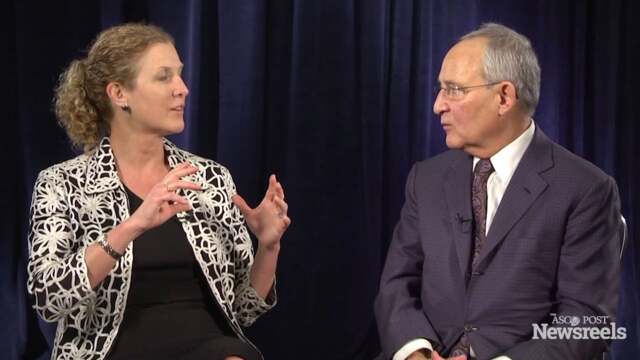
Lisa Carey, MD, and Kathy Albain, MD, on Results of the SWOG-8814 Trial
2015 San Antonio Breast Cancer Symposium
Lisa A. Carey, MD, of the University of North Carolina, and Kathy S. Albain, MD, of Loyola University Medical Center, discuss molecular predictors of outcome on adjuvant CAF plus tamoxifen, vs tamoxifen in postmenopausal patients with estrogen receptor–positive, node-positive breast cancer (Abstract S3-02).
Related Videos
Matthew J. Ellis, PhD, FRCP
Matthew J. Ellis, PhD, FRCP, of the Baylor College of Medicine, gives his expert perspective on this evolving area of research.
Lisa A. Carey, MD, and Jay Harris, MD
Lisa A. Carey, MD, of the University of North Carolina, and Jay Harris, MD, of Dana-Farber Cancer Institute and Brigham and Women’s Hospital, discuss Dr. Harris' plenary lecture.
Jack Cuzick, PhD, FMedSci
Jack Cuzick, PhD, FMedSci, of Queen Mary, University of London, discusses his phase III study on postmenopausal women with DCIS who had similar outcomes whether they took tamoxifen or anastrozole for 5 years after surgery. (Abstract S6-03)
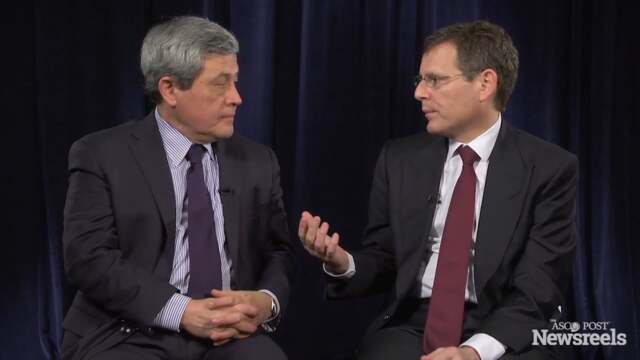
Clifford A. Hudis, MD, and Carlos L. Arteaga, MD
Clifford A. Hudis, MD, of Memorial Sloan Kettering Cancer Center, and Carlos L. Arteaga, MD, of Vanderbilt University, discuss the roles of IGF/insulin signaling, adipokines and inflammation, and metformin and lifestyle change in breast cancer and risk for the disease.
Michael Gnant, MD
Michael Gnant, MD, of the Medical University of Vienna, discusses a study in which denosumab was added to adjuvant aromatase inhibitor therapy to improve disease-free survival in postmenopausal patients with early-stage, hormone receptor–positive breast cancer (Abstract S2-02).