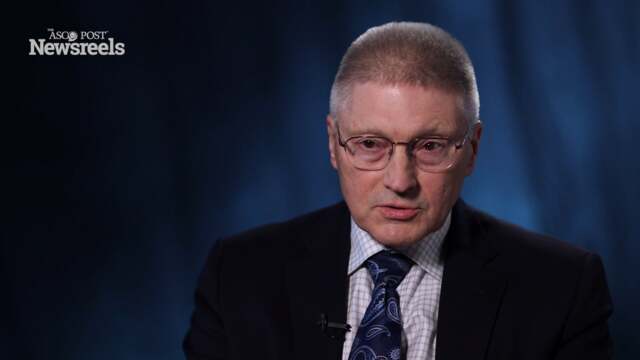
Vassiliki Papadimitrakopoulou, MD, on The Lung MAP Clinical Trial
2015 IASLC World Conference on Lung Cancer
Vassiliki Papadimitrakopoulou, MD, of MD Anderson Cancer Center, discusses the ways in which patients, investigators, and pharmaceutical companies are working together to accelerate research and access to care (Abstract MTE 02.01).
Silvia Novello, MD, PhD
Silvia Novello, MD, PhD, of the University of Turin, discusses a much-neglected aspect of lung cancer: It is not just the province of men; women are affected in great numbers as well.
Lorraine Cheryl Pelosof, MD, PhD
Lorraine Cheryl Pelosof, MD, PhD, of UT Southwestern Medical Center, discusses her study findings, which demonstrate an increasing proportion of never-smokers among patients with non–small cell lung cancer (Abstract ORAL 22.01).
Alice T. Shaw, MD, PhD
Alice T. Shaw, MD, PhD, of Massachusetts General Hospital, summarizes efficacy and safety data from studies on crizotinib, brigatinib, and alectinib for ALK-positive non–small cell lung cancer (ORAL 33.03, 33.06, 33.07).
Everett E. Vokes, MD
Everett E. Vokes, MD, of the University of Chicago, summarizes expert views on treating stage IIIA disease: decision-making in selecting patients for surgery; multiple-modality choices; and using induction chemotherapy (Abstract ED10).
Philip Bonomi, MD
Philip Bonomi, MD, of Rush Medical College, summarizes a debate on two important issues: choosing between surgery and stereotactic body radiation therapy (SBRT) in operable NSCLC, and whether or not to use SBRT for nonbiopsied lung nodules (Abstract PC 01).