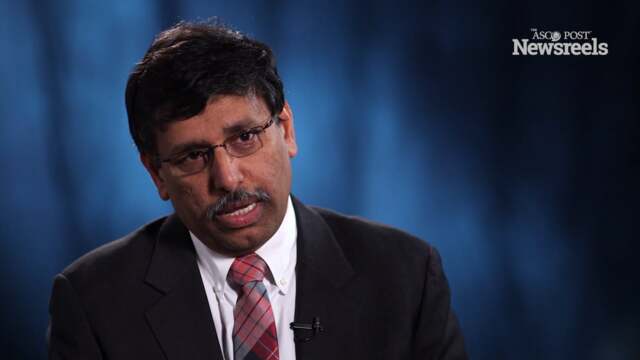
Roy S. Herbst, MD, PhD, on Results From SWOG S0819
2015 IASLC World Conference on Lung Cancer
Roy S. Herbst, MD, PhD, of the Smilow Cancer Hospital at Yale Cancer Center, discusses his findings of a phase III study comparing carboplatin/paclitaxel or carboplatin/paclitaxel/bevacizumab with or without concurrent cetuximab in advanced non–small cell lung cancer (Abstract PLEN04.01).
Vassiliki Papadimitrakopoulou, MD
Vassiliki Papadimitrakopoulou, MD, of MD Anderson Cancer Center, discusses the ways in which patients, investigators, and pharmaceutical companies are working together to accelerate research and access to care (Abstract MTE 02.01).
Barbara J. Gitlitz, MD
Barbara J. Gitlitz, MD, of USC/Norris Cancer Center, discusses the first prospective study on the genomic drivers and demographics of lung cancer in patients under 40 who took part in the study remotely via the Internet (Abstract ORAL22.05).
Ugo Pastorino, MD
Ugo Pastorino, MD, of the Istituto Nazionale dei Tumori Foundation, discusses his study, which showed that stopping smoking before or during low-dose computed tomography screening reduced overall mortality by more than 25%, a benefit that is three- to fivefold greater than this type of screening (Abstract PLEN04.07).
Heather A. Wakelee, MD
Heather A. Wakelee, MD, of Stanford University discusses the study that explored the question of whether adding bevacizumab to adjuvant chemotherapy is beneficial in the setting of resected non–small cell lung cancer (Abstract PLEN04.03).
Ramaswamy Govindan, MD
Ramaswamy Govindan, MD, of Washington University, summarizes three important papers: ROVA-T in relapsed and refractory small cell lung cancer, genomic characterization of large-cell neuroendocrine tumors, and the ECOG study on bevacizumab following chemotherapy for resected non–small cell lung cancer.