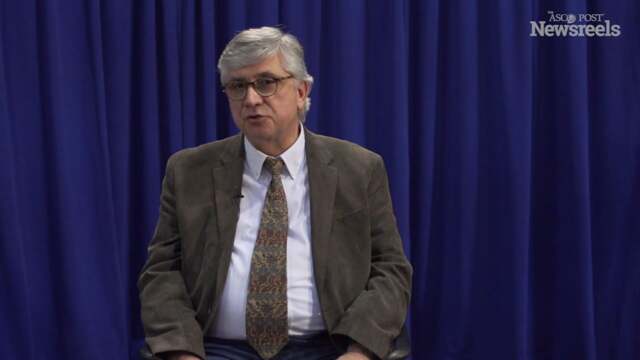
Olivier Casasnovas, MD, on Advanced-Stage Hodgkin Lymphoma: Interim Analysis of the Lysa Study
2015 ASH Annual Meeting
Olivier Casasnovas, MD, of Hôpital Le Bocage, discusses a phase III study comparing an early PET-driven treatment de-escalation to a not PET-monitored strategy in patients with advanced Hodgkin lymphoma (Abstract 577). To see the French language version of this video, please click here.
Hagop M. Kantarjian, MD
Hagop M. Kantarjian, MD, of MD Anderson Cancer Center, discusses a study that compared efficacy and safety results of using 5-day and 10-day regimens of a novel hypomethylating agent in 103 treatment-naïve AML patients who were not candidates for intensive chemotherapy (Abstract 458).
Sagar Lonial, MD
Sagar Lonial, MD, of Emory University School of Medicine, summarizes his educational session on this vital topic.
S. Vincent Rajkumar, MD
S. Vincent Rajkumar, MD, of the Mayo Clinic, summarizes a special FDA-sponsored session on the three myeloma drugs that were approved this November––daratumumab, ixazomib, and elotozumab––and their current and future roles in treating the disease.
Kieron Dunleavy, MD
Kieron Dunleavy, MD, of the National Cancer Institute, discusses a multi-center trial that set out to validate the effectiveness of DA-EPOCH-R-based therapy and whether a risk-adapted approach using the regimen is beneficial for patients with Burkitt lymphoma (Abstract 342).
Stephen J. Schuster, MD
Stephen J. Schuster, MD, of the University of Pennsylvania, discusses the findings of a study of chimeric antigen receptor modified T cells directed against CD19 in patients with relapsed or refractory disease (Abstract 183).