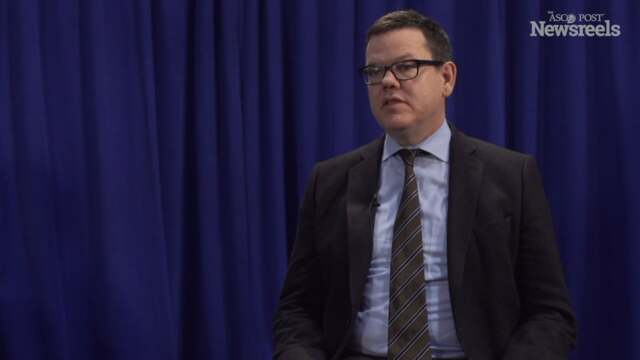
Kieron Dunleavy, MD, on Burkitt Lymphoma: Preliminary Report of the DA-EPOCH-R Trial
2015 ASH Annual Meeting
Kieron Dunleavy, MD, of the National Cancer Institute, discusses a multi-center trial that set out to validate the effectiveness of DA-EPOCH-R-based therapy and whether a risk-adapted approach using the regimen is beneficial for patients with Burkitt lymphoma (Abstract 342).
Andrew D. Zelenetz, MD, PhD
Andrew D. Zelenetz, MD, PhD, of Memorial Sloan Kettering Cancer Center, discusses a late-breaking abstract on the superiority of this three-drug combination compared to bendamustine and rituximab alone in patients with relapsed/refractory chronic lymphocytic leukemia (Abstract LBA5).
Olivier Casasnovas, MD
Olivier Casasnovas, MD, of Hôpital Le Bocage, discusses in French a phase III study comparing an early PET-driven treatment de-escalation to a not PET-monitored strategy in patients with advanced Hodgkin lymphoma (Abstract 577).
James Foran, MD
James Foran, MD, of the Mayo Clinic Cancer Center, discusses two key studies on clofarabine: as a single agent for induction and postremission therapy in newly diagnosed AML, and as the basis for consolidation in nonfavorable AML (Abstracts 217 and 218).
Sagar Lonial, MD, and Torben Plesner, MD
Sagar Lonial, MD, of Emory University School of Medicine, and Torben Plesner, MD, of Vejle Hospital, discuss the latest findings on the use of daratumumab in combination with lenalidomide and dexamethasone in patients with relapsed or relapsed and refractory multiple myeloma (Abstract 507).
Andrew D. Zelenetz, MD, PhD, and Stephan Stilgenbauer, MD, PhD
Andrew D. Zelenetz, MD, PhD, of Memorial Sloan Kettering Cancer Center, and Stephan Stilgenbauer, MD, PhD, of the University of Ulm, discuss this late-breaking abstract on venetoclax monotherapy and deep remissions in ultra-high risk relapsed/refractory chronic lymphocytic leukemia with 17p deletion (Abstract LBA6).