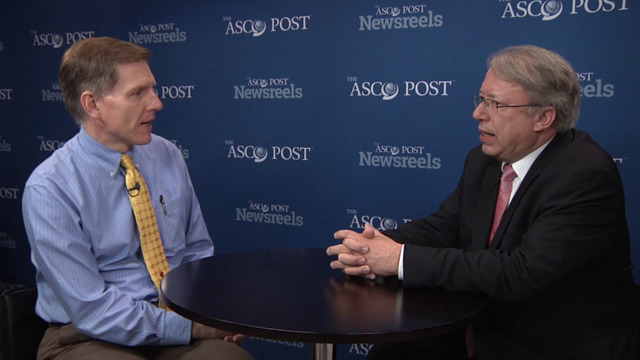
Eric Van Cutsem, MD, PhD, and Axel Grothey, MD, on HERACLES and Other Colorectal Cancer Findings
2015 ASCO Annual Meeting
Eric Van Cutsem, MD, PhD, of University Hospitals Gasthuisberg/Leuven, and Axel Grothey, MD, of the Mayo Clinic, discuss the Italian-led study on trastuzumab and lapatinib in HER2-amplified metastatic colorectal as well as other colorectal cancer findings discussed at ASCO (Abstract 3508).
Related Videos
Andrew James Martin, PhD, and Anthony J. Olszanski, RPh, MD
Andrew James Martin, PhD, of NHMRC Clinical Trials Centre, University of Sydney, and Anthony J. Olszanski, RPh, MD, of Fox Chase Cancer Center, discuss a form of vitamin B3 that reduced the incidence of new nonmelanoma skin cancers in high-risk patients (Abstract 9000).
Patrick Schöffski, MD
Patrick Schöffski, MD, of the University Hospital Leuven, discusses a phase III study in which he and his colleagues found, for the first time in soft-tissue sarcomas, a significant overall survival benefit of a single agent compared to a standard treatment (Abstract LBA10502).
Saad Usmani, MD
For a heavily pretreated multiple myeloma population, daratumumab as a monotherapy showed meaningful, durable activity with deep responses and a favorable safety profile. Saad Usmani, MD, of the Levine Cancer Institute, provides the highlights of this study on the first monoclonal antibody to show promise in multiple myeloma (Abstract LBA8512).
Eduardo Cazap, MD, PhD and James O. Armitage, MD
Eduardo Cazap, MD, PhD, of the Latin American & Caribbean Society of Medical Oncology, and James O. Armitage, MD, of the University of Nebraska Medical Center, discuss oncology from an international point of view.
Claus Garbe, MD, and Anthony J. Olszanski, RPh, MD
Claus Garbe, MD, of the University of Tuebingen, and Anthony J. Olszanski, RPh, MD, of Fox Chase Cancer Center, discuss the survival of sentinel lymph node-positive melanoma patients with and without complete lymph node dissection (Abstract LBA9002).