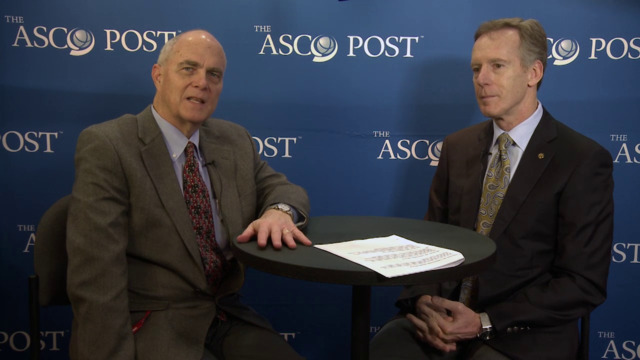
James O. Armitage, MD, FACP, FRCP, and Richard M. Stone, MD
James O. Armitage, MD, FACP, FRCP, of the University of Nebraska Medical Center, and Richard M. Stone, MD of the Dana-Farber Cancer Institute, discuss three clinical trials: different doses of daunorubicin for AML; comparing azacitidine plus lenolidomide to vorinostat vs azacitidine monotherapy in MDS and CMML; and sorafenib vs placebo in addition to standard treatment for AML.
Sagar Lonial, MD
Sagar Lonial, MD, of Winship Cancer Institute, offers his thoughts on abstract 302, “Final Results for the 1703 Phase Ib/II Study of Elotuzumab in Combination With Lenalidomide and Dexamethasone in Patients With Relapsed/Refractory Multiple Myeloma,” presented by Paul G. Richardson, MD; abstract 84, “Safety and Efficacy of Daratumumab With Lenalidomide and Dexamethasone in Relapsed or Relapsed/ Refractory Multiple Myeloma,” presented by Torben Plesner, MD; and “A Phase Ib Dose Escalation Trial of SAR650984 (Anti–CD-38 mAb) in Combination With Lenalidomide and Dexamethasone in Relapsed/Refractory Multiple Myeloma,” presented by Thomas G. Martin III, MD.
Alan F. List, MD, and James O. Armitage, MD, FACP, FRCP
Alan F. List, MD, of Moffitt Cancer Center and the University of South Florida, and James O. Armitage, MD, FACP, FRCP, of the University of Nebraska Medical Center, discuss the biology and diagnostic criteria for myelodysplastic syndrome, as well as advances in the disease presented at the 56th ASH Annual Meeting.