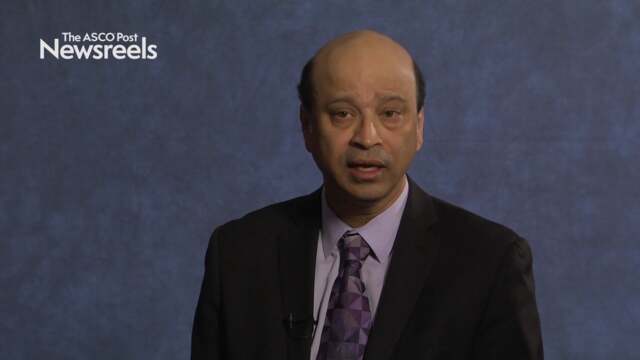
Rowan T. Chlebowski, MD, PhD, on Weight Loss and Breast Cancer Risk: Results From the Women’s Health Initiative
2017 San Antonio Breast Cancer Symposium
Rowan T. Chlebowski, MD, PhD, of the City of Hope National Medical Center, discusses 11-year followup results that showed a significantly lower breast cancer incidence among women with a greater than 5% weight loss (Abstract GS5-07).
Harold J. Burstein, MD, PhD, of the Dana-Farber Cancer Institute, discusses study findings on a comparison of adjuvant tamoxifen plus ovarian function suppression vs tamoxifen in premenopausal women with hormone receptor–positive breast cancer (Abstract GS4-03).
Joseph A. Sparano, MD, of Montefiore Medical Center/Albert Einstein College of Medicine, discusses findings that suggest circulating tumor cells 5 years after diagnosis are prognostic for late recurrence in operable stage II–III breast cancer (Abstract GS6-03).
Michael Gnant, MD, of the Medical University of Vienna, discusses phase III study findings on giving an additional 2 vs an additional 5 years of anastrozole after the first 5 years of adjuvant endocrine therapy (Abstract GS3-01).
Sibylle Loibl, MD, PhD, of the German Breast Group, discusses a study evaluating palbociclib plus endocrine treatment vs a chemotherapy-based treatment strategy in patients with hormone receptor–positive, HER2-negative metastatic breast cancer (Abstract OT3-05-04).
Debu Tripathy, MD, of The University of Texas MD Anderson Cancer Center, discusses phase III study findings on first-line ribociclib vs placebo with goserelin and tamoxifen or a nonsteroidal aromatase inhibitor in premenopausal women with hormone receptor–positive, HER2-negative advanced breast cancer (Abstract GS2-05).