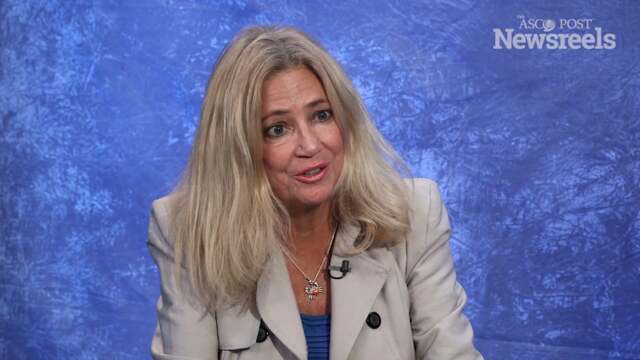
Elizabeth J. Shpall, MD, and Nina Shah, MD—Mentor and Mentee: A Conversation
2017 ASCO Annual Meeting
Elizabeth J. Shpall, MD, of The University of Texas MD Anderson Cancer Center, and recipient of the 2017 Women Who Conquer Cancer Mentorship Award, discusses promoting women in oncology with Nina Shah, MD, of the University of California, San Francisco, the protégé who nominated Dr. Shpall for this recognition.
Alice Tsang Shaw, MD, PhD, of Massachusetts General Hospital, and Tony Mok, MD, of the Chinese University of Hong Kong, discuss their two ASCO-featured abstracts on non–small cell lung cancer: alectinib vs crizotinib in treatment-naive advanced ALK+ disease, and dacomitinib vs gefitinib for first-line treatment of advanced EGFR+ disease. (Abstracts LBA9008 and LBA9007)
Matteo Lambertini, MD, of the Institut Jules Bordet, discusses a long-term follow-up analysis of the safety of pregnancy in patients with a history of estrogen receptor–positive breast cancer. (Abstract LBA10066)
Julie Vose, MD, MBA, of the University of Nebraska Medical Center, discusses two hematologic abstracts: results from the OPTIMAL>60 study on radiotherapy to bulky disease PET-negative after immunochemotherapy in elderly patients with diffuse large B-cell lymphoma; and an analysis of autologous vs matched sibling donor or matched unrelated donor allogeneic hematopoietic cell transplantation in follicular lymphoma patients with early chemoimmunotherapy failure. (Abstracts 7506, 7508)
Dean F. Bajorin, MD, of Memorial Sloan Kettering Cancer Center, and Peter H. O’Donnell, MD, of The University of Chicago Medical Center, discuss their study findings on treating advanced urothelial cancer with pembrolizumab, paclitaxel, docetaxel, or vinflunine. (Abstracts 4501 and 4502)
Greta Stifel recounts her story about a misdiagnosed tumor and urges physicians to raise awareness of neuroendocrine disease.