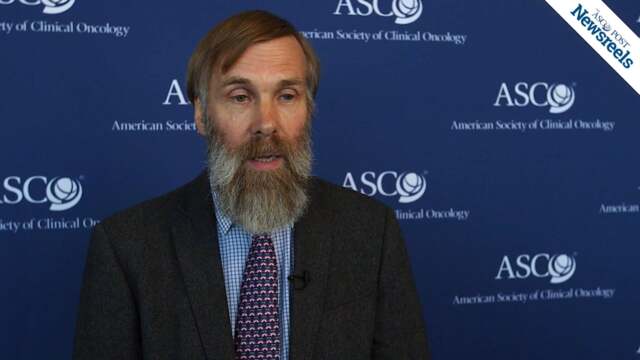
Bruce E. Johnson, MD, and Julie Vose, MD, MBA: A Conversation With ASCO’s 2017–2018 President
2017 ASCO Annual Meeting
Julie Vose, MD, MBA, of the University of Nebraska Medical Center, and Bruce E. Johnson, MD, of the Lowe Center for Thoracic Oncology at Dana-Farber Cancer Institute, discuss Dr. Johnson’s upcoming tenure as ASCO President and his goals for the year ahead.
Ann-Lii Cheng, MD, PhD, of the National Taiwan University Hospital, discusses phase III study findings on lenvatinib vs sorafenib in first-line treatment of patients with unresectable hepatocellular carcinoma. (Abstract 4001)
Lisa A. Carey, MD, of the University of North Carolina, and Richard S. Finn, MD, of UCLA Medical Center, discuss phase II overall survival findings on palbociclib in combination with letrozole vs letrozole alone for front-line treatment of ER+/HER2– advanced breast cancer. (Abstract 1001)
Eric Jonasch, MD, of The University of Texas MD Anderson Cancer Center, discusses the largest prospective VHL disease-specific therapeutic trial performed to date, and the data that show pazopanib resulted in significant and sustained disease control for the majority of patients enrolled on the study. (Abstract 4516)
Temidayo Fadelu, MD, of Dana-Farber Cancer Institute, discusses study findings on nut consumption and survival in stage III colon cancer patients. Higher consumption of nuts may be associated with significantly reduced cancer recurrence and death in this group. (Abstract 3517)
Peter Hoskin, MD, of Mount Vernon Cancer Centre, discusses study findings on single-dose radiotherapy compared with multifraction radiotherapy in patients with metastatic spinal canal compression. (Abstract LBA10004)