
In 2015, LH, a 66-year-old female, was diagnosed with chronic lymphocytic leukemia (CLL), Rai stage 0. Untreated, the woman’s lymphocyte count rose from 5,000/mm3 to 16,000/mm3 in 6 years (doubling time = 4.2 years). She was then advised to stop eating red meat (see the figure). Commercially sourced fish, fowl, and seafood were allowed. Within 3 months, the patient’s leukemic cell count dropped to 10,000 mm3 (see point #2 in the figure). When meat consumption was resumed the count rose, reaching 20,000 mm3 within 2 years (#3). Meat avoidance was reinstituted and sustained. The patient’s lymphocyte count slowly declined for the next 2 years (#4), then reversed course, rising rapidly to 32,000 (doubling time = 10 months) (#5).
At that point, dietary fish, fowl, and seafood were purchased raw and home-cooked, keeping temperatures under 300°F. Internal cooking temperatures of fowl were kept above 165°F to eradicate harmful bacteria. The lymphocyte count abruptly stopped rising (#6) and fell to the same level as that recorded 5 years earlier when dietary restrictions were first introduced (compare points #1 and #7 in the figure). To date, the patient’s M protein values have remained stable.
In 2002, SH, a 63-year-old female, presented with small lymphocytic lymphoma (SLL). Following medical advice, she avoided red meat in her diet and relied on plant-based food sources. No other treatment was administered. Within 1 year, complete remission was documented. She resumed her previous diet, including consumption of (barbecued) meat. Within 3 years lymphoma recurred, but now the cells were larger, requiring chemoimmunotherapy to induce complete remission. SH remains in remission 23 years after the original diagnosis.
Diet is implicated as a cause of malignant disease, but widely applicable effective counteracting maneuvers remain unidentified.1-3 The interventions described herein were aimed at reducing the patients’ intake of dietary carcinogens produced during high-heat cooking of animal proteins.4 Through a combination of avoiding red meat, reducing cooking temperatures of other animal proteins, and relying on plant-based food sources, the CLL activity was partially suppressed and the SLL activity was completely suppressed. The abrupt reduction in CLL cell count doubling time to 0 by reducing the cooking temperature of meat is particularly noteworthy. Clinical studies of dietary maneuvers for treating and preventing malignant disease could start with this step in newly diagnosed CLL, the most common leukemia in the aging population.
—William Hryniuk MD, FRCP (C)
1972–1977 Scholar, Leukemia Society of America
(Career Development Award)
Hamilton, Ontario
DISCLOSURE: The author reported no conflicts of interest.
REFERENCES
1. Ilerhunmwuwa NP, Khader AHSA, Smith C, et al: Dietary interventions in cancer: A systematic review of all randomized trials. J Natl Cancer Inst 116(7):1026-1034, 2024
2. Raucci F, et al: Cyclic fasting—mimicking diet plus bortezomib and rituximab is an effective treatment for chronic lymphocytic leukemia. Cancer Res 84:1133-1148, 2024
3. Shanafelt TD, Call TG, Zent CS, et al: Phase 2 trial of daily, oral Polyphenon E in patients with asymptomatic, Rai stage 0 to II chronic lymphocytic leukemia. Cancer 119(2):363-370, 2013.
4. National Cancer Institute: Chemicals in meat cooked at high temperatures and cancer risk. National Cancer Institute, Bethesda, 2017. Available at: https://www.cancer.gov/about-cancer/causes-prevention/risk/diet/cooked-meats-fact-sheet. Accessed March 3, 2026.
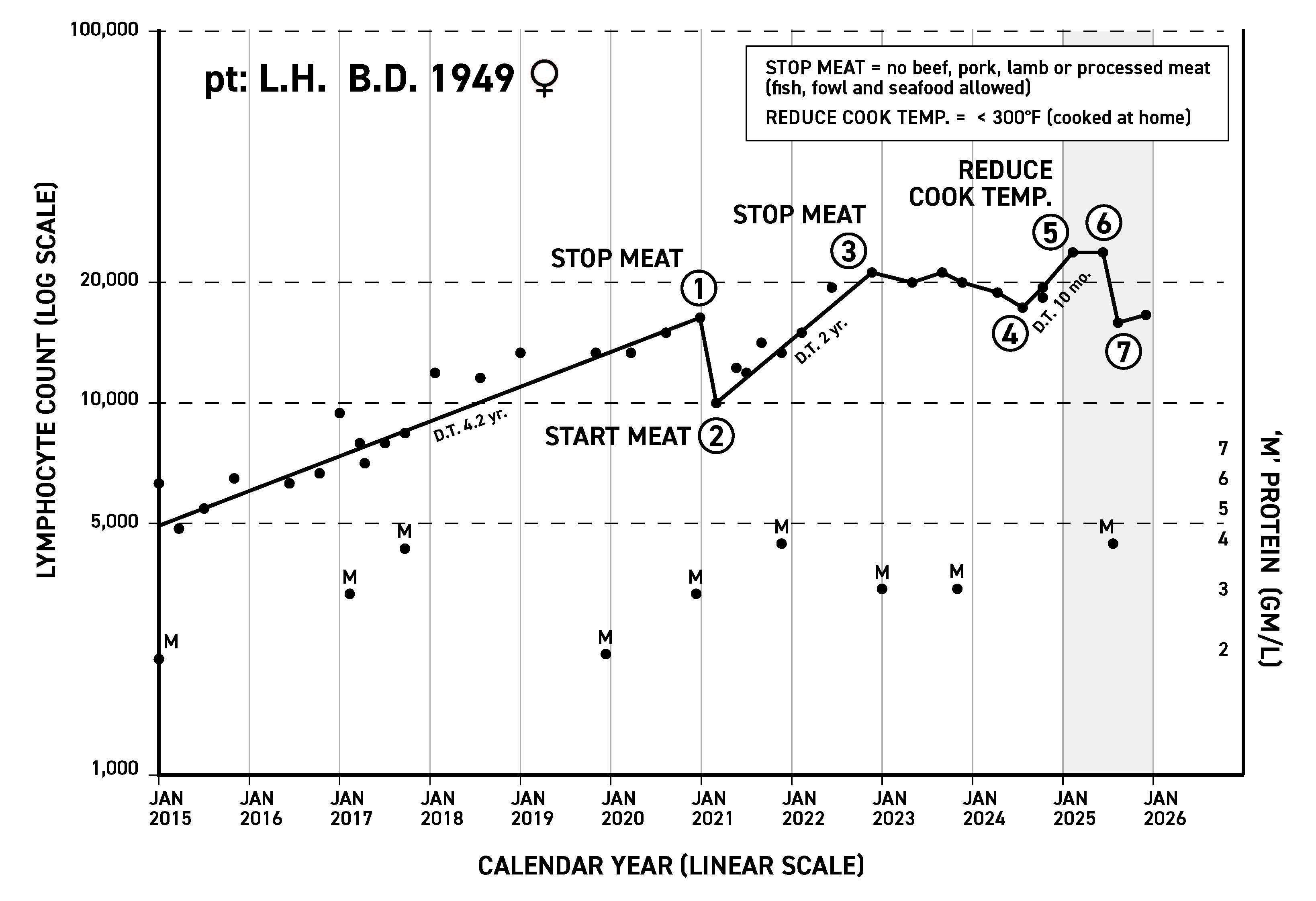
In 2015, LH, a 66-year-old female, was diagnosed with CLL, Rai stage 0. Following several dietary maneuvers, the patient’s lymphocyte count was carefully monitored, indicating an association between a no-meat diet and the suppression of lymphocyte counts.
