
In a phase Ib study published in the Journal of Clinical Oncology, Zhao et al found that the first-in-class bispecific antibody-drug conjugate (ADC) izalontamab brengitecan (iza-bren, BL-B01D1), which targets EGFR and HER3, demonstrated antitumor activity in patients with relapsed extensive-stage small cell lung cancer, particularly when used as second-line therapy.1
Study Details
The open-label, multicenter, dose-expansion phase Ib trial enrolled 52 patients with extensive-stage small cell lung cancer who had experienced disease progression following at least one prior platinum-based chemotherapy regimen and PD-(L)1 inhibitor treatment. Patients received iza-bren at 2.5 mg/kg on days 1 and 8 of each 3-week cycle, the recommended phase II dose established in earlier studies. The primary endpoints were objective response rate and safety/tolerability, whereas secondary endpoints included disease control rate, duration of response, progression-free survival, and overall survival. Exploratory analyses evaluated potential associations between EGFR and HER3 expression and clinical outcomes.
The median patient age was 60.5 years; 32.6% had brain metastases at baseline, and 57.7% had received at least two prior lines of therapy. A total of 42.3% of participants received iza-bren as second-line treatment after a single prior line of therapy. Tumor assessments were performed every 6 weeks during the first year of treatment and every 12 weeks thereafter, with safety monitored throughout treatment and follow-up.
Key Results
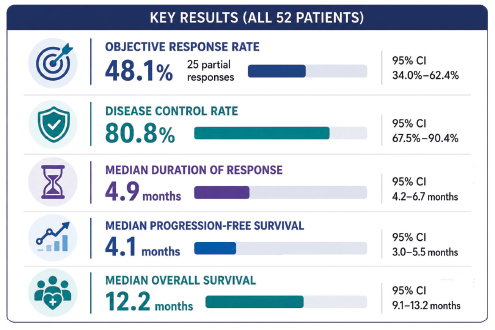
At the data cutoff of December 5, 2024, the objective response rate was 48.1% (95% confidence interval [CI] = 34.0%–62.4%), with 25 partial responses and a disease control rate of 80.8% (95% CI = 67.5%–90.4%). Median duration of response was 4.9 months (95% CI = 4.2–6.7 months), median progression-free survival was 4.1 months (95% CI = 3.0–5.5 months), and median overall survival was 12.2 months (95% CI = 9.1–13.2 months) (Figure 1).
Among the 22 patients treated in the second-line setting, the objective response rate was 72.7%, disease control rate was 90.9%, median progression-free survival was 6.2 months, and median overall survival was 15.0 months. Patients previously treated with irinotecan had an objective response rate of 31.6%, whereas exploratory biomarker analyses suggested that HER3-positive tumors were associated with higher response rates than HER3-negative tumors (68.8% vs 14.3%). EGFR expression did not appear to correlate with response.
Treatment-related adverse events were manageable with supportive measures and dose modifications, according to the investigators. The most common treatment-related adverse events included anemia (84.6%), thrombocytopenia (75.0%), leukopenia (73.1%), and neutropenia (71.2%). Grade 3 or higher treatment-related adverse events occurred in 75% of patients, resulting in dose reductions in 46% and treatment discontinuation in 13%. No treatment-related interstitial lung disease was observed. Two patients (3.8%) experienced grade 5 treatment-related adverse events leading to death, one from respiratory failure and one from gastrointestinal infection.
The investigators concluded: “Iza-bren showed encouraging antitumor activity in relapsed [extensive-stage small cell lung cancer], particularly in the second-line setting. A phase III randomized controlled trial of iza-bren compared with topotecan is ongoing” (ClinicalTrials.gov identifier: NCT06500026).
Yan Huang, MD, PhD, of the Department of Medical Oncology, Sun Yat-sen University Cancer Center, State Key Laboratory of Oncology in South China, Collaborative Innovation Center for Cancer Medicine, Guangdong Provincial Clinical Research Center for Cancer, Guangzhou, China is the corresponding author for the Journal of Clinical Oncology article.
DISCLOSURE: The study was supported by Sichuan Baili Pharmaceuticals Co., Ltd. For full disclosures of all study authors, visit ascopubs.org.
REFERENCE
1. Zhao Y, Zhao H, Wang Q, et al: Izalontamab brengitecan (Iza-Bren), a first-in-class EGFR-HER3 bispecific antibody-drug conjugate in extensive-stage small cell lung cancer: Results from a phase Ib study. J Clin Oncol. Published online July 24, 2026.
