
First-line treatment with darovasertib plus crizotinib significantly improved progression-free survival and response rates compared with investigator’s choice of treatment in patients with HLA-A2–negative metastatic uveal melanoma, according to primary results from the phase IIb portion of the OptimUM-02 trial presented at the 2026 ASCO Annual Meeting.1
“These results support a potential new therapeutic standard for a disease with limited treatment options and poor prognosis,” said Marlana Orloff, MD, of Thomas Jefferson University Hospital in Philadelphia.

Marlana Orloff, MD
Darovasertib is a first-in-class oral protein kinase C inhibitor and was combined with crizotinib, an oral small molecule tyrosine kinase inhibitor of ALK, cMET, and ROS1, after prior preclinical and clinical work suggested complementary activity. These mutations are detected in more than 95% of uveal melanoma tumors, Dr. Orloff explained.
The OptimUM-02 Trial enrolled treatment-naive patients with metastatic uveal melanoma who were HLA-A*02:01–negative and therefore ineligible for HLA-A02:01-restricted therapies, such as the T-cell receptor bispecific molecule tebentafusp (glycoprotein 100 and CD3). Further, there are no FDA-approved systemic or targeted treatments for this population, Dr. Orloff pointed out. Uveal melanoma is the most common ocular cancer in adults, and although primary treatment can be effective, up to one-half of patients may develop metastatic disease.
Once metastases develop, prognosis is poor and systemic treatment options are limited. Dr. Orloff contrasted the biology of uveal melanoma with that of cutaneous melanoma, where BRAF may be targetable.
Unlike cutaneous melanoma, where we have the opportunity to target BRAF, uveal melanoma is defined by [GNAQ/GNA11 mutations] that activate the PKC [protein-kinase C] signaling pathway,” Dr. Orloff said, adding that persistent PKC signaling promotes uveal melanoma growth.
A First-Line Trial in an HLA-A2–Negative Population
OptimUM-02 is a phase II/III multicenter, multiarm, multistage open-label study. In the phase IIb and phase III portions, patients were randomly assigned 2:1 to receive darovasertib at 300 mg twice-daily plus crizotinib at 200 mg twice-daily or investigator’s choice of pembrolizumab, ipilimumab/nivolumab, or dacarbazine. Treatment continued until disease progression, unacceptable toxicity, discontinuation, or death.
The phase IIb primary endpoint was progression-free survival assessed by blinded independent central review. Secondary endpoints included investigator-assessed progression-free survival, objective response rate, duration of response, disease control rate, and safety. Overall survival is the phase III primary endpoint and will be presented when the data mature.
The efficacy population included 313 patients: 210 were assigned to darovasertib plus crizotinib and 103 were assigned to investigator’s choice. In the control arm, 76.7% of patients received ipilimumab/nivolumab, and the remainder received pembrolizumab. No patients ultimately received dacarbazine.
Baseline characteristics were generally balanced between the two arms, although Dr. Orloff noted that numerically more patients in the darovasertib/crizotinib arm had an ECOG PS of 1 and larger tumors. Baseline LDH and metastatic patterns were well balanced; most patients had liver involvement.
Progression-Free Survival and Responses Favored the Combination
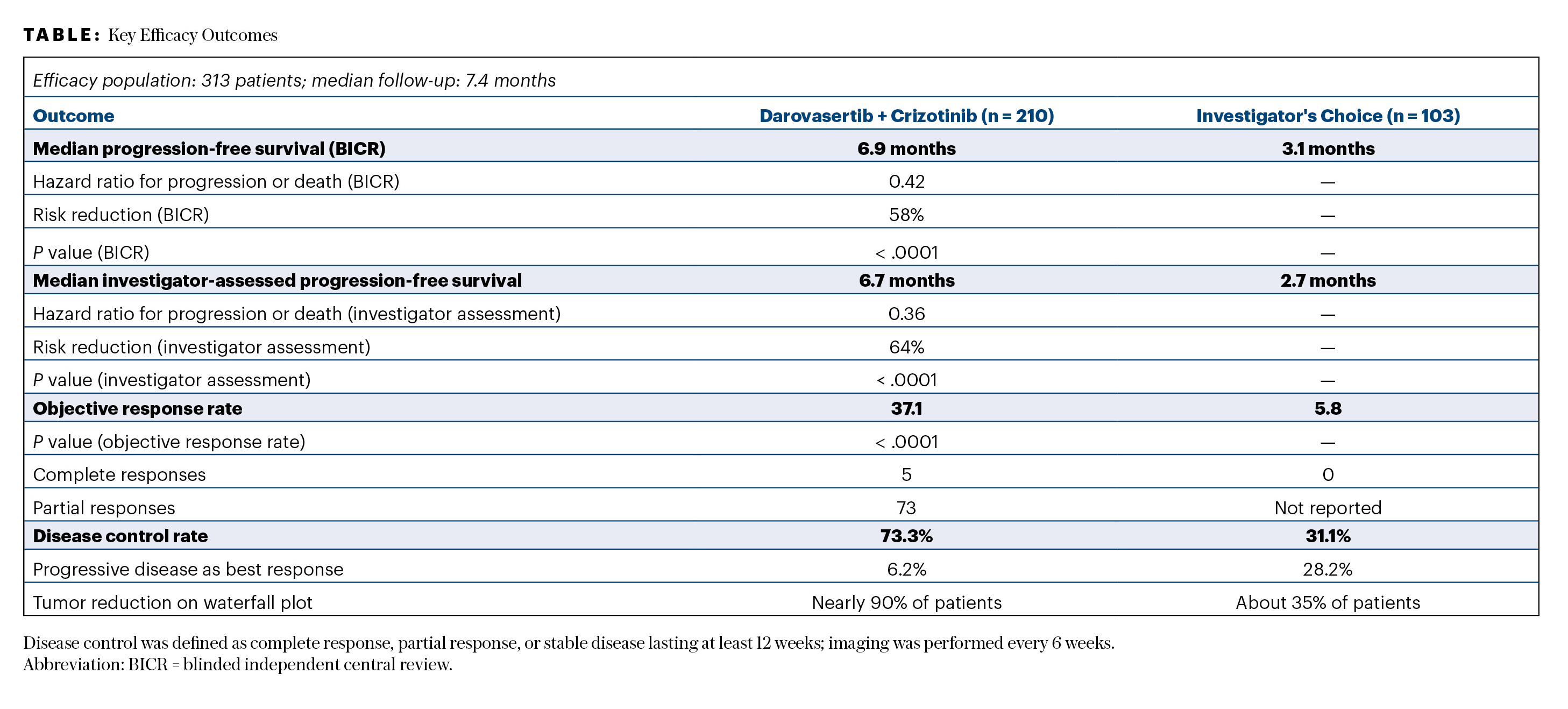
At a median follow-up of 7.4 months, median progression-free survival by blinded independent central review was 6.9 months with darovasertib plus crizotinib compared with 3.1 months with investigator’s choice, representing a 58% reduction in the risk of disease progression or death (hazard ratio [HR] = 0.42; P < .0001).
The benefit was similar by investigator assessment. Median investigator-assessed progression-free survival was 6.7 months with the combination vs 2.7 months with investigator’s choice, representing a 64% reduction in the risk of disease progression or death (HR = 0.36; P < .0001).
The progression-free survival benefit was observed across the analyzed subgroups, including baseline LDH, investigator’s choice treatment category, age, sex, ECOG performance status, geographic region, largest target lesion size, and metastatic site.
Objective responses also favored darovasertib plus crizotinib. The objective response rate was 37.1% with darovasertib plus crizotinib compared with 5.8% with investigator’s choice (P < .0001). Responses in the combination arm included 5 complete responses and 73 partial responses; no complete responses were observed in the investigator’s choice arm.
Disease control was also higher with the targeted combination; the disease control rate was 73.3% with darovasertib plus crizotinib compared with 31.1% with investigator’s choice. Dr. Orloff noted that disease control was defined as complete response, partial response, or stable disease lasting at least 12 weeks, with imaging performed every 6 weeks.
Progressive disease as best response occurred in 6.2% of patients who received darovasertib plus crizotinib vs 28.2% of those assigned to investigator’s choice. Dr. Orloff also noted that the waterfall plots showed tumor reduction in nearly 90% of patients in the darovasertib/crizotinib arm compared with about 35% in the control arm.
Overall survival data are not yet mature, but Dr. Orloff reported an early trend toward improved overall survival with darovasertib plus crizotinib. Those data will be presented at a later date.
Toxicity Was Common but Generally Manageable
Treatment-related adverse events were common in both arms. Any treatment-related adverse event occurred in 98.3% of patients receiving darovasertib plus crizotinib and 89.0% of those receiving investigator’s choice. Grade 3 or 4 treatment-related adverse events occurred in 40.6% and 37.0% of patients, respectively.
With darovasertib plus crizotinib, the most common all-grade treatment-related adverse events included diarrhea, nausea, peripheral edema, vomiting, dermatitis acneiform, fatigue, and hypotension.
Dr. Orloff discussed hypotension and syncope as distinctive toxicities associated with protein kinase C inhibition, noting that they were managed with hydration, holding blood pressure medications when appropriate, and a 7-day darovasertib run-in before crizotinib was added.
In the investigator’s choice arm, the toxicity profile largely reflected checkpoint inhibitor therapy, with events including diarrhea, liver enzyme elevations, hepatitis, colitis, and endocrinopathies.
Treatment-related serious adverse events occurred in 9.2% of patients receiving darovasertib plus crizotinib compared with 25.0% of those receiving investigator’s choice. Darovasertib was withdrawn because of treatment-related adverse events in 2.5% of patients and crizotinib in 10.0%; investigator’s choice was withdrawn in 19.0% of patients. Dose reductions occurred in 23.4% of patients for darovasertib and 26.4% for crizotinib.
Expert Perspective: Where the Combination May Fit in Practice
Formal discussant Jose Lutzky, MD, of Sylvester Comprehensive Cancer Center, described the OptimUM-02 trial study as addressing a major unmet need and emphasized that the control arm was clinically meaningful, because nearly 77% of patients received ipilimumab/nivolumab and the rest received pembrolizumab.
“In a disease where checkpoint inhibitors typically achieve response rates in the low teens and short progression-free survivals, these results clearly stand out,” Dr. Lutzky said.
He characterized the findings as “one of the strongest randomized efficacy signals we have seen in metastatic uveal melanoma,” while noting that overall survival data remain immature. He also pointed out that the progression-free survival benefit was seen despite slight baseline imbalances favoring the control arm.
On safety, Dr. Lutzky said grade 3 and 4 toxicity rates were comparable to those seen with current therapies and that discontinuation rates remained relatively low, although about one-quarter of patients required dose reductions. He noted that quality-of-life data were not presented, which he considered important given the chronic administration of two oral targeted agents.
“Nonetheless, the efficacy signal is sufficiently strong that I believe the burden of proof has now shifted away from demonstrating activity and toward defining optimal sequencing,” Dr. Lutzky said.
For HLA-A*02:01–positive metastatic uveal melanoma, Dr. Lutzky said tebentafusp remains the preferred first-line therapy because of its proven survival benefit. However, he said darovasertib plus crizotinib may become an attractive alternative for selected patients with rapidly progressive disease, extensive liver involvement, or a need for prompt tumor shrinkage, once available and as additional data emerge.
For HLA-A*02:01–negative disease, he was direct.
“The picture is clear,” Dr. Lutzky said. “Darovasertib plus crizotinib appears likely to become the preferred systemic first-line option.”
He added that liver-directed therapies remain important, particularly percutaneous hepatic perfusion for appropriate patients with liver-dominant disease and preserved hepatic function. Clinical trials also remain vital across HLA groups and lines of therapy, he said, because metastatic uveal melanoma is still not curable for most patients.
He noted that several questions remain, including whether progression-free survival will translate into overall survival, how available treatments should be sequenced, whether targeted therapy can be safely combined with liver-directed approaches or immunotherapy, and whether these benefits can be moved into the adjuvant setting.
“These are the questions that will define the next generation of uveal melanoma trials,” said Dr. Lutzky.
DISCLOSURE: Dr. Orloff reported employment with Pfizer for an immediate family member; honoraria from Immunocore; consulting or advisory roles with Delcath Systems, IDEAYA Biosciences, Immunocore, Replimune, and TriSalus Life Sciences; speakers bureau participation with Immunocore; and institutional research funding from Bristol-Myers Squibb, Delcath Systems, IDEAYA Biosciences, Immunocore, iOnctura, Iovance Biotherapeutics, Linnaeus Therapeutics, Novelwise, Regeneron, Replimune, and TriSalus Life Sciences. Dr. Lutzky reported consulting or advisory roles with Aulos Bioscience, Castle Biosciences, Delcath Systems, and Iovance Biotherapeutics; institutional research funding from AsherBio, Aulos Bioscience, Bristol-Myers Squibb, Dragonfly Therapeutics, Erasca, Immatics, Immunocore, Iovance Biotherapeutics, Perspective Therapeutics, Regeneron, Replimune, Syntrix Biosystems, Tango Therapeutics, and TScan Therapeutics; and travel, accommodations, or expenses from Castle Biosciences and Erasca.
REFERENCE
1. Orloff MM, Ramelyte E, Butler MO, et al: Darovasertib plus crizotinib vs investigator’s choice as first-line treatment for patients with HLA-A2–negative metastatic uveal melanoma: Primary results from the OptimUM-02 trial. 2026 ASCO Annual Meeting. Abstract LBA9503. Presented June 1, 2026.
