

Philip A. Salem, MD
Our data on a triplet combination of chemotherapy, immune checkpoint inhibitors, and targeted therapy (ICTriplex) in advanced and refractory malignancies were presented in June at the 2026 ASCO Breakthrough Conference in Singapore.
ICTriplex is a therapeutic strategy; it is not a single specific treatment. In this strategy, every patient receives the combination, but no two patients receive the same treatment. Therapy is highly personalized and tailored to the specific individual patient and to his or her specific cancer. Treatment was designed based on the individual’s diagnosis, prior therapy, and the biological identity of his or her tumor. This identity was determined by studying the tumor’s biological and genomic profile.
Overview
It has been shown that at the biological and genomic level, every cancer disease is unique, and one patient’s disease is distinctly different from another patient who may have the same microscopic and anatomic diagnosis. Our strategy is an attempt to utilize the biological uniqueness of each tumor and to design a highly personalized and individualized treatment accordingly. It is also an attempt to use the three therapeutic modalities of chemotherapy, immunotherapy, and targeted treatment concomitantly.
Study Design and Outcomes
Between March 2017 and February 2026, a total of 73 evaluable patients with advanced malignancies that were considered terminal by standard criteria or refractory to conventional therapy were treated in a single center (Salem Oncology Center, Houston). All patients were considered evaluable, except those who did not complete one cycle of therapy.
In the design of the treatment program, the chemotherapy component was selected as the best available standard treatment (primarily taxanes, gemcitabine, and platinum agents). In addition to chemotherapy, immunotherapy with immune checkpoint inhibitors (primarily atezolizumab, nivolumab, and pembrolizumab) plus targeted therapy (primarily bevacizumab and erlotinib) were added. The extensive genomic studies of the tumor were critical in the design of the treatment. Tumor types were diverse and included: lung (n = 14), colorectal (n = 13), pancreatic (n = 11), biliary tract (n = 6), breast (n = 6), ovarian (n = 4), sarcoma (n = 4), glioblastoma multiforme (n = 3), melanoma (n = 3), gastric (n = 3), cervical (n = 2), and others (n = 4).
Objective responses were observed across multiple tumor types. Complete remissions were achieved in all types of cancer treated, except in ovarian cancer and sarcoma. Across all groups, the complete remission rate was 47.9%; the partial remission rate was 39.7%; and the overall remission rate was 87.6% (Table 1).
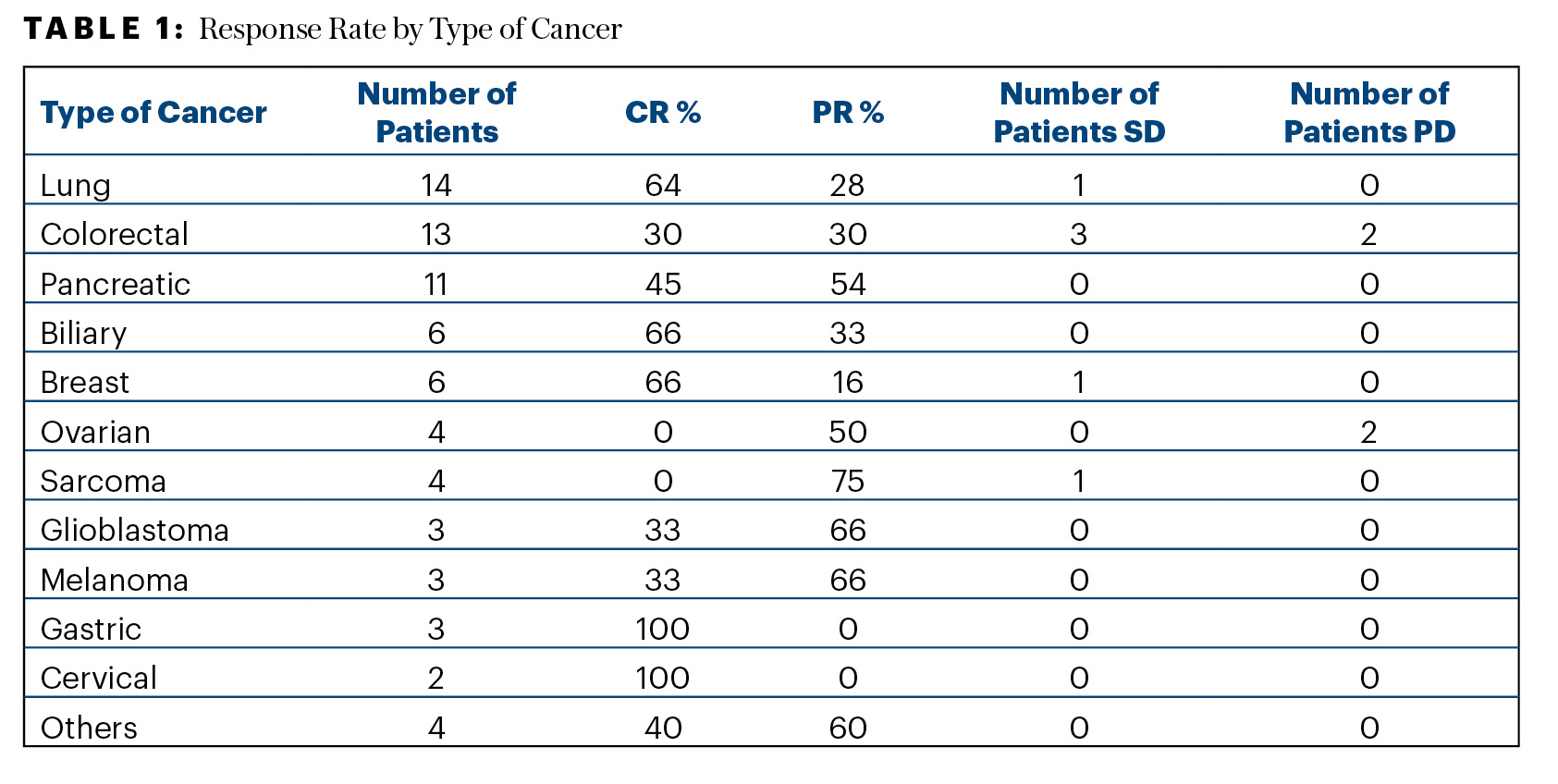
Lung cancer was the most sensitive tumor type with a complete remission rate of 64%. In 5 patients with lung cancer and brain metastasis, complete remission in the brain was achieved in 4 when complete remission was achieved systemically. One patient achieved complete remission systemically, but not in the brain.
Of the total 73 patients, 4 who were considered terminal prior to treatment are now alive and free of disease at 5 years.
Discussion
Complete remission in this study was significantly associated with improved outcomes, with a median progression-free survival of 15 months and a median overall survival of 41 months. Progression-free survival and overall survival rates were estimated using Kaplan-Meier Methodology.
A patient was considered in complete remission only when his or her PET/CT scan was negative. A negative CT scan was not considered complete remission if the PET/CT showed residual metabolic activity. All patients were rigorously followed and monitored in a single center.Fatal complications occurred in 3 patients. These complications were possibly but not definitively related to checkpoint inhibitors. Other toxicities were manageable and within the expected range.
In view of the results observed in this single-center study, with a complete remission rate of 47.9% achieved in a category of patients who were previously considered to have terminal advanced or refractory cancer, this strategy should be considered a new and innovative approach to the treatment of advanced cancer.
In summary, continued study of the role and usefulness of ICTriplex is warranted. ICTriplex should be considered an option for patients with advanced and refractory malignancies who have exhausted standard therapy, or without known optimal therapy.
In conclusion, ICTriplex achieved significantly higher remission rates and encouraging survival in heterogeneous heavily pretreated populations. These findings confirm and extend our previously reported data1-6 and support ICTriplex as an appropriate option for patients with advanced malignancies where no standard treatment is available for them.
DISCLOSURE: Philip A. Salem, MD, is President of the Salem Oncology Center.
REFERENCES
1. Salem PA, Jabboury K, Stenoien RR, et al: Personalized multimodality therapy with immune checkpoint inhibitors (ICI), chemotherapy (CT), and targeted treatment (TT) in advanced /refractory cancer. J Clin Oncol 37:e14254, 2019.
2. Salem PA, Jabboury K, et al: ICIs combined with CT and TT yield high remission rates in advanced cancers. Trends Ca Research 15:49-62, 2020.
3. Salem PA, Jabboury K, et al: Personalized multimodality therapy with ICIs, CT, and TT in advanced refractory cancer. J Clin Oncol 38:e15150, 2020.
4. Salem PA, Jabboury KW, et al: Personalized multimodality therapy with ICTriplex in advanced/refractory cancer. J Clin Oncol 40:e14590, 2022.
5. Salem PA, Gensini L, et al: ICTriplex in advanced/refractory cancer. J Clin Oncol 42, 2024. Abstract 23. ASCO Breakthrough, Yokohama, 2024.
6. Salem PH, Jabboury KW, et al: ICTriplex in advanced/refractory malignancies. ASCO Breakthrough, Singapore; J Clin Oncol 44: Abstract 82, 2026.
Readers who would like to contact Dr. Salem may do so via The ASCO Post at editor@ascopost.com or directly at Dr. Salem’s e-mail address, salem@pasalem.com.
