
The recent announcement1 that divarasib, a next-generation KRAS G12C inhibitor, improved both progression-free and overall survival compared with first-generation KRAS G12C inhibitors (ie, sotorasib, adagrasib) is an important scientific milestone in the treatment of KRAS G12C–mutated non–small cell lung cancer (NSCLC). If confirmed in a peer-reviewed publication, divarasib will likely become the preferred inhibitor in this disease. The scientific achievement deserves praise: in roughly a decade, investigators transformed KRAS G12C from an “undruggable” target into a precision oncology success story, then improved on the first generation of compounds. But scientific progress should also prompt reflection. Have we improved only the molecules, or have we also improved the way we develop them?
The distinction between scientific advance and clinical advance lies at the heart of the FDA’s Project Optimus initiative.2 The program was not created because oncology lacked effective therapies. It was created because demonstrating efficacy had increasingly come to substitute for demonstrating dose optimization. The two questions are orthogonal. Demonstrating superiority between molecules does not establish optimality within a molecule. The goal of Project Optimus was not simply to encourage better pharmacokinetics or more sophisticated phase I trials. It was to establish a new standard for oncology drug development: Before a dose becomes embedded in clinical practice, there should be compelling evidence that it is the minimum dose capable of achieving maximal efficacy. The concept is grounded in the bioethical principle that incremental risks are acceptable only if incremental benefits are likely.3

Garth W. Strohbehn, MD, MPhil

Allen S. Lichter, MD, FASCO

Mark J. Ratain, MD, FASCO
Sotorasib was an early test of that principle.4 Pharmacokinetic analyses demonstrated saturable absorption, meaning that incrementally higher doses (beyond 240 mg daily) did not increase serum drug concentrations but were associated with higher rates of treatment-related toxicities, particularly diarrhea.5 Rather than treating this as a pharmacologic curiosity, the FDA’s response was to distinguish activity from optimization.4 At the time of accelerated approval, the FDA issued two separate postmarketing requirements: one to demonstrate the superiority of sotorasib over the standard of care in a randomized phase III trial, and the other to compare the registration trial dose (960 mg daily) with the hypothesized minimum dose needed to achieve maximal activity and efficacy (240 mg daily).6 Although the higher dose failed to demonstrate superiority for the efficacy endpoint prespecified by the FDA,7 both the FDA and Amgen declined to change the approved dose to 240 mg.8 The postmarketing dose-optimization study accomplished something equally important: It established efficacy and dose optimization as distinct scientific questions requiring distinct evidence and created the expectation that future oncology drugs would not be advanced without addressing both issues.
The next generation of KRAS G12C inhibitors offers the first meaningful opportunity to determine whether Project Optimus fundamentally changed oncology drug development. Both divarasib and elisrasib, another next-generation KRAS G12C inhibitor, entered first-in-human testing before Project Optimus was publicly announced in 2021, a chronology that deserves acknowledgment. However, dose selection, expansion cohort development, and progression to registration trials occurred after the FDA had articulated a fundamentally different evidentiary standard for oncology dose optimization. These programs therefore represent an early test of whether that standard has extended beyond regulatory rhetoric to sponsor behavior.
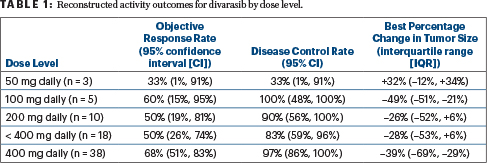
The publicly available divarasib data provide little reassurance that it has. In the published first-in-human study, patients with NSCLC received doses ranging from 50 to 400 mg daily.9 There was clear-cut evidence of antitumor activity across multiple dose levels, including doses as low as 50 mg daily (Table 1). Although these cohorts were small and nonrandomized, reconstruction of the published waterfall plot did not demonstrate a clear relationship between dose and objective response, disease control, or depth of tumor shrinkage. More importantly, the available data do not independently establish that 400 mg daily—the dose selected for expansion and subsequent registration development—is the minimum dose capable of achieving maximal efficacy. Although it remains entirely possible that 400 mg is the optimal dose, the point is that the available evidence does not support that conclusion.
Equally notable is what has not been reported thus far. Unlike many contemporary phase I studies, the publication included only scant pharmacokinetic data—from four patients who received the 400-mg dose—and no systematic evaluation of dose-toxicity or exposure-toxicity relationships. This makes it difficult to independently assess whether the selected dose appropriately balances incremental efficacy against incremental toxicity.
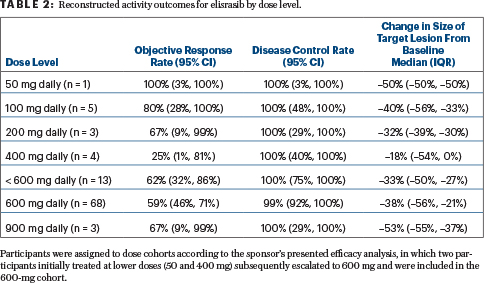
Elisrasib illustrates that improved pharmacology alone does not resolve the optimization question. Elisrasib demonstrates orderly, dose-dependent pharmacokinetics, with steadily increasing systemic exposure across doses.10 The pharmacologic rationale for dose escalation is therefore readily apparent, since higher doses lead to higher exposures. Indeed, the sponsor explicitly stated that the 600-mg expansion dose was selected based on pharmacokinetics rather than comparative efficacy.10 Results from the expansion cohort are encouraging, with an objective response rate approaching 60%, a disease control rate approaching 100%, and activity in tumors previously exposed to first-generation KRAS G12C inhibitors.11 Yet reconstruction of the publicly available efficacy data does not reveal a corresponding dose-response relationship. Objective response, disease control, and median tumor shrinkage among participants treated with doses below 600 mg daily were similar to those observed in the expansion cohort (Table 2). Although the sponsor described individual patients whose tumors responded following intrapatient dose escalation, such observations cannot establish superior population-level efficacy at higher doses. To our knowledge, no randomized dose-optimization study is planned.
Taken together, these next-generation KRAS G12C inhibitor development programs raise a broader question: If this is what Project Optimus–era oncology drug development looks like, then what, exactly, has Project Optimus changed?
That question is less about the sponsors than about the evidentiary standard to which they are responding. Although sponsors are free to invest hundreds of millions of dollars in a global registration trial without first obtaining FDA concurrence that the proposed development program will be acceptable, they are unlikely to do so. Sponsors design studies to satisfy regulators. If randomized dose-optimization studies are absent, one must ask whether they were considered unnecessary by the sponsor and regulators, discouraged because of concerns about delaying development, or simply not required. Whatever the explanation, the result is the same: Registration trials are proceeding apace despite the continued existence of clinically plausible alternative doses that have not been rigorously evaluated, meaning that avoidable excess toxicity could become baked into cancer care.
One possibility is that the regulatory signal itself became diluted. Sotorasib demonstrated precisely why dose optimization matters. The randomized comparison of 960 mg and 240 mg suggested that higher doses produced neither higher exposures nor additional efficacy but did increase toxicity. Yet the approved dose remained unchanged. Whether or not that decision was ultimately justified, sponsors observing the experience with sotorasib might conclude that randomized dose-optimization studies—even when requested and even when they generate data suggesting, if not proving, that the registration dose is suboptimal—are unlikely to alter the approved dose. Regulatory guidance derives its influence not only from what it says but also from what it does. If sponsors perceive that the consequences of failing to rigorously establish the minimum maximally effective dose are limited, it should surprise no one if they prioritize speed of development over definitive dose optimization.
None of this should be interpreted as an argument that divarasib or elisrasib were developed at the wrong doses. Based on the publicly available evidence, it remains possible that both drugs are currently being advanced at their minimum maximally effective doses. Nor is it an argument that every oncology drug requires exhaustive randomized comparisons across the entire dose range. Rather, it is an argument that when multiple clinically plausible doses remain consistent with the available efficacy data, the burden of proof should shift. Whether the drug works is not the only question worth answering. Whether additional milligrams of a drug produce additional value for patients matters, too.
That question becomes even more important as targeted therapies are combined with other targeted agents and immunotherapies. The consequences of selecting an unnecessarily high dose extend beyond a single agent. Indeed, toxicities that appear acceptable in the monotherapy setting may become dose limiting when combined with other targeted therapies, immunotherapies, or antibody-drug conjugates. Identifying the minimum dose capable of preserving efficacy is therefore not simply an exercise in pharmacology. It is a risk-management strategy for patients, sponsors, and regulators alike. A drug developed at its minimum maximally effective dose enters future combination studies with greater therapeutic flexibility, potentially broader applicability, and stronger justification for the cumulative toxicities that patients are asked to accept.
Project Optimus was created to ensure that these questions would be answered before, rather than after, registration. For divarasib, the available evidence suggests that doses of 100, 200, and 400 mg each remain clinically plausible candidates for the minimum maximally effective dose. A randomized comparison among these doses would directly address the central question that Project Optimus was designed to answer. Elisrasib presents a similar opportunity. Given its orderly pharmacokinetics and encouraging early efficacy, randomized evaluation of lower doses—potentially including doses as low as 50 or 100 mg daily, as previously suggested by its sponsor12—alongside intermediate and proposed registration doses could determine whether incremental exposure produces incremental clinical benefit. The objective is not to demonstrate that less drug is always better. It is to identify the point beyond which more drug is no longer meaningfully better.
Ultimately, the credibility of Project Optimus will be determined not by the guidance documents it produced but by the registration programs it permits and, as a result, the avoidable harms it prevents. The initiative articulated an important principle: Patients should not be exposed to unnecessary toxicity without evidence that additional drug provides additional benefit. If the FDA believes that the evidence supporting dose selection for the next generation of KRAS G12C inhibitors satisfies that standard, it should explain why. If not, it should insist on the randomized dose-optimization studies that Project Optimus was designed to promote before these doses become embedded in routine clinical practice. Old habits may die hard, but the principles that underpin Project Optimus and the evidentiary standards it demands should not.
DISCLOSURE: Dr. Strohbehn is an employee of the U.S. Department of Veterans Affairs; the views expressed do not reflect those of the U.S. federal government; he has received consulting fees from EBSCO Information Systems and VIVIO Health; is a co-inventor in a filed method-of-use patent in dose optimization (held by the Department of Veterans Affairs and the University of Michigan, for which he receives no royalties); and is a co-inventor (with M.R.) in a filed method-of-use patent in dose optimization of tocilizumab for viral infections (held by the University of Chicago, for which they receive no royalties). Dr. Lichter reported consulting fees from Cellworks and Ascentage Pharma. Dr. Ratain owns stock in SAB Biotherapeutics; has received honoraria from Emerald Lake Safety; has held a consulting or advisory role with Apotex, EQRx, Bayer Pharmaceuticals, Cantex Pharmaceuticals, Cerona Therapeutics, T3 Pharmaceuticals, Astellas Pharma, Halozyme, and Oscotec; has received research funding from AbbVie and Xencor; has received royalties related to UGT1A1 genotyping for irinotecan; has a provisional patent application for a method of treating viral pneumonitis with low-dose tocilizumab; and has provided expert testimony for multiple generic companies (defendants in patent litigation). All authors are Directors of the Optimal Cancer Care Alliance.
REFERENCES
1. Roche: Roche’s divarasib shows superiority in head-to-head phase III trial against approved KRAS G12C inhibitors in non-small cell lung cancer. July 2, 2026. Available at: https://www.roche.com/media/releases/med-cor-2026-07-02. Accessed July 23, 2026.
2. U.S. Food and Drug Administration: Project Optimus. Available at: https://www.fda.gov/about-fda/oncology-center-excellence/project-optimus. Accessed July 23, 2026.
3. Shah M, et al: The Drug-Dosing Conundrum in Oncology—When Less Is More. N Engl J Med 385:1445-1447, 2021.
4. Ratain MJ, Lichter AS, Strohbehn GW: Sotorasib: The poster child for Project Optimus truths and fantasies. The ASCO Post. February 25, 2024.
5. Ratain MJ, Lichter AS: Empowering the FDA to require dose optimization of all new oncology drugs. The ASCO Post. January 25, 2021.
6. U.S. Food and Drug Administration: Accelerated Approval Letter: Lumakras (sotorasib). May 28, 2021. Available at: https://www.accessdata.fda.gov/drugsatfda_docs/appletter/2021/214665Orig1s000ltr.pdf. Accessed July 23, 2026.
7. Hochmair MJ et al: Sotorasib (960 mg or 240 mg) once daily in patients with previously treated KRAS G12C-mutated advanced NSCLC. Eur J Cancer 208, 2024.
8. Amgen: Amgen provides regulatory update on status of LUMAKRAS (sotorasib). December 22, 2023. Available at: https://www.amgen.com/newsroom/press-releases/2023/12/amgen-provides-regulatory-update-on-status-of-lumakras-sotorasib. Accessed July 23, 2026.
9. Sacher A, et al: Single-agent divarasib (GDC-6036) in solid tumors with a KRAS G12C mutation. N Engl J Med 389:710-721, 2023.
10. Cho BC, et al: D3S-001 in advanced solid tumors with KRAS G12C mutations: A phase 1 trial. Nat Med 31:2768-2777, 2025.
11. Cho BC, et al: Abstract CT020: Safety and efficacy of Elisrasib (D3S-001), a next generation GDP-bound KRAS G12C inhibitor, as monotherapy in advanced non-small cell lung cancer (NSCLC) previously treated with or without a KRAS G12C inhibitor: Results from a phase 1/2 study. AACR Annual Meeting 2026. San Diego, CA.
12. Lu J, et al: D3S-001, a highly potent, selective, and differentiated covalent inhibitor of KRAS G12C: Human dose prediction and first-in-human (FIH) trial design. J Clin Oncol 40, e15087-e15087, 2022.
Dr. Strohbehn is Assistant Professor in the Department of Internal Medicine, University of Michigan, and an investigator in the Veterans Affairs Center for Clinical Management Research, both in Ann Arbor. Dr. Lichter served as Chair and Professor of Radiation Oncology at the University of Michigan from 1984 to 1998; Dean of the University of Michigan Medical School from 1998 to 2006; and Chief Executive Officer of ASCO and Conquer Cancer: the ASCO Foundation, from 2006 to 2016. Dr. Ratain is Leon O. Jacobson Professor of Medicine, Director, Center for Personalized Therapeutics, The University of Chicago.
Disclaimer: This commentary represents the views of the author and may not necessarily reflect the views of ASCO or The ASCO Post.
