
ASCO has published a guideline update offering clinicians new recommendations for breast cancer follow-up and surveillance after primary treatment.1
For this patient population, determining the optimal frequency and timing of visits can be a challenge, according to Expert Panel Co-Chair Maryam Lustberg, MD, MPH, of Yale Yale School of Medicine.

Maryam Lustberg, MD, MPH

Zeina Nahleh, MD, FACP
“How often do we get tests? How often do we get scans? These questions come up very often, and it was important to come together as a group of multidisciplinary experts to reevaluate what data have shown,” Dr. Lustberg said.
ASCO convened an Expert Panel to review evidence published since the last guideline update in 2013. One randomized controlled trial was used to inform recommendations for surveillance mammography, and the remaining recommendations were generated by expert consensus methodology.
Intensity-Based Surveillance
One important update to the guideline was the incorporation of intensity-based post-treatment surveillance that tailors the follow-up approach to the varying risk of recurrence in the adjuvant setting.
“The goal of [the] risk-stratified approach is to better address the heterogeneity of patients’ needs and account for these differences,” said Expert Panel Co-Chair Zeina Nahleh, MD, FACP, of the Cleveland Clinic Maroone Cancer Center in Weston, Florida. “It also emphasizes utilizing resources more effectively in light of the workforce shortage in oncology and rising health-care costs.”
The update organizes patients into three intensity subgroups—low, intermediate, and high—each with surveillance recommendations (Table).
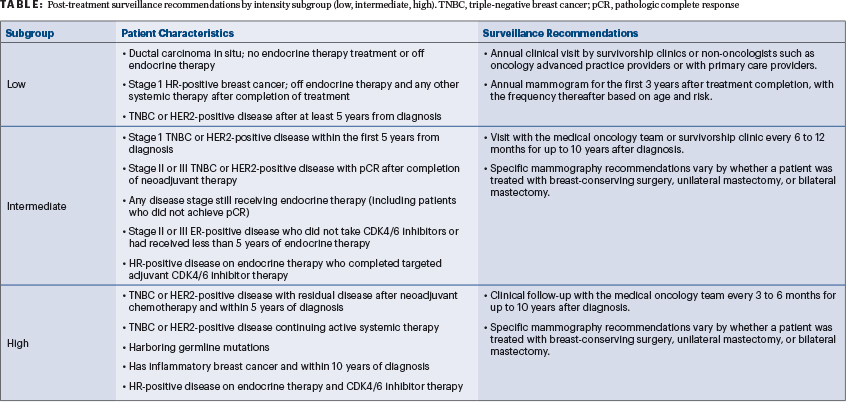
“Part of what the guideline aims to do is see follow-up of breast cancer survivors as a collective duty to be spread beyond oncologists, as appropriate,” Dr. Lustberg said. “Patients with the highest risk and greatest needs would be followed more frequently by oncologists, whereas patients at lower risk have the opportunity for transition of care and follow-up [to] other well-qualified clinicians.”
The guideline update also addresses the use of blood-based biomarkers and supplemental surveillance imaging. “These are rapidly evolving, and we clarified the importance of waiting for more thorough and complete research before introducing these tests into clinical practice,” Dr. Nahleh said.
Dr. Nahleh said that the guideline is not a replacement for patient-physician discussion, which remains important for communicating goals of care.
REFERENCE
