
On October 1, 2025, Benjamin L. Ebert, MD, PhD, celebrated the 1-year anniversary of being named President and Chief Executive Officer (CEO) of Dana-Farber Cancer Institute in Boston. He also holds the titles of Director of Dana-Farber/Harvard Cancer Center, the Richard and Susan Smith Professor of Medicine at Harvard Medical School; and previously served as Chair of the Department of Medical Oncology at Dana-Farber from 2017 to 2024.
Reaching this pinnacle in his medical and research career is the culmination of decades of scientific pursuit, most notably in the understanding of blood disorders and cancers at the genetic level and developing more effective therapies for patients with these diseases.
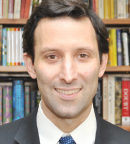
Benjamin L. Ebert, MD, PhD
On family legacy: We are a family of physicians. My father, grandfathers, great uncle, and great grandfather were all physicians.
On serendipity: I was President of the American Society of Clinical Investigation in 2017-2018, exactly 60 years after my grandfather served as president of that organization.
On a research career: “I was captivated by the process of working in a lab. The challenge of designing experiments that make a discovery with confidence, and the potential of scientific discoveries that decrease the burden of disease, were both daunting and thrilling to me.”
On the role of AI in health care: “The promise that AI can accelerate the development of new cancer drugs and accelerate scientific research broadly is absolutely thrilling.”
A fourth-generation physician—his father, both grandfathers, great-grandfather, and a great-uncle were all physicians—Dr. Ebert knew from an early age that he loved science and wanted to be a doctor.
“In high school and through college, I worked in research laboratories, and absolutely loved it,” said Dr. Ebert. “I was captivated by the process of working in a lab. The challenge of designing experiments that make a discovery with confidence, and the potential of scientific discoveries that decrease the burden of disease, were both daunting and thrilling to me. By the end of college, I was sure that I wanted to do some combination of medicine and science, and that I wanted to pursue an MD-PhD dual degree.”
After studying mathematics and chemistry at Williams College in Williamstown, Massachusetts, Dr. Ebert attended Oxford University in the United Kingdom, as a Rhodes Scholar, where he completed his doctorate. He worked in the laboratory of molecular biologist, Sir Peter Ratcliffe, FRS, FMedSci, a nephrologist, who was investigating the role of the regulation of hypoxia and related metabolic stresses in driving the development of various diseases, including cancer. In 2019, Dr. Ratcliffe was honored for his work in how cells in the body adapt to oxygen availability with the Nobel Prize in Physiology or Medicine.1
After receiving his doctorate from Oxford University, Dr. Ebert moved back to Massachusetts, and completed his medical degree, in 1999, at Harvard Medical School. While at Harvard, Dr. Ebert continued his research related to oxygen sensing in blood cells in the laboratory of H. Franklin Bunn, MD. He then completed his residency in internal medicine at Massachusetts General Hospital, and a fellowship in hematology/oncology at Dana-Farber Cancer Institute.
He has remained in the Boston area ever since.
Advancing Treatments for Blood Cancers
Following the full-time clinical portion of his fellowship, Dr. Ebert joined the laboratory of Todd R. Golub, MD, now the Director of the Broad Institute of Massachusetts Institute of Technology (MIT) and Harvard, where he made the study of myelodysplastic syndromes (MDS) a primary focus. In 2008, Dr. Ebert’s research led to the discovery that RPS14 gene deficiency contributes to the hematopoietic defect characteristic of a form of MDS called 5q– syndrome. Three years later, Dr. Ebert and his colleagues published their findings of a set of gene mutations found in about half of patients with MDS that predict the development of acute leukemia and overall survival.2
That same year, Dr. Ebert was elected to the American Society for Clinical Investigation, and later served as its president. In 2014, Dr. Ebert’s laboratory discovered that lenalidomide, a derivative of thalidomide, targeted the proteins IKZF1 and IKZF3 for degradation, which has led to treatments for both del(5q) MDS and multiple myeloma. Also in 2014, Dr. Ebert’s laboratory reported that clonal hematopoiesis, a premalignant condition for blood cancers, is both highly common and predictive of overall survival. In 2021, Dr. Ebert was awarded the Sjöberg Prize for his discovery of the mode of action of lenalidomide in the treatment of hematologic disorders.
Guest Editor
Jame Abraham, MD, FACP
Dr. Abraham is Chairman of the Department of Hematology and Medical Oncology at Cleveland Clinic and Professor of Medicine at Lerner College of Medicine.
In addition to the Sjöberg Prize, Dr. Ebert has been recognized for his research in hematologic malignancies with the William Dameshek Prize from the American Society of Hematology, the Meyenburg Prize for Cancer Research, and the Korsmeyer Award from the American Society of Clinical Investigation. He has also received awards from Harvard Medical School and the Harvard-MIT Health Sciences and Technology Program for mentorship.
In this installment of The ASCO Post’s Living a Full Life series, Guest Editor Jame Abraham, MD, FACP, spoke with Dr. Ebert about the early beginnings of his stellar career, making the transition from physician/scientist to administrator of a renowned cancer center, and the impact artificial intelligence is having on oncology care. Here are excerpts from their conversation, which have been edited for length and clarity.
Tracing the Early Beginnings
Jame Abraham, MD, FACP: First, let me congratulate you on being named President and CEO of Dana-Farber Cancer Institute. You are leading one of the best cancer centers in the world, especially at this time with your new collaboration with Beth Israel Deaconess Medical Center, a Harvard-affiliated medical center, and its affiliated physician group, Harvard Medical Faculty Physicians. You have had such an incredible clinical and research career. Please talk about the impact being mentored by Sir Peter Ratcliffe, FRS, FMedSci, while a student in his lab, has had on your research career.
Benjamin L. Ebert, MD, PhD: It took multiple twists of good fortune to get there. I knew I wanted to be a physician/scientist at that time, but I had not broadly applied for scholarships. When I got to Oxford University, I was initially planning on getting a second bachelor’s degree. But I soon realized that this would be less a productive course for me. So, I decided instead to do research for a couple of years, and then go back to the United States for an MD-PhD dual degree.
I couldn’t figure out where the best place for me would be to start my research training. I finally had a meeting with Sir John Bell, FRS, HonFREng, PMedSci, who was the Nuffield Professor of Clinical Medicine at Oxford, and he told me about a junior investigator, Peter Ratcliffe, who had recently started a lab at the university. Professor Bell promised me Dr. Ratcliffe was going to do great things in the future.
Working with Dr. Ratcliffe was an extraordinary experience. He was extremely involved in the lab, and had an amazing work ethic, and an incredible scientific mind in terms of thinking through the most important experiment at every juncture. I learned so much from the rigor of his thinking and the rigor of his analysis and writing. To get to work in his laboratory at that moment in time is one of the greatest experiences in my life. I ultimately ended up deciding to stay at Oxford to complete my doctorate before returning to the United States for medical school.
It was also important for me to have lived abroad and to see the United States from an outside perspective, and to see how a different health-care system and scientific research work in another country.
Joining the Family Business
Dr. Abraham: Your father, both grandfathers, and a great-uncle were all physicians. How did having this family heritage influence your desire to become a clinician/researcher?
Dr. Ebert: Actually, we are a family of physicians. In addition to my father, grandfathers, and great-uncle, my great-grandfather, who was orphaned at a young age, was also a physician. My great-grandfather was adopted by the Ebert family, which gave us our surname. When his adoptive parents died, he used his inheritance to go to medical school. He had been a school teacher, and later became a dermatologist in Chicago. Then, he had two children, both of whom became doctors, my father is a doctor, and my brother and I are both doctors.
So, I had a lot of exposure to medicine at a young age and clearly internalized the profession in some way. Being a physician connects me to a family tradition and to members of my family in profound ways.
One nice connection is that I was President of the American Society of Clinical Investigation, in 2017-2018, exactly 60 years after my grandfather served as president of that organization.
Deciding on a Career Path
Dr. Abraham: Your father was a psychiatrist, and other family members were general internists. What led you to the field of oncology?
Dr. Ebert: Part of what drove me into this field was the set of mentors I had in my early career. When I was at Oxford working in Dr. Ratcliffe’s lab, I worked on sensing hypoxia. The specific gene we studied was the regulator of erythropoietin in response to hypoxia, a field that connected me to hematology. Sir David Weatherall, GBE, FRS, was Oxford University’s Nuffield Professor of Clinical Medicine when I was enrolled there, and a giant in hematology.
When I was in medical school, I worked with Dr. H. Franklin Bunn [Professor of Medicine, Brigham and Women’s Hospital and Harvard Medical School], who is a hematologist, and received the 2009 Wallace H. Coulter Award for Lifetime Achievement in Hematology. So, I had a lot of role models who were practicing in hematology and oncology, and they had a critical influence in my career choice.
In addition, I knew I wanted to enter a field of medicine that was going to be transformed by scientific insights during the course of my career. And no field seemed more likely to be transformed than oncology. Certainly, that has been even more true than I ever could have expected. Oncology is a field in which basic science yields insights that produces new therapies at a rate that, arguably, no other field matches.
Transitioning From Clinician/Scientist to Administrator
Dr. Abraham: What has it been like for you to make the transition from clinician/scientist to administrator of a large cancer center?
Dr. Ebert: I always loved seeing patients, but the majority of my time in the
early- and mid-stages of my career focused on running a research laboratory. I’ve had the good fortune of working with extraordinary people in my lab. Being a principal investigator of a laboratory has always been such a joy, and extremely motivating and exciting.
For a long time, I’ve been focused on myeloid malignancies, which have included work on the premalignant stages of disease, including defining clonal hematopoiesis on a very broad scale in large datasets and the biology of the mutations that drive clonal hematopoiesis and myeloid malignancies.
Experiments to understand the mechanism of action of the drug lenalidomide, which is highly effective for the treatment of blood cancers, especially multiple myeloma, have led to insights into targeted protein degradation. This work contributed to a rapidly growing field, yielding many new drugs that work by targeting protein degradation. So, I’ve always loved working in the laboratory, and the mentorship of early career investigators. The community of our research laboratory has always been a source of joy and pride.
I also practiced medicine, and I always enjoyed putting on a white coat, and having the joy of seeing patients. In 2017, I became Chair of the Department of Medical Oncology, and held that position until 2024, when I was named President and CEO of Dana-Farber Cancer Institute.
As Chair of Medical Oncology, I had the privilege of working with an extraordinary set of oncologists, and had the opportunity to think more broadly about how to integrate basic science and clinical medicine and how to make sure that the environment is optimized for collaboration. I learned how to hire staff that are going to become highly collaborative members of our community, and to cultivate the right ethos and the right environment for scientific discovery and the practice of clinical medicine at the very highest level.
I loved being Chair of the Department of Medical Oncology, and would have been happy to stay in that position. But when my predecessor, Dr. Laurie Glimcher, announced she was stepping down as President of Dana-Farber, I decided to apply for the position, and took on the role of president and CEO a year ago. It’s just been an incredible experience and an amazing job to have.
Garnering Bipartisan Support for Cancer Research
Dr. Abraham: On September 29, 2025, Anthony Letai, MD, PhD, a medical oncologist at Dana-Farber, and Professor of Medicine at Harvard Medical School, became the 18th Director of the National Cancer Institute (NCI). What impact do you think Dr. Letai will have on the agency given the funding cuts happening throughout the federal health agencies?
Dr. Ebert: I am so thrilled and so proud that Tony is now Director of the NCI. He’s a great physician/scientist, a great friend, and a great colleague. I’m glad he decided to take that position, because it has such important ramifications for all of us.
I’ve been spending a bit of time in Washington, and while we are concerned about support for biomedical research, every time I visit with Congressional members, I’m impressed by the bipartisan support there is for biomedical research, particularly in cancer research. I’m also impressed by the profound public support there is for biomedical research and for cancer research.
That support is gratifying to see and it gives me hope for the long-term future of research and continued advances in diseases, especially in the treatment of cancer.
Striking a Work/Life Balance
Dr. Abraham: How do you achieve a work/life balance; what do you do to relax outside of work?
Dr. Ebert: My wifeand I have three children. A son,19, who’s a sophomore at my alma mater, Williams College in Western Massachusetts, and two daughters who are now 13 and 16 years old. My wife is on the faculty of Brandeis University, so we have a busy household, which is wonderful. I treasure the moments we have when the kids are home, and the house is bustling with their activities, and the ups and downs of their days.
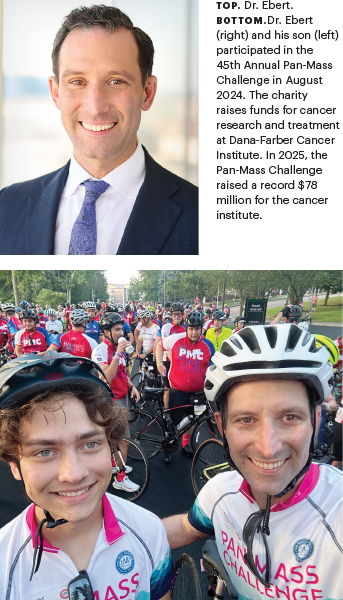
Outside of work, I like to run and cycle. I participate in the many athletic fundraisers at Dana-Farber, including the Pan-Mass Challenge, which is now the largest athletic fundraiser in the country. My family and I also participate in the Dana-Farber Half-Marathon, and the Jimmy Fund Walk. These events bring us together with the entire Dana-Farber community, including our patients, cancer survivors, and their family members, to support cancer research and cancer care.
Understanding the Impact of Technology on Clinical Practice
Dr. Abraham: For my last question, I wanted to ask you about the impact artificial intelligence is having and will have on the practice of oncology.
Dr. Ebert: We are certainly thinking a lot about this technology. My colleague Eliezer Van Allen, MD [Chief, Division of Population Sciences and Chandra Nohria Family Chair for AI in Cancer Research at Dana-Farber Cancer Institute], has pointed out how AI is a technology that can reintroduce humanism into medicine, which is a wonderful way to think about it. AI in oncology isn’t a way of replacing humans. It’s a way of taking care of some of the administrative tasks that allow us to have more human interactions with our patients.
We and others are very focused on how AI will influence the way we practice radiology and pathology. Again, not in terms of replacing radiologists or pathologists, but how it will improve diagnostic accuracy. And on the research side, AI can give us the ability to analyze enormous volumes of data with large language models and potentially transform translational research. Advances in this technology are changing month-to-month, so it’s really hard to envision all the possibilities of how AI will change our operations, clinical care, and scientific research.
The promise that AI can accelerate the development of new cancer drugs and accelerate scientific research broadly is absolutely thrilling. Oncology practice will change in ways we can’t predict right now, but we’re already seeing glimpses of how AI can improve oncology care. This is an exciting time for us and for our patients.
DISCLOSURE: Dr. Ebert has received research funding from Novartis and Calico, and consulting fees from AbbVie. He is a member of the scientific advisory board and a shareholder of Neomorph Inc., Big Sur Bio, Skyhawk Therapeutics, and Exo Therapeutics.
REFERENCES
1. The Nobel Prize: Sir Peter J. Ratcliffe. Available at www.nobelprize.org/prizes/medicine/2019/ratcliffe/facts/.
2. Bejar R, et al: Clinical effect of point mutations in myelodysplastic syndromes. N Engl J Med 364:2496-2506, 2011.
