
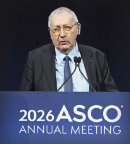
In the treatment of advanced dedifferentiated liposarcoma, a rare and aggressive soft-tissue sarcoma, the CDK4/6 inhibitor abemaciclib significantly reduced the risk of disease progression or death by 62% as compared with placebo in the randomized phase III SARC041 study.1 Mark Dickson, MD, of Memorial Sloan Kettering Cancer Center, presented the study findings during the Plenary Session at the 2026 ASCO Annual Meeting.
“Better treatment options for dedifferentiated liposarcoma are needed, given that the prognosis is poor … Abemaciclib provided a clinically meaningful and statistically significant improvement in progression-free survival for patients with dedifferentiated liposarcoma and is a new treatment option for this rare tumor,” Dr. Dickson said.

Abemaciclib provided a clinically meaningful and statistically significant improvement in progression-free survival for patients with dedifferentiated liposarcoma and is a new treatment option for this rare tumor.— Mark Dickson, MD
Tweet this quote
Median progression-free survival reached 9.7 months in patients randomized to receive abemaciclib vs 1.5 months in the placebo arm (hazard ratio [HR], 0.38; P < .001). At 6 months, 60% of patients in the abemaciclib arm were progression-free compared to 22% of the placebo arm. At 12 months, these rates were 39% and 13%, respectively.
Putting this into context, Dr. Dickson noted that conventional chemotherapy for this cancer typically confers median progression-free survivals ranging from 2 to 7 months.
Why This Drug?
Dr. Dickson explained how abemaciclib was chosen for investigation. He noted that nearly all cases of dedifferentiated liposarcoma have high level amplification of a section of chromosome 12 that contains the gene CDK4, which drives tumor growth. “Our group has shown that CDK4 inhibitors block the growth of liposarcoma cells both in vitro and in xenografts. These observations launched the first investigator-initiated clinical trials of CDK4 inhibitors in liposarcoma, back in 2010,” he said.
Subsequent research showed better outcomes and less toxicity with abemaciclib than palbociclib, another CDK4/6 inhibitor, because abemaciclib is more selective for CDK4 and also can be dosed continuously. Therefore, the Sarcoma Alliance for Research through Collaboration (SARC), a group whose goal is to accelerate progress in ultra-rare tumors, selected abemaciclib for SARC041. They chose placebo for the control arm because conventional chemotherapy conveys toxicity without much benefit; the crossover design permitted patients randomized to placebo to receive abemaciclib post-progression.
Findings in SARC041
Nine academic centers in the United States enrolled 108 patients, median age 67, randomizing them to abemaciclib 200 mg per day or placebo. These patients all had dedifferentiated liposarcoma that had returned after surgery. Patients with extensive disease deemed to require chemotherapy were excluded. About one-half of the patients were treated in the first-line setting with the remainder treated in the later-line setting.
After disease progression, 85% of patients in the placebo arm crossed over to receive abemaciclib; their median progression-free survival after crossover was 3.4 months. Despite this high number of crossover patients, a strong trend toward overall survival was still achieved. Median overall survival was not reached with abemaciclib and was 25.5 months with placebo (HR, 0.55; P = .07). At 12 months, 85% of patients in the abemaciclib arm were alive compared with 71% of patients in the placebo arm; at 24 months, 72% of patients were alive in the abemaciclib arm vs 51%, respectively. Responses were observed in 9% and 0%, respectively, Dr. Dickson reported.
KEY POINTS
- For the first time in a phase III trial, targeting of CDK4 yielded a statistically significant and clinically meaningful benefit in patients with advanced dedifferentiated liposarcoma that had returned after surgery.
- The CDK4/6 inhibitor abemaciclib improved median progression-free survival by an absolute 8.2 months as compared to placebo, and reduced deaths by 45%.
- Median progression-free survival was 9.7 months with abemaciclib vs. 1.5 months with placebo (HR, 0.38; P < .001).
In an exploratory analysis, the 50% of patients who received abemaciclib as their first systemic therapy had a median progression-free survival of 16.4 months, whereas for patients receiving the drug as a later-line therapy median progression-free survival was limited to 5.3 months. This finding suggests that earlier use of the drug provides the greatest benefit, he said.
Dr. Dickson put the findings into context with studies of other drugs for this rare tumor: those for other oral targeted agents, including selinexor, which targets the XPO1 protein, and milademetan and brigimadlin, which target the MDM2 protein, have all been negative, he noted. Two chemotherapy agents, eribulin, a microtubule dynamics inhibitor, and trabectedin, an alkylating agent, were approved years ago for use in the second- and third-line settings, but median progression-free survival was only 2.0 and 2.2 months, respectively, in those trials. “This is the first positive clinical trial in dedifferentiated liposarcoma,” he reported.
Adverse events occurring more frequently with abemaciclib than placebo included decreased blood counts and gastrointestinal events such as diarrhea, nausea, and abdominal pain. These adverse events were generally manageable, although dose reductions were required in 39% of patients.
DISCLOSURE: Dr. Dickson had no personal financial disclosures.
REFERENCE
1. Dickson MA, et al: SARC041: A phase III randomized double-blind study of abemaciclib vs placebo in patients with advanced dedifferentiated liposarcoma. 2026 ASCO Annual Meeting. Abstract LBA2. Presented May 31, 2026.
EXPERT POINT OF VIEW
Paolo G. Casali, MD, Director of the Medical Oncology Unit 2 at the Fondazione IRCCS Istituto Nazionale dei Tumori, Milan, and Associate Professor of Medical Oncology at the University of Milan, was invited to discuss the randomized phase III SARC041 study presented by Mark Dickson, MD, during the Plenary Session at the 2026 ASCO Annual Meeting.1“My final takeaway would be that abemaciclib was shown to be effective in advanced dedifferentiated liposarcoma and I believe these findings can bring about future developments,” he said.
Paolo G. Casali, MD
“The primary end-point of this trial was progression-free survival. One could question that progression-free survival is not a surrogate endpoint in dedifferentiated liposarcoma. First, I could answer that we are not alone in medical oncology. Secondly, I would focus much more on the magnitude of benefit,” he commented.
“In terms of the comparative efficacy, the investigator’s choice was to use placebo as a control. This wouldn’t have been my personal choice, and this was not the choice of investigators developing anti-MDM2 agents brigimadlin and milademetan in dedifferentiated liposarcoma: they chose doxorubicin in the first-line setting and trabectedin in the second-line setting. So for an assessment of the comparative efficacy of this trial, we must resort to some extent to external controls,” he noted.
Because of the crossover built into the study design “for very good ethical reasons,” an overall survival benefit could be difficult to prove, although the magnitude of benefit in terms of progression-free survival is clear, he indicated. “Only a minority of patients were insensitive,” he said, “but as many as 60% of patients had prolongation [of progression-free survival] and about 15% had a plateau [on the Kaplan Meier curve] … This was especially true when looking at the progression-free survival of patients receiving abemaciclib in the first-line setting, where the median progression-free survival benefit was particularly remarkable.”
The same pattern was shown in a prior phase II study,2 and also with the anti-MDM2 agents, he noted. “On the other hand, the response rate was low, and this may be interesting biologically but this also can be, clinically speaking, a limiting factor,” though assessment of tumor response in these tumors may not be easy, he acknowledged, for technical reasons.
Next Steps
“For patients who might be offered abemaciclib in the future, we could say that there may be a 60% or so chance of a short- to medium-term benefit and a 15% chance of a medium- to long-term benefit. It may be difficult to say how a comparator would fare today, but definitely the results would not be the same,” Dr. Casali concluded.
Future steps will involve analysis of archival tumor tissue for biomarkers of response and mechanisms of resistance as well as the study of the possible role of senescence in the mechanism of action, he said, adding that, if this were confirmed, lessons learned in this rare tumor might be informative for other malignancies, not necessarily the rare ones.
DISCLOSURE: Dr. Casali had no personal financial disclosures.
REFERENCES
1. Dickson MA, Ballman KV, Weiss MC, et al : SARC041: A phase III randomized double-blind study of abemaciclib VS placebo in patients with advanced dedifferentiated liposarcoma. 2026 ASCO Annual Meeting. Abstract LBA2. Presented May 31, 2026.
2. Gleason CE, Dickson MA, Klein ME, et al. Therapy-induced senescence contributes to the efficacy of abemaciclib in patients with dedifferentiated liposarcoma. Clin Cancer Res 30:703-718, 2024.
