
ERIC J. SMALL, MD, FASCO
“Good morning, and welcome to the 62nd Annual Meeting of ASCO! ¡Buenos días, y bienvenidos a la sexagésima segunda reunión anual de ASCO! This is the world’s largest cancer research conference and the premier global platform for oncology innovation! But what brings us together today is not just discovery; it is purpose.
As ASCO members, we are part of the largest collective force dedicated to fighting cancer worldwide, with more than 50,000 members, about 40% of whom are international, hailing from more than 170 countries. And these aren’t just numbers. They represent responsibility—our responsibility—to promote scientific integrity and high-quality cancer care all over the world.
Because discovery alone is not enough; it’s about what becomes of what we discover. It’s about translation. We have a duty, a mission, to translate scientific breakthroughs like the ones we’ll learn about [at the ASCO Annual Meeting] into positive outcomes for every patient, every cancer, everywhere. Let me explain why this responsibility is deeply personal to me, and why I chose translation as my presidential theme.
A Calling in Oncology
I was born and raised in Mexico City. My parents were U.S. citizens: union organizers who became targets of the xenophobia of the McCarthy Era in the early 1950s. Their work and their lives were predicated on their unwavering belief in fairness and human dignity. They emigrated to Mexico where they were welcomed, not as aliens, but as members of a diverse Mexican tapestry, and where my brothers and I grew up, in a bilingual, multicultural environment. That life experience shaped my values. My parents taught me, through word and deed, to serve others, to make a difference.
I found my calling in oncology, in the nexus between harnessing and translating science, and that most sacred privilege of accompanying patients and their loved ones on their cancer journey. These values subsequently led me to active membership and later, leadership, in ASCO.
The concept of translation became central to my growth from a young child in Mexico to this moment. Because whether you are translating language, or cultural context, or science, translation connects knowledge to meaning.
Translation: The treatments we use today, and the innovations we will hear about at this meeting, are the product of translation from bench to bedside to society.
Translation: The P values and hazard ratios of Kaplan-Meier plots must be translated into what truly matters to patients.
Translation: It is incumbent on us to translate the content of this meeting across languages, cultures, geographies, resource availability, and practice sites, so that all patients can benefit.
Translation Turns Personal
Translation was always important to me, but last year, it became personal.
My partner of 18 years, Dr. Amy Lin, who also was an oncologist, died last December of a rare cancer—metastatic clear cell ovarian cancer, which is incident in approximately 2,000 women in the United States each year, and 30,000 women globally. In our search for answers, we found precious little clinical research on this chemo-unresponsive disease. The few treatments that did exist came with a heavy toxicity burden.
Amy was very clear: Quality of life was most important to her. And yet, even with that clarity, with her ability to communicate her wishes, and with her expertise as a medical oncologist, she suffered profoundly, both from the cancer and from the treatments she underwent.
My personal experience with cancer has only intensified my belief in our collective moral responsibility. We must double down on supporting the science that underpins clinical advances; we must put what matters to patients at the forefront, always; and we must ensure that oncology advances are available for every patient, every cancer, everywhere. Cada paciente, cada cáncer, en todas partes.
My Presidential Theme
That’s why I chose my presidential theme. ‘The Science and Practice of Translation: Improving Cancer Outcomes Worldwide.’ When I was thinking about this theme, it struck me that in Spanish there are two different words to describe two meanings of the word translation. If you are translating laboratory science into the clinic, it’s traslación, if translating language, you say traducción.
As I’ve suggested, in oncology, translation might also have multiple meanings: translating science from the lab to the clinic, certainly, but also translating clinical trials into real-world, patient-centric care, and translating innovation so it reaches every patient. This year, at this meeting, we are being very intentional about addressing all three of these meanings of translation.
As we start this meeting, I would like to thank and acknowledge the extraordinary work undertaken by my colleagues, Dr. Jo Chien, Scientific Program Committee Chair, and Dr. Erika Ruiz-Garcia, Education Program Committee Chair. Erika y Jo: gracias.
Let me explain why I believe these three types of translation are critical to the continued advancement of our field and to providing the best care for all our patients.
Translating Discovery Bench Science to the Clinic
Let’s start with the first, most conventional definition of translational science: translating discovery bench science to the clinic. So much of what we celebrate at this meeting, from immunotherapy to targeted therapies and liquid biopsies, to novel imaging and biomarkers, exists because of discovery bench science. New tools (AI and machine learning) are accelerating this process even further, helping us predict which patients will respond to therapy, to identify disease earlier, and uncover patterns we could not see before.
Translational science will empower us to apply new discoveries to all populations and all cancers. It will help us solve the mysteries of rare cancers, like Amy’s. And it will illuminate the differential benefits and toxicities that populations with different ancestral backgrounds, like Amy, may experience. (Parenthetically, in addition to understanding the biologic basis of these differences, diverse representation in clinical trials is essential if we are to give all patients an equal opportunity to benefit from our advances.)
At this meeting, you will hear about remarkable scientific breakthroughs, virtually all predicated on discovery science. But we cannot take any of this progress for granted, especially now, when science itself is under attack.
When science remains independent and grant funding is awarded on merit, not ideology, we all win. When we strengthen bonds of trust between patients and community oncologists, we all win. When we ensure that patients with cancer on Medicaid can focus on their treatment and recovery, instead of working, we all win. When prior authorization is guided by expert clinical evidence to ensure timely access to care, when we bolster our commitment to global health programs, and when we champion the life-saving evidence behind vaccines, we all win.
Knowledge Can Conquer Cancer
Science matters. Without it, the breakthroughs we’ll discuss at this meeting would not exist. Our patients can help us disseminate this message. Please, encourage and empower them to share their stories.
ASCO knows science matters. To ensure the future of discovery, ASCO invests heavily in the next generation of scientists. It is not an accident that I am wearing an orange tie. Orange is the color of Conquer Cancer, the ASCO Foundation. Yesterday, at one of my favorite events of the ASCO Annual Meeting, we celebrated the newest group of Conquer Cancer award recipients—the brilliant minds whose discoveries are translating bold ideas into innovation.
One of the best things I’ve ever done at ASCO was to help crowdsource a Young Investigator Award in honor of my dear friend and generational translational scientist, Felix Feng, also taken from us too soon by cancer. Thanks to many of you, this year and every year, the Conquer Cancer–Dr. Felix Feng Endowed Young Investigator Award will go to a young translational scientist working in prostate cancer.
Because of you, Conquer Cancer is able to fund so many grants with the potential to launch careers and bring science to bear on issues of biology, rare malignancies, cancer disparities, quality of life, and lives ended too soon. On behalf of Conquer Cancer, please, consider a donation to honor or remember a loved one. You can do so in the Conquer Cancer Donor Lounge or online [https://www.conquer.org/giving/ways-give].
Translating Clinical Research Into Real-World, Patient-Centric Care
I’d like to turn now to the second type of translation: translating clinical research into real-world, patient-centric care. As we all know, clinical trials are conducted with carefully selected patients in highly controlled environments. But our patients do not live in controlled environments. The challenge of implementation science is to translate what we learn from trials to the reality of patient care.
I work at the University of California, San Francisco, a large urban academic medical center. Some of my patients are farm workers in California’s Central Valley, living 4 to 6 hours away. Traveling 8 to 12 hours round trip for medical care is simply not an option for them. Missing a day’s work means missing a day’s pay.
For these patients, access to novel therapeutic agents on a clinical trial is no more realistic than if they lived in rural El Salvador or Tanzania. Patients in LMICs—low- and middle-income countries and low- and middle-income counties—face treatment toxicities beyond side effects: financial toxicity and time toxicity. If a patient cannot afford a drug, or cannot travel to treatment, then it’s not a treatment. It’s an unfulfilled promise.
So how do we fulfill this promise? How do we place the information from this remarkable, dynamic meeting into the context of our practices, wherever they might be?
I am proud to announce that our highly successful Highlights of the Day has evolved into Highlights of the Year. Rather than a simple prior-day recap, these sessions will now provide context with science from other meetings and publications from throughout the year. We will address knowledge gaps, and application of these advances to clinical practice, including in resource-constrained environments.
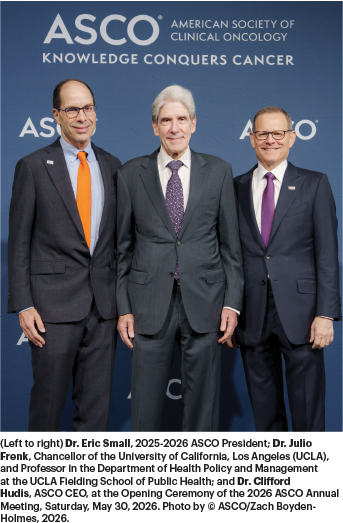
Across the meeting, we’ve asked discussants to contextualize the science, and if appropriate, to consider how clinical implementation might look in resource-constrained environments. Our goal is to ensure you leave Chicago not only with new data, but also with resources to translate breakthrough science into the reality of your practice, your community, and your region, whether you work in Valparaiso, Indiana, or Valparaíso, Chile.
The journey that Amy and I took convinced me, more than ever, that what matters to patients matters most. For example, we do a disservice to our patients when we casually report that the toxicity observed on a clinical trial was ‘acceptable.’ Toxicity is acceptable only if it’s acceptable to the patient. This experience has challenged me to rethink how we define success of a cancer trial.
I look forward to a session on Sunday, where panelists from Common Sense Oncology will talk about
delivering outcomes that matter to patients. In fact, throughout this meeting, we have asked discussants to frame the results of pivotal trials in this context.
But no matter how we frame oncologic success, we must acknowledge the reality that far too often, we are not curing cancer. Even after almost 30 years as an oncologist, I was not prepared for Amy’s death and the grief that followed.
To be frank, for us as clinicians, after a patient’s death, an ongoing relationship with our patient’s loved ones is rare. But for our patient’s loved ones, it’s just the beginning of an inconceivably painful, and often lonely, grief journey which is poorly understood, and for which we provide precious little support and guidance. Until you have experienced the pain of loss, you can’t understand what our patients’ loved ones go through.
Because grief doesn’t end with time. There is no closure. The pain of loss lives on indefinitely, because love doesn’t end with death. I will always grieve Amy because I will always love her.
As cancer care providers, we need to better understand grief and incorporate this into our practices. To that end, I am so grateful that we have the privilege of hearing from David Kessler, one of the world’s leading experts on grief and loss, in this Opening Session. David’s work has helped me to channel Amy’s kindness and humility, her joy, her spirit—to keep fighting, for my patients, for oncology, for science, for the future.
Translating Innovation Into Approaches Relevant to Different Environments
The third type of translation may be the most important: translating innovation into approaches relevant to different environments. In order to deliver optimal outcomes for every patient, everywhere, we must account for cultural, geographic, social, technological, and economic differences and disparities. Because quality cancer care is a basic human right no matter where patients live.
It can be as simple as translating language. This year, for the first time, simultaneous translation is available in six languages for this Opening Session and for the Plenary Session. We also have people speaking in their native languages in the wonderful ASCO Global Voices session.
Beyond language, our Educational Program Committee, under Dr. Ruiz-Garcia’s leadership, has developed a rich program reflecting the diversity of our global membership and the different needs of resource-constrained communities. We’ll hear from the Lancet Oncology Commission on the global oncology workforce crisis, and from JCO Global Oncology about new, cost-effective approaches to cancer care, like metronomic chemotherapy dosing, low-dose immunotherapy, and risk-stratification tools that identify patients unlikely to benefit from therapies.
These sessions highlight the two-way nature of translation. In the past, science has often been developed in the Global North and sent across the globe—where it hasn’t always translated. Innovative, accessible, cost-effective approaches are being pioneered in places like India, Egypt, and Mexico that are highly relevant to resource-constrained environments right here in the U.S. And, as we study more diverse populations globally, we can apply those learnings to diverse and immigrant domestic populations as well.
This is critical. By 2050, cancer cases and deaths are projected to nearly triple in resource-constrained countries. It’s the next impending global health catastrophe. One important way to address this crisis is by increasing our efforts in prevention and early detection.
In this regard, I am so pleased that ASCO has developed a Memorandum of Understanding with ASPO, the American Society of Preventive Oncology. We have developed an ASCO/ASPO Joint Session at this meeting, as well as a number of Education Sessions focused on cancer prevention and control.
Last, in response to requests from ASCO members from around the world, the ASCO International Affairs Committee, and our global Regional Councils, I am pleased to announce a new ASCO initiative.
You may be familiar with the wonderful ASCO Global Leadership Development Program and International Clinical Research Scholars Program, which provide leadership and research training to talented individuals around the world. To scale these programs in order to build capacity and help train the tens of thousands of people needed, ASCO is developing a global curriculum for cancer clinical research, composed of modular units that can be selected and adapted to any region or country. Initial topics include designing research projects, implementation science, and generating real-world evidence, with many more to come. I’m proud of this initiative, and the potential it holds.
All of these efforts, whether at the Annual Meeting or reflecting ASCO’s activities year-round, are about one thing: Ensuring that knowledge is not just created, but that it’s also translated for the benefit of patients, everywhere.
This is our charge, as ASCO and as individuals who provide care for patients with cancer, because all of us practice in a global environment, and all of us have patients who are resource-constrained.
I think often about Amy, and about what worked—and what didn’t. About how much of the gap was not in discovery, but in translation.
Translation is not simply a scientific process. It is a responsibility. A responsibility to ensure that we develop treatments that are meaningful to patients, and that are available to all patients. A responsibility to ensure that innovation becomes access, that progress becomes universal, and that no patient—anywhere—is left behind.
Because knowledge can conquer cancer. Every patient, every cancer, everywhere. Cada paciente, cada cáncer, en todas partes.
That is our mandate, and our call to action. Because we are ASCO, and that is what ASCO does. This year’s meeting provides unprecedented possibility for exactly this kind of translation.”
DISCLOSURE: Dr. Small owns stock in Fortis and Teon Therapeutics.
Dr. Small is the 2025-2026 President of ASCO, and Co-Leader of the University of California, San Francisco (UCSF) Prostate Cancer Program and Deputy Director and Chief Scientific Officer at the UCSF Helen Diller Family Comprehensive Cancer Center.
