
In patients newly diagnosed with high-risk large B-cell lymphoma, the addition of the CD19 monoclonal antibody tafasitamab plus the immunomodulatory drug lenalidomide (Tafa/Len) to standard therapy led to a 25% reduction in the risk of death or progression in the phase III frontMIND trial. Importantly, the experimental regimen provided benefit regardless of molecular cell-of-origin subtype, researchers reported at the 2026 ASCO Annual Meeting.1 The study was simultaneously published in The Lancet. 2
“Point estimates suggested the progression-free survival advantage with Tafa/Len/R-CHOP was broadly consistent across key prespecified subgroups, including both cell-of-origin molecular subtypes,” said lead investigator Georg Lenz, MD, of University Hospital Münster in Germany. “The results support the use of Tafa/Len/R-CHOP as a potential new standard first-line treatment option for patients with high-risk diffuse large B-cell lymphoma (DLBCL) or high-grade B-cell lymphoma, regardless of cell of origin.”

Georg Lenz, MD
The trial compared progression-free survival with tafasitamab, an anti-CD19 monoclonal antibody, plus lenalidomide and rituximab/cyclophosphamide/doxorubicin/vincristine/ prednisone (R-CHOP) vs R-CHOP alone in 899 previously untreated patients. Tafasitamab plus lenalidomide previously demonstrated safety and efficacy in the phase Ib First-MIND study in newly diagnosed DLBCL.2
As Dr. Lenz noted, approximately 40% of patients with DLBCL are not cured with standard first-line R-CHOP immunochemotherapy, representing a persistent unmet need.The current frontMIND trial was designed to definitively evaluate the triplet strategy as a first-line treatment in high-risk aggressive B-cell lymphomas.
While lenalidomide has “moderate activity” in DLBLC, he said, the combination of lenalidomide plus tafasitamab is synergistic and has been shown preclinically and clinically to kill malignant B cells. Tafasitamab plus lenalidomide is currently approved in the relapsed/refractory setting.
Key Findings in frontMIND
The phase III frontMIND study included 899 adults with newly diagnosed, high-intermediate or high-risk DLBCL or high-grade B-cell lymphoma, defined by an International Prognostic Index (IPI) score of 3–5 or age-adjusted IPI of 2–3 for those ≤ 60 years. Patients were randomized 1:1 to Tafa/Len-/R-CHOP or R-CHOP alone. The primary endpoint was investigator-assessed progression-free survival.
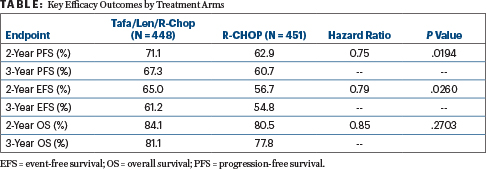
The study met its primary endpoint. At a median follow-up of 35.2 months, in the overall population patients treated with Tafa/Len/R-CHOP achieved a statistically significant improvement in progression-free survival over R-CHOP (hazard ratio [HR] 0.75; P = .019). The 24-month progression-free survival rate was 71.1% with Tafa/Len/R-CHOP vs 62.9% with R-CHOP, an absolute difference of 8.2%. At 36 months, rates were 67.3% vs 60.7%, respectively, a 6.6% difference, Dr. Lenz reported, noting that the median progression-free survival has not been reached.
Among the 773 patients with centrally confirmed lymphoma subtypes, the benefit was more pronounced: the 24-month progression-free survival rates were 72.7% vs 62.2%—a difference of 10.5% (HR, 0.68; 95% confidence interval [CI], 0.52-0.88), the analysis showed.
KEY POINTS
- The phase III frontMIND trial evaluated the CD19 monoclonal antibody tafasitamab plus lenalidomide and R-CHOP vs R-CHOP alone in newly diagnosed high-risk DLBCL and high-grade B-cell lymphoma patients.
- As compared to R-CHOP alone, the novel regimen significantly reduced the risk of progression or death by 25%.
- A benefit was observed in both molecular subtypes.
Importantly, a trend for benefit was observed for Tafa/Len/R-CHOP in both molecular cell-of-origin subtypes, with hazard ratios of 0.59 (95% CI, 0.36-0.95) for the activated B-cell–like (ABC) subtype and 0.69 (95% CI, 0.40-1.19) for the germinal center B-cell–like (GCB) subtype, he reported.
Tafa/Len/R-CHOP also produced a statistically significant improvement in event-free survival (HR 0.79; P = .0260) and a numerical benefit for overall survival (Table). The final overall survival analysis is planned at 5 years. “After 3 years, we see a 4% difference in overall survival. We never know how these curves will develop, but I am a little hopeful,” Dr. Lenz commented at a press briefing.
Overall and complete response rates did not significantly differ between the arms.
Safety
Any-grade treatment-emergent adverse events were comparable between the two study arms—98.6% with Tafa/Len/R-CHOP vs 97.1% with R-CHOP—but grade ≥ 3 toxicities were more frequent with the experimental regimen—86.7% vs. 76.1%. The most common adverse events were cytopenias and infections.
Discontinuations due to treatment-emergent adverse events were observed in 5.2% and 5.4%, respectively. Overall there were fewer deaths with Tafa/Len/R-CHOP (18.5% vs 21.7%), suggesting the increase in treatment-related toxicity did not translate into excess mortality, he said.
“Importantly, the addition of Tafa/Len did not affect the delivery of R-CHOP,” he added. “The median relative dose intensities were high and the same in both treatment groups across six cycles for each R-CHOP component.”
The data will be used to seek regulatory approval of tafasitamab and lenalidomide with R-CHOP as a first-line treatment for newly diagnosed DLBCL and high-grade B-cell lymphoma. At the press briefing, Dr. Lenz acknowledged that the therapeutic pipeline for DLBCL is rapidly changing and tafasitamab’s exact place in the treatment landscape is unclear. “I would say, at least at this stage, the results of frontMIND are very promising,” he said. “I believe the regimen will become approved in the first-line setting and I think it will be used.”
DISCLOSURE: Dr. Lenz had personal financial disclosures for AbbVie, ADC Therapeutics, AstraZeneca, BeiGene/BeOne, Bristol-Myers Squibb, Exscientia, Genmab, Gilead, GlaxoSmithKline, Hexal, Immagene/Flindr, Incyte, Lilly, Miltenyl Biotec, MSD, Novartis, Pentixapharm, Pierra Fabre, Roche/Genetech, and Sobi.
REFERENCES
1. Lenz G, Tvedskov TF, Ryden L, et al: FrontMIND: Phase III study of tafasitamabplus lenalidomide and R-CHOP for patients with newly diagnosed diffuse large B-cell lymphoma. 2026 ASCO Annual Meeting. Abstract LBA7000. Presented May 30, 2026.
2. Lenz G, Tvedskov TF, Burke JM, et al. Tafasitamab plus lenalidomide and R-CHOP versus R-CHOP for first-line treatment of patients with high-risk diffuse large B-cell lymphoma (frontMIND): a global, phase 3, randomized, double-blind, placebo-controlled trial. Lancet. Published online first. May 30, 2026.
3. Belada D, Kopeckova K, Burgues JMB, et al: Safety and efficacy of tafasitamab with or without lenalidomide added to first-line R-CHOP for DLBCL: The phase 1b First-MIND study. Blood 142:1348–1358, 2023.
EXPERT POINT OF VIEW
“For more than two decades, R-CHOP has been the global standard of care for newly diagnosed patients with DLBCL, leading to cure in about 60% of them. Unfortunately, it has been difficult to advance on that paradigm. The frontLINE trial1 represents only the second phase III study to meet its primary endpoint in the past 2 decades,” said ASCO lymphoma expert Krish Patel, MD, Executive Director of Hematologic Cancer Research at Sarah Cannon Research Institute, Nashville, who commented on the frontMIND findings at a press briefing.

Krish Patel, MD
Dr. Patel was referring to the POLARIX study, in which polatuzumab vedotin plus rituximab/ cyclophosphamide/doxorubicin/ prednisone (Pola-R-CHP) showed a significant progression-free survival benefit vs R-CHOP in patients with previously untreated intermediate- or high-risk DLBCL (HR, 0.73; P < .02).2 Exploratory analyses revealed a benefit in patients with the ABC subtype but not the GCB subtype.
Dr. Patel highlighted that difference. “Also of importance in frontMIND is the consistency of the primary endpoint across the molecular subgroups, which was not found in POLARIX,” he said. “It is also encouraging to see, in frontMIND, that the delivery of the curative therapy R-CHOP was not compromised by the addition of two new agents.”
The study’s findings have implications for prognosis, he concluded. “The study tells us that adding a CD19-targeting therapy in the front line can lead to an improvement in meaningful clinical efficacy outcomes for our patients…The improvement we see in progression-free survival is expected to lead to an improvement in curative outcomes for these patients.”
DISCLOSURE: Dr. Patel had personal financial disclosures for ADC Therapeutics, Pfizer, Sana Biotechnology, Kite and Bristol Myers Squibb.
REFERENCES
1. Lenz G, et al: FrontMIND: Phase III study of tafasitamab plus lenalidomide and R-CHOP for patients with newly diagnosed diffuse large B-cell lymphoma. 2026 ASCO Annual Meeting. Abstract LBA7000. Presented May 30, 2026.
2. Tilly H, et al: Polatuzumab vedotin in previously untreated diffuse large B-cell lymphoma. N Engl J Med 386:351–363, 2022.
