

Ajay Prakash, MD, PhD

Emil Lou, MD, PhD, FACP, FASCO
Wolpin and colleagues have demonstrated in the global randomized Phase III RASolute 302 trial that daraxonrasib, an oral RAS(ON) inhibitor, nearly doubles median overall survival in previously treated metastatic pancreatic ductal adenocarcinoma, producing a median overall survival of 13.2 months vs 6.7 months with investigator-choice chemotherapy (hazard ratio [HR] = 0.40; P = 4.6 x 10⁻¹¹).1 They found an even greater impact in objective response rate with 33.2% for daraxonrasib vs 11.8% for chemotherapy, with overall parity in treatment tolerance. Grade 3 adverse events were noted in 61.8% of patients on daraxonrasib and 69.6% of patients on chemotherapy, with the most common adverse events being rash and diarrhea. These results, presented in the plenary session at the 2026 ASCO Annual Meeting, published concurrently in The New England Journal of Medicine, and reported in this issue of The ASCO Post, represent the most significant advance in systemic therapy for this disease in more than a decade and establish pan-RAS inhibition as a viable therapeutic strategy in a tumor type where KRAS mutations are nearly universal.
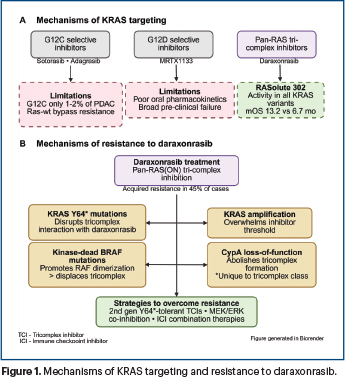
While this study is a critical first step in catalyzing the field of novel therapeutics in pancreatic adenocarcinoma, the ultimate goals of treatment to remission and cure remain open. To understand what this trial accomplishes and what it leaves unresolved, it is necessary to examine why earlier KRAS-targeting strategies fell short, what mechanistic innovation daraxonrasib embodies, and where the field must now direct its attention. Der and Yeh have elegantly described the scientific foundations of RAS targeting and the mechanistic rationale for daraxonrasib in the context of the Phase I/II data.2,3 The present commentary addresses the confirmatory Phase III survival benefit, the emerging landscape of resistance, and the path toward rational combinations (Figure 1).
The Long Road To KRAS
Since the late 20th century, we have known KRAS is the most frequently mutated driver oncogene in human cancer, and for much of that time it was considered ‘undruggable.’ The RAS GTPase fold offers no obvious allosteric pockets, binds guanosine nucleotides with picomolar affinity, and achieves its oncogenic effect through pathologic maintenance of the GTP-bound active state. In this pathophysiologic setting, competitive inhibition of nucleotide binding was never feasible.4
The first tractable approach exploited a unique feature of the KRAS G12C variant: a cysteine residue amenable to covalent modification, and the mutant protein retains sufficient GTPase activity to cycle through the GDP-bound inactive state.5,6The KRAS inhibitors sotorasib and adagrasib trapped KRAS G12C in this OFF state, and their approvals in KRAS G12C-mutant non–small cell lung cancer were genuine milestones. In pancreatic ductal adenocarcinoma, however, G12C accounts for only 1% to 2% of cases, limiting the clinical impact of these agents. Even within that small fraction, responses were modest, with median progression-free survival rates of approximately 4 to 5 months, owing to dense desmoplastic stroma, co-occurring resistance alterations, and rapid MAPK pathway reactivation through wild-type RAS isoforms. An inhibitor blind to wild-type RAS cannot prevent this bypass, and mutation-specific inhibition addresses only one arm of a multi-armed signaling network.
Efforts toward G12D-selective inhibitors, including MRTX1133 and zoldonrasib (RMC-9805), confronted an analogous population constraint.7,8 Targeting the dominant pancreatic ductal adenocarcinoma KRAS allele, present in approximately 40% of cases, still excludes the majority of patients harboring non-G12D KRAS variants. What was needed was a strategy capable of engaging KRAS across its full oncogenic spectrum, including in the GTP-bound active state that all prior inhibitors could not touch.
PAN-RAS Inhibition and the Tricomplex Strategy
Daraxonrasib achieves what prior KRAS inhibitors could not through a molecular glue mechanism.9 Rather than binding directly to RAS, it first engages the intracellular chaperone cyclophilin A to form a binary complex, which then binds the active GTP-bound form of RAS across the switch I and switch II interface, sterically occluding downstream effector proteins including RAF and PI3K.10The result is oncogenic signal blockade regardless of which RAS mutation is present, spanning G12D, G12V, G12R, G12C, G13D, Q61 variants, and wild-type isoforms. The allelic heterogeneity of KRAS in pancreatic ductal adenocarcinoma, previously an insurmountable obstacle for targeted therapy, becomes clinically irrelevant. This approach yielded the landmark findings of RASolute 302, demonstrating a near-doubling of overall survival in previously treated KRAS-mutant pancreatic cancer.
The Enduring Problem of Resistance
RASolute 302 establishes a new standard for second-line pancreatic ductal adenocarcinoma, but resistance to daraxonrasib is already characterized and will define the next research agenda.11Analysis of paired specimens from 40 patients treated with daraxonrasib identified acquired resistance alterations in 45% of cases. The most recurrent mechanism involved secondary KRAS Y64 missense substitutions that disrupt tricomplex formation. Kinase-dead BRAF mutations emerged in a subset of cases, promoting RAF dimerization that is harder to displace from active RAS than the monomeric form. KRAS amplification, MAP2K1/2 mutations, and loss-of-function alterations in cyclophilin A itself were also identified, the last representing a resistance mechanism unique to the tricomplex class.
The Future of RAS Inhibition
Other groups are looking past this tricomplex modality to address persistent therapeutic gaps. The novel molecules BI-2493 and BI-2865 may improve tolerability of KRAS inhibition through a mechanistically distinct approach.12 These noncovalent pan-KRAS inhibitors target the inactive GDP-bound state while sparing wild-type NRAS and HRAS, potentially reducing on-target effects in normal tissues. Preclinical data across this class also demonstrate that RAS signal suppression remodels the tumor immune microenvironment, reducing immunosuppressive myeloid populations and augmenting CD8+ T cell infiltration.13 These preliminary data establish a biological rationale for checkpoint inhibition combination therapy that is now entering clinical evaluation.14
Conclusion
The Phase III RASolute 302 study will now fundamentally transform the treatment landscape in pancreatic cancer. While many patients will benefit from the results of this study, further questions should be raised, especially regarding drug resistance and combination therapies. The path forward will require second-generation molecules designed against known resistance alleles, and finding the right combination strategies targeting MAPK reactivation and the immunosuppressive tumor microenvironment. The RASolute 302 data will also prompt prospective evaluation of daraxonrasib in the first-line and perioperative settings.
RASolute 302 establishes daraxonrasib as the new standard for previously treated metastatic pancreatic ductal adenocarcinoma and defines the research agenda for the next decade of RAS-directed therapy. However, the task before us remains the same: to find and cultivate further novel therapies that may one day cure pancreas cancer.
DISCLOSURE: The authors reported no conflicts of interest.
REFERENCES
1. O’Reilly EM, Wainberg, ZA, Hendifar AE, et al: Daraxonrasib or chemotherapy in previously treated metastatic pancreatic cancer. N Engl J Med doi:10.1056/NEJMoa2605555, Published online May 31, 2026..
2. Der CJ, Yeh JJ: Advances in RAS therapeutics for pancreatic cancer. N Engl J Med 394:1857-1861, 2026.
3. Wolpin BM, Park W, Garrido-Laguna I, et al: Daraxonrasib in previously treated advanced RAS-mutated pancreatic cancer. N Engl J Med 394:1790-1802, 2026.
4. Riedl JM, Matsubara H, McNeil R, et al: Emerging landscape of KRAS inhibitors in cancer treatment. Cancer Cell 44:471-497, 2026.
5. Bekaii-Saab TS, Yaeger R, Spira AI, et al: Adagrasib in advanced solid tumors harboring a KRASG12C mutation. J Clin Oncol 41:4097-4106, 2023.
6. Strickler JH, Satake H, George TJ, et al: Sotorasib in KRAS p.G12C–mutated advanced pancreatic cancer. N Engl J Med 388:33-43, 2023.
7. Hallin J, Bowcut V, Calinisan A, et al: Anti-tumor efficacy of a potent and selective non-covalent KRASG12D inhibitor. Nat Med 28:2171-2182, 2022.
8. Spira AI, Papadopoulos KP, Kim DW, et al: Preliminary safety, antitumor activity, and circulating tumor DNA (ctDNA) changes with RMC-9805, an oral, RAS(ON) G12D-selective tri-complex inhibitor in patients with KRAS G12D pancreatic ductal adenocarcinoma (PDAC) from a phase 1 study in advanced solid tumors. J Clin Oncol 43:724-724, 2025.
9. Jiang J, Jiang L, Maldonato BJ, et al: Translational and therapeutic evaluation of RAS-GTP inhibition by RMC-6236 in RAS-driven cancers. Cancer Discov 14:994-1017, 2024.
10. Ma Z, Zhou M, Shen Q, et al: RAS(ON) therapies on the horizon to address KRAS resistance: Highlight on a phase III clinical candidate daraxonrasib (RMC-6236). J Med Chem 68:12287-12292, 2025.
11. Sang B, Ye LF, Hu F, et al: Mechanisms of resistance to active state selective tri-complex RAS inhibitors [Internet]. Cancer Biology 2025. Available at http://biorxiv.org/lookup/doi/10.1101/2025.04.24.649345. Accessed May 11, 2026.
12. Tedeschi A, Schischlik F, Rocchetti F, et al: Pan-KRAS inhibitors BI-2493 and BI-2865 display potent antitumor activity in tumors with KRAS wild-type allele amplification. Mol Cancer Ther 24:550-562, 2025.
13. Orlen M, Vostrejs WP, Sor R, et al: T-cell dependency of tumor regressions and complete responses with RAS(ON) multi-selective inhibition in preclinical models of pancreatic ductal adenocarcinoma. Cancer Discov 15:1697-1716, 2025.
14. Wasko-Kornberg UN, Lee JY, Wei X, et al: Abstract A118: Daraxonrasib, a RAS(ON) multi-selective inhibitor, exhibits potent antitumor activity and combinatorial benefit with standard of care chemotherapy and with anti-PD-1 in preclinical models of KRAS G12R PDAC. Cancer Res 85:A118-A118, 2025.
Dr. Prakash is Assistant Professor of Medicine, and Dr. Lou is a Tenured Professor of Medicine, both at the University of Minnesota Masonic Cancer Center, in Minneapolis.
