
Guest Editor’s Note: In October, the Society for Integrative Oncology (SIO) held its annual international conference in Boston. The theme was “The Future of Integrative Oncology,” with presentations and workshops focused on evidence-based integrative therapies and innovative research methodologies. Participants from around the world enriched the discussions on best practices and innovation. In this article, Drs. Bao and Paller highlight the conference proceedings.
The SIO 22nd International Conference, held October 27–29 in Boston, was hosted by the Dana-Farber Cancer Institute’s Leonard P. Zakim Center for Integrative Therapies and Healthy Living. The event drew 440 in-person attendees from 25 countries, as well as 85 virtual participants, making it one of the most highly attended meetings in over a decade. Twenty-nine travel scholarships were awarded to students, trainees, and patient advocates. Sponsors included the Leonard P. Zakim Center for Integrative Therapies and Healthy Living at Dana-Farber, the Cherng Family Center for Integrative Oncology at City of Hope, the Dr. Rogers Prize, the Weil Foundation, Novartis, and Pfizer.
Ting Bao, MD, MS, FSIO
Channing Paller, MD
Eight preconference workshops attracted over 300 participants, providing a vibrant introduction to the expanding landscape of integrative oncology. Sessions ranged from foundational principles to specialized modalities that enhance patient-centered care. The workshop “Paving the way to Integrative Oncology” explored strategies for integrating evidence-based approaches into clinical practice, while “Elevating Person-Centered Oncology Care Through Interdisciplinary Collaboration” highlighted the growing role of music therapy in supporting emotional and spiritual well-being. Neurosomatic and noetic medicine as pathways to holistic healing were examined in the workshop “Practicing the New Healthcare Intelligence in Oncology.” Global traditions were represented through workshops on Korean medicine, Ayurveda, and culinary medicine, emphasizing cross-cultural approaches to symptom relief and wellness. Skill-based workshops in oncology acupuncture and massage therapy offered practical, safety-focused training, while the workshop “Synergy in Cancer Care” provided strategies for assessing the use of dietary supplements. Together, these workshops underscored the field’s commitment to combining science, compassion, and collaboration in cancer care.
The four keynote presentations highlighted the evolving frontiers of integrative oncology. Helene Langevin, MD, discussed the role of expressive arts in cancer care, illustrating how creative expression supports healing and quality of life. Research on mindfulness was presented by Judson Brewer, MD, PhD, demonstrating how these practices can rewire anxiety pathways in the brain and promote emotional freedom. Hal Gunn, MD, explored artificial intelligence (AI) in medicine, advocating for applications that enhance holistic, patient-centered care rather than reductionist approaches. The series concluded with a presentation by Christina Dieli-Conwright, PhD, MPH, FACSM, CSCS, emphasizing the importance of diversity and inclusion in clinical trials and offering actionable strategies to ensure that research represents diverse populations.
Five plenary sessions showcased innovation and collaboration across multiple therapeutic domains. The session “Music as Medicine” highlighted the healing power of music in oncology and palliative care, with presentations on symptom management and live performance. There were no dry eyes in the audience at the end of the session, making it the most memorable session at the SIO 2025 conference. Findings from the MATCH trial, comparing mindfulness-based interventions with tai chi and qigong for reducing psychological distress and fear of recurrence, were presented during the session “Mindfulness and Mindful Movement for Cancer.” The session “Dietary Supplements and Herbal Medicine for Cancer” provided evidence-based insights into integrating traditional Chinese medicine and common supplements while balancing benefits and safety. The Consortium, Multinational Association of Supportive Care in Cancer (MASCC), and SIO joined forces to bring leaders together and discuss strategies for incorporating integrative medicine into standard oncology care. The final plenary, “Psychedelic Research in Cancer Care,” explored emerging evidence on psychedelic-assisted therapies for managing existential distress, anxiety, and depression in people living with cancer.
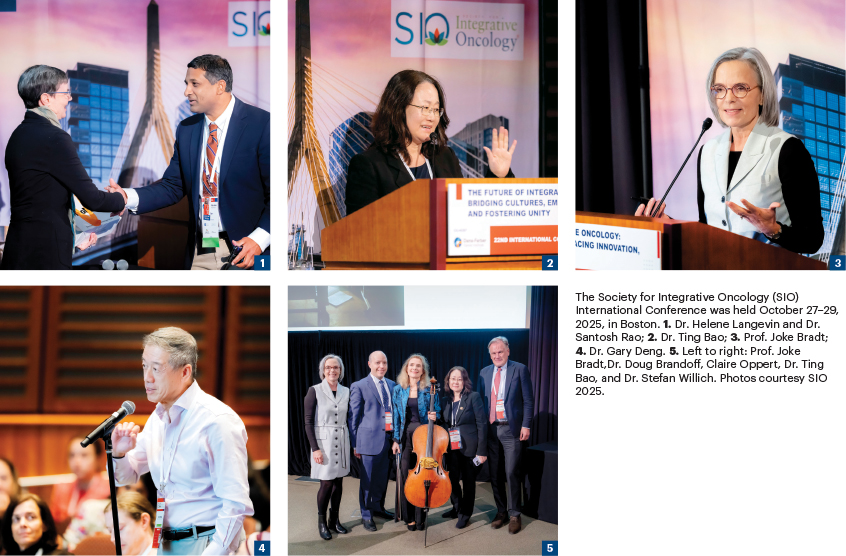
Special sessions and events celebrated the global reach and collaborative spirit of the integrative oncology community. During “The Global Committee Session: Global Implementation of Integrative Oncology,” experts from Israel, South Korea, Australia, Italy, Brazil, China, India, and Cyprus shared international perspectives on the evolution, current practices, and future directions of integrative oncology. The “Best of SIO” session highlighted compelling research, including the NOCTURNAL trial of acupuncture for prostate cancer survivors, a yoga study for patients and caregivers during radiotherapy, updates to the 2025 joint SIO and ASCO Clinical Practice Guideline, and the AcuOva study of mobile self-acupressure for cancer fatigue. The session on integrative medicine highlights from the past year provided an overview of recent advancements, with presentations on the BWEL trial, the role of integrative medicine in addressing treatment disparities, developments in immuno-oncology, and the patient’s perspective.
Four sets of four concurrent sessions provided diverse learning across research, clinical practice, and global collaboration. Topics included healthcare utilization, traditional Chinese medicine research, AI and energy modalities, lifestyle interventions, mindfulness, traditional dance, herbal and supplement use, implementation science, equity, music therapy, massage, lifestyle medicine integration, training for providers managing diabetes during chemotherapy, and bench and preclinical research. The poster session offered a lively and interactive environment, with food, beverages, and the “Lucky Poster-Viewer Award” game. Attendees engaged with presenters using “Poster Passports” to collect stickers and signatures for prize drawings, fostering dialogue and community building.
A highlight of the conference was the elegant gala at Boston’s Museum of Fine Arts. Approximately 180 guests enjoyed a cocktail hour and private museum exploration, followed by a plated dinner in the stunning surroundings.
Guest Editor
Jun J. Mao, MD, MSCE
Dr. Mao is the Laurance S. Rockefeller Chair in Integrative Medicine and Chief of Integrative Medicine Service at Memorial Sloan Kettering Cancer Center, New York.
The SIO 22nd International Conference marked a significant milestone in the growth of integrative oncology, advancing science, fostering collaboration, and promoting compassionate care. The presentations strengthened the evidence base for integrative interventions, while global participation enriched discussions on best practices and innovation. Sessions on health equity emphasized access and representation, and emerging topics such as psychedelic-assisted therapy and AI demonstrated the field’s embrace of both ancient wisdom and modern technology. Networking events, workshops, and social gatherings deepened professional relationships and fostered interdisciplinary growth, while the updated joint SIO and ASCO Clinical Practice Guideline ensured clinicians had access to the latest evidence-based recommendations.
Looking ahead, SIO will convene its 2026 International Conference in Detroit, under the leadership of Suzanna Zick, a naturopathic doctor (ND), MPH, and Eleanor Walker, MD. Building on the momentum from Boston, the conference will continue to advance the translation of research into clinical practice and address barriers to equitable care. The success of SIO 2025 reaffirmed that integrative oncology is a dynamic, global, and patient-centered discipline—uniting science, culture, and compassion to improve the lives of people affected by cancer worldwide.
DISCLOSURE: Drs. Bao and Paller reported no conflicts of interest.
Dr. Bao is Co-Director, Leonard P. Zakim Center for Integrative Therapies and Healthy Living, and Associate Professor, Harvard Medical School, Dana-Farber Cancer Institute, Boston, and the 2025 SIO Conference Co-Chair. Dr. Paller is Professor, Department of Oncology, Associate Director of Oncology, Johns Hopkins Clinical Research Network, Sidney Kimmel Comprehensive Cancer Center, Johns Hopkins University, Baltimore, Vice President of Advancement, SIO, and the 2025 SIO Conference Co-Chair.
