
On October 30, 2025, Google Cloud held its second annual Cancer AI Symposium to explore how artificial intelligence (AI) is advancing cancer research, diagnosis, and treatment, in unparalleled ways. Held at Google’s St. John’s Terminal office in New York City, the event brought together leaders in the fields of health care, technology, and public policy to examine the transformative potential of AI in revolutionizing cancer care.
Chris Sakalosky

Clifford A. Hudis, MD, FACP, FASCO

Francis deSouza
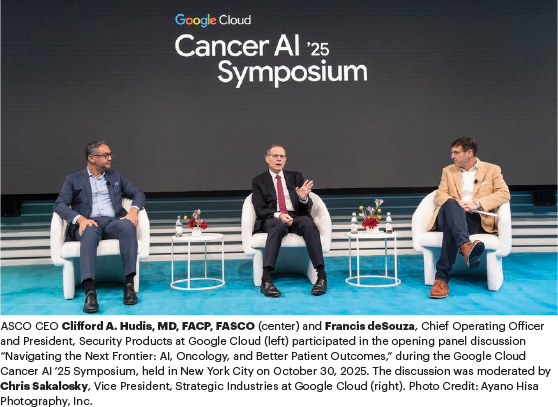
The opening panel discussion “Navigating the Next Frontier: AI, Oncology, and Better Patient Outcomes,” was moderated by Chris Sakalosky, Vice President, Strategic Industries at Google Cloud, and featured Clifford A. Hudis, MD, FACP, FASCO, ASCO’s Chief Executive Officer and Executive Vice Chair of its foundation Conquer Cancer, and Francis deSouza, Chief Operating Officer and President, Security Products at Google Cloud.
Below are excerpts from their conversation, which have been edited for length and clarity.
Chris Sakalosky: We’re going to jump right in. Dr. Hudis, I’ll start with you. Your work over the past 30 years at ASCO has truly raised the global standard for breast cancer treatment. Can you share how AI is being used to support cancer research specifically and some of the real-world examples that you see out there today?
Trustworthy Information and the Adoption of AI
Clifford A. Hudis, MD, FACP, FASCO: Thanks very much. Just for introduction, ASCO has about 51,000 oncology community members around the world, both domestic and international, and in all disciplines. So, we think broadly about the full range of research opportunities that this diverse group of both clinicians and translational investigators pursue. And I don’t think there’s a simple, single answer.
For us at ASCO, it’s about making sure that clinicians have access to the latest, most accurate, up-to-date, trustworthy information possible. And, of course, that’s where our collaboration with Google Cloud has been so important, because it’s allowed us to organize and efficiently share trustworthy information that investigators can use when they are planning their next experiment, or clinicians can use when they’re planning treatment.
Mr. Sakalosky: Excellent. Francis, same question for you. Where are you seeing the real-world impact today of AI and cancer research?
Francis deSouza: Sure. Thanks, Chris. The mission around the work we do to try and advance health care and specifically treatment of cancer is important to all of us and certainly one that personally resonates with me. What’s interesting to see is that at Google Cloud, obviously, we provide a lot of infrastructure and AI tools across industries, but what’s fascinating to see this time with AI is that health care specifically is one of the industries that’s driving the adoption of AI. Typically, health care is one of the industries that takes a little bit longer to adopt new technologies, but this time it’s very different.
I was looking at a study recently that said that health-care AI spending this year is projected to be about $1.4 billion, triple that of last year, and AI is being adopted in health care at a pace about 2.2 times faster than other industry averages. And that’s fascinating to see because again, typically, those are not stats we see in terms of technology adoption in this space.
But as we dig deeper, what we’re seeing is that the health-care industry is absorbing AI partly to deal with the volumes of data that they’ve amassed over the last few years. So, when we survey health-care customers and life sciences customers, one of the biggest areas of adoption, and there are a bunch of areas that AI is being adopted, but one of the biggest is in R&D.
And, so, nearly two-thirds of the respondents of the survey I looked at said that they were looking to adopt and were already adopting AI in a lot of cases for R&D. And so what customers and organizations are doing is saying, “Look, we’ve amassed a lot of health-care data, imaging data, genomic data, [and other] data, and now we need to make sense of all of this. And we’re in this good place where we have longitudinal data, too.” And they’re looking for tools in the AI family to try and parse this. And so we’ve seen a lot of interest in the tools that we have developed with partners even in the last year.
You heard a little bit this morning about the Cell2Sentence work that we’ve done, which is a $27 billion parameter foundational model that we developed with Yale. And what we’ve already been able to see with that model is a model’s predicted novel and now experimentally verified behavior for cancer cellular behavior development, and that sort of hints at potential pathways for new drug development.
We’ve also seen a lot of interest in the deep somatic model that we’ve put out, which is a convolutional neural network model that focuses on pediatric leukemia. And so we’re seeing a lot of interest in absorbing these AI models to make sense of all these data. And we’ve had a number of good examples of customers that have talked publicly about the work that they’re doing. So, Baxter, for example, talked about the work they’re doing to develop a platform for radiology, and that platform is intended to help accelerate applications that use AI in that field.
Pfizer is looking to use AI to understand the behavior and the function of amino acids and the impact of protein folding on potential drug targets. And then, obviously, Recursion is building an AI platform for their drug development. And so I think that’s a big driver, which is we’ve got lots of data now and complex data, and AI is one of the tools that can help unravel those data and understand complex messy biology and point to potential targets of drugs.
AI From Bench to Bedside
Mr. Sakalosky: What you’re talking about is how AI really impacts the workbench. When you think about the researchers and the clinicians that are on that side of it, and really what we see as we talk about this often is that AI is having an impact not only in the research and development side, but also at the bedside.
I’ll shift this to Dr. Hudis. We recently collaborated on the ASCO Guidelines Assistant, and just got a lot of great buzz. I’d love to hear your thoughts on where that’s driving real impact at the bedside and how it’s improving the workflow for the clinician.
Dr. Hudis: The pace of development in oncology, you just hinted at it, is unprecedented. And I’ll just remind everybody that we’re already on a successful trajectory, albeit not fast enough. Peak mortality for cancer in the United States was around 1990, and it’s been falling steadily sincebecause of multifactorial advances.
This is in part due to the tremendous expansion in the number of treatment options and opportunities to improve outcomes for patients based on technology, and new, better therapies, more precisely targeted to smaller and smaller subsets of patients.
The way that clinicians and investigators keep the advancement going and help ensure that every patient they see on a given day is getting the most up-to-date care is through guidelines in most cases. We, along with many others, produce guidelines, which are very conventional documents, 3,000 to 5,000 words, often in a PDF format. So, imagine you’re a busy clinician. You’re not at a tertiary cancer center, you’re not a one-disease doctor, but you’re actually seeing a range of cancers in the course of a morning or the afternoon. Think about the interruption to the very pressured workflow as you try to make sure that you are recommending and administering the right therapy to each patient. You might see a patient with lymphoma at 9:00, another with colon cancer at 9:20, and still a third patient with lung cancer at 9:40, and so forth. It’s a pretty daunting, if not humbling task.
So, for generations, our approach was to write these guidelines and push them out there. Clinicians would find them online, pull down the PDF, and search for the situation they’re dealing with that day.
We decided to look at our guidelines program and create a new way to approach them. The revolution that Google Cloud is driving with AI unveiled the solution: Gemini. And we asked ourselves, could we use Gemini to put our guidelines in a walled garden, so that they would be the only source of truth and allow our audience, our members, and others to write natural language queries, dictate them, and get immediately to the information they need? And the team at Google Cloud helped us to do exactly that.
Now, you said something earlier that I think is fascinating. The pace of uptake of these tools in health care is outpacing both historical standards and the rest of the economy. That’s fascinating because our community starts with trust. We can’t write a prescription for a toxic drug. We can’t treat a patient with an intervention that could cause harm without a high degree of confidence that it’s the right thing to do. So, building that trust has been a significant part of this effort.
And the solution we created allows clinicians to see the cited source material in our AI tool, and that builds trust. I think that’s going to be a foundation for even faster adoption in the future. That’s the real point here. So, I see this as a bridging technology, helping our community get used to these tools, starting to trust them, and I think you’re going to see accelerated adoption.
The Business of AI in Health Care
Mr. Sakalosky: Absolutely exciting. Francis, we’ve talked about the bench, the workbench and how these AI tools are impacting [research]. We’ve talked about the bedside, but there’s this business of oncological research. What have you seen [with] AI? How is it impacting things from the administrative facts? How are we moving friction with AI? What’s your point of view?
Mr. deSouza: It’s a great point because in talking to health-care organizations, care delivery organizations, the reality is it feels like there’s almost no part of the organization that’s not going to be touched by AI. And so the leaders of these organizations are pushing for the impact of AI we see in a number of areas.
One area, for example, is helping how they interact with patients to streamline the delivery and availability of health care between visits. So for example, you touched on earlier today, the work they’re doing at [Google Cloud], where what they’re doing is looking to leverage AI, and they’ve created an AI agent that streamlines the process of getting women access to breast cancer screening. So eligibility criteria, outreach, helping them sign up to the right screening that’s appropriate for them, that’s near them, that’s available for them.
Another area would be matching patients with clinical trials. The good news is there are a lot of trials going on with novel therapies, as you talked about. We’re probably in this great area where we’re seeing a lot of innovation in the therapeutics that are becoming available, but it is a challenge to wade through all the criteria for selection and match a patient to the right clinical trial. And so there are organizations like Castor [AI] that are really using AI to accelerate, streamline that process. They talk about the idea of a self-driving clinical trial, and the idea is to, again, get the right patient into the right trial for them.
Another whole area that we’re seeing people leverage AI to get benefit from is to increase the amount of time that a health-care provider has with patients. There are surveys that show that a care physician can spend up to 28 hours a week on administrative tasks. And so there’s a lot of work going on, so can we use AI to reduce that work and automate a lot of tasks. And so if you look at companies like IPS Health [and Wellness], for example, they’re using AI to push technology that allows you to streamline a lot of administrative work that a physician would have to do. Things like ambient documentation. So listening and help create a draft of the documentation that a physician would primarily have to do. But even really pushing on the claim submission process, so charting, coding, claim submission, prior authorization, all of that. If you could take the burden away from the physicians and the nurses and really have that done more quickly. And by the way, accelerate the process, reduce errors in the process. And so another whole area is around saying, can we take the administrative burden off the care delivery professionals and give them more time [with their] patients?
And then, frankly, looking at the entire backend operations of an organization and say, whether it’s supplier management, cash management, any process in the backend, can we leverage AI because the reality is really financially constrained environments, and it’d be better for an organization to move money from supporting backend operations to care and delivery. And so that’s another area we’re seeing people really push the use of AI in their organizations.
Mr. Sakalosky: Excellent. I’m going to keep this one with you, Francis. We’ve talked about the what, what impact can AI have in this sector, but combine your experience from your time as CEO of Illumina and what you’re seeing now in the whirlwind where we have you out meeting with health customers across the globe. And maybe talk about what you were seeing as some of the primary barriers to adoption of these AI technologies. What barriers do you see and what insights would you have for our audience members?
Mr. deSouza: I’d see maybe three main barriers. The first barrier is just the amount and the state of data in organizations, right? The reality is there is no AI strategy without a data strategy. And so organizations start by saying, “Well, shoot, we have a lot of data and it’s in silos and we’re not sure how clean it is.” And so do we have to first embark on this odyssey to clean our data and connect our data and migrate our data before we can embark on an AI strategy?
So, the reality is, you need a strategy that allows you to tap into that data source because data [are] what fuels the efficiency of AI, but be able to do it where it exists today without having to move it or copy it. And so we talk about a platform approach that allows you to do that.
So first is, people get overwhelmed with, good news is they have a lot of data, but they get overwhelmed with how do we start when we have this data across sites?
The second point, and Dr. Hudis touched on this, which is there is a trust point, which is, do you believe in the results that you’re getting out of your AI systems? How do you know that it’s verifiable? Can you audit how it got to the answers it did? Is it really using only your data and not data from anywhere else? And is it keeping your data safe? And can you do all that in a way that’s auditable and secure and compliant?
So, there’s a whole big area around making sure that the platform you choose for your AI infrastructure gives you all of that as table stakes. This is not something you want to retrofit later. And so that’s a conversation you have with your partner around AI, but it’s essential as we build the trust with the health-care providers and the patients that the results you’re getting are the right results. It can’t be right most of the time or nearly all the time. It has to be right all the time.
And then the third area I’d say is just making sure that the AI is integrated into the existing workflow in your organization. You can’t be now launching a whole set of new tools and need to retrain behaviors. So your success with AI is going to be related to how you embedded it into existing workflow. So again, things like ambient AI are great. It says it’s listening and doesn’t require you to do a whole lot more, but things that require you to go to an entirely new system, I think this is going to be a challenge.
Mr. Sakalosky: I’m going to stick with the theme of implementation, but I’m going to shift it from the breadcrumbs and the nuggets of how, into the ROI [return on investment]. Some of the hesitancy that we see is in the ROI. Now you both have, in your careers, have pushed the boundaries on the leading edge of what technology can provide, but in many cases, our audience members may be dealing with boards of directors or executive staff to say, “Hey, how are we going to measure the ROI of this as we embark on this? So maybe in terms of both ROI and patient outcomes, how are you seeing this, Dr. Hudis, from an ASCO lens and then your broad worldview?
Dr. Hudis: The ROI in the short term is about higher quality care being delivered more efficiently, more quickly to more patients. And I think that’s happening, although it’s very hard to measure.
In the last couple of weeks, I read one of these classic papers about the big spend on AI and it reported that the boards and CEOs aren’t seeing the ROI. And I’m old enough to remember a very similar article that was published when the PC was first launched onto the desktop, which brought great benefits, but there were similar articles about low ROI back then. So, we’re not really focused on short-term financial ROI.
[Ambient listening] is just the beginning of the automation steps that will ultimately allow [health-care professionals] to provide the kind of humanistic, compassionate care that I think is the ultimate driver of a career in medicine.— Clifford A. Hudis, MD, FACP, FASCO
Tweet this quote
Speaking about AI more broadly, in many cases, the ROI is so apparent that the embedding that you talked about is happening both seen and unseen at an unprecedented pace, and that’s because of the improvement in quality of care and outcomes.
Because of AI, I think that variations in standard of care will be much less tolerable. You will not be able to say that because you’re in a small town, you don’t have access to the latest and greatest information or interventions. And that’s another example of potential non-financial ROI. The ROI for us is about accelerating the pace of our work. And in the future, we hope to use AI to help keep our guidelines current. I couldn’t be more bullish than I am about this.
The AI Horizon
Mr. Sakalosky: Thank you. I can’t let either of you off the stage without a long-term vision question for both of you. So Francis, I’m going to start with you. Looking 5 to 10 years into the future, what’s the one area of cancer care that you believe AI will fundamentally transform?
Mr. deSouza: There are two areas I’m very excited about. One, is just the biological breakthroughs that we are going to see. Our understanding of biology will be significantly advanced by AI in terms of understanding diseases in a way that we never have. Whether it’s what cancer really is, how it evolves, neurological diseases, or the interplay between diseases today that we may not think are connected.
So, I’m super excited about just fundamental biological understanding of the mechanism of disease..
And then two, and this is going to sound sort of counterintuitive, but I believe that AI will help us advance human-powered health care even more in the sense that we will give our health-care providers the space, the time, and sort of the understanding to be able to continue to push the humanity in how we deliver health care, and that a lot of the pressures today that are on them because of the administrative burden and, so on, will be taken off. Those are the two [areas] I’m most excited about.
Mr. Sakalosky: Thank you for that. I think that’s super insightful for our folks because I think a lot of stuff’s coming right now, and we’re right on the cusp of it. I’m going to date myself. For those of you who are Star Trek fans, [it’s] the tricorder.
For me, colleagues and I met with colleagues of Dr. Hudis in Minneapolis, and we had an opportunity to talk about the confluence of these technologies, the work you did at Illumina, the work that’s happening at organizations like Tempest, the work that’s coming out of some of the key research organizations like Memorial Sloan Kettering [Cancer Center], and how they’re all converging into services and devices. For the first time ever, I can actually see the beginnings of what the tricorder is. Will it be there during our time during our lives? I’m not sure. But you can see how more of the expertise for people who’ve gone to school for say 13 plus years, plus fellowships, and everything else on top, you can see how more and more of that can be fused with artificial intelligence to assist the clinician in new meaningful ways.
Last forum and microphone to Dr. Hudis. What are we going to be celebrating if we’re really reading the headlines over the next 3 to 5 to 10 years?
Dr. Hudis: I think you touched on it. The technology is almost self-fueling because our thirst for knowledge and our drive to make advances is a powerful force. And I agree with you. We’re going to have amazing technology. We’re going to have amazing new tools, and work to develop them is underway. But what I’m most excited about is a return to humanity that AI is facilitating.
When I started in oncology, I went to clinic with a rack of paper charts and a pen and a nurse, and that was it. But in the last 25 years in clinical medicine, we’ve seen the imposition of lots of layers of technology and digital tools, which have done a lot of good, but, in my view, they have not necessarily made the clinical interaction between doctors and patients better in many cases. They can be a burden, as you described when you talked earlier about the administrative time commitment clinicians face.
But AI is changing that. We’ve talked a little bit about ambient listening. That’s just the beginning of the automation steps that will ultimately allow me, our members, our colleagues, to sit down, face a patient, not a keyboard, shake a hand, rest an arm on another, and provide the kind of humanistic, compassionate care that I think is the ultimate driver of a career in medicine. And that is, I think, really promising for the future because when we get sick, we want a caring doctor.
Mr. Sakalosky: Excellent. Thank you both for your time. I hope you all walked away with some great nuggets to take back to your organizations.
Disclosures: Dr. Hudis has no financial conflicts of interest to disclose. Mr. Sakalosky is Vice President, Strategic Industries at Google Cloud. Mr. deSouza is Chief Operating Officer and President, Security Products at Google Cloud.
