
ASCO’s mission to conquer cancer through research, education, and promotion of the highest quality patient care requires curiosity, open-mindedness, and an evidence-based approach to emerging technologies. ASCO is committed to helping the oncology community understand, develop, apply, and monitor artificial intelligence (AI) applications in cancer care in a way that centers the best interests of oncology professionals and the health and well-being of every patient with cancer. Attendees onsite at the 2025 ASCO Annual Meeting had the opportunity to try the AI-powered ASCO Guidelines Assistant and other AI tools.
ASCO Position Statements on AI Use
To guide ASCO’s consideration of all aspects of AI, the Society published a policy statement, “Principles for the Responsible Use of Artificial Intelligence in Oncology,” in May 2024; the statement was updated in May 2025. The principles are offered as a framework to help the oncology community safely use AI for the benefit of patients and clinicians, highlighting the need for a human-centered approach to this technology.
The statement outlines the following six principles:
- Transparency: AI tools and applications should be transparent throughout their lifecycle.
- Informed Stakeholders: Patients and clinicians should be aware when AI is used in clinical decision-making and patient care.
- Fairness: Developers and users of AI should protect against bias in AI model design and use and ensure access to AI tools in application.
- Accountability: AI systems must comply with legal, regulatory, and ethical requirements that govern the use of data. AI developers should assume responsibility for their AI systems, their decisions, and their adherence to legal, regulatory, and ethical standards.
- Oversight and Privacy: Decision-makers should establish institutional compliance policies that govern the use of AI, including protections that guard clinician and patient autonomy in clinical decision-making and privacy of personal health information.
- Human-Centered Application: Human interaction is a fundamental element of health care delivery; AI does not eliminate the need for human interaction and should not be used as a substitute for sensitive interactions that require it.
Along with detailed rationales for these guiding principles, the policy statement provides an overview of current and potential uses of AI in oncology, as well as challenges and concerns about its potential misuse.
ASCO published a subsequent position statement in May 2025 specifically on the use of AI for prior authorization, reflecting growing concerns about the impact of prior authorization practices on the quality and timeliness of care. The current lack of transparency has exposed several critical issues, according to the statement: the proprietary nature of payer algorithms, which make it difficult for clinicians and patients to understand or challenge their care decisions; AI tools directly or indirectly overriding clinical judgement, impacting patient care; AI tools contradicting a professional medical opinion and influencing automation bias in payer reviewer decisions; and the pressing need for stronger oversight.
ASCO’s statement on “The Use of Artificial Intelligence in Prior Authorization” makes the following recommendations to protect against the potential negative impacts that AI could have on the prior authorization process, and urges federal and state governments to:
- Enact legislation mandating oversight of AI tools used in prior authorization practices, including enforcement of governance and compliance policies
- Direct regulatory agencies to establish system requirements for the appropriate use of AI and guarantee rigorous validation of AI tools used in prior authorization
- Require payers to ensure transparency and proper disclosure regarding use of AI in coverage determinations
- Payers must require human review and empower patient and clinician rights
- These recommendations are supported by sets of actions that should be taken to ensure that patient well-being is prioritized.
Practical AI Applications to Support ASCO Guidelines
In May 2025, ASCO itself entered the AI space, collaborating with Google Cloud to create the AI-powered ASCO Guidelines Assistant.
“Quicker and easier access to ASCO’s evidence-based clinical guidelines through an intuitive chat, along with the ability to ask precise questions, will enable clinicians to make faster and better-informed clinical decisions in partnership with their patients,” said ASCO CEO Clifford A. Hudis, MD, FACP, FASCO, in an interview with ASCO Daily News.
Unlike other AI tools, the ASCO Guidelines Assistant draws solely from ASCO’s published guidelines and provides clear citations and sources of all information generated from the tool. Users can ask the ASCO Guidelines Assistant follow-up questions, as well as provide feedback to help refine and improve the tool. The tool is updated as new ASCO guidelines are published or revised to reflect new evidence.

Clifford A. Hudis, MD, FACP, FASCO
Dr. Hudis noted that the ASCO Guidelines Assistant offers “a very different function than a typical chatbot interaction where you tend to get the answer and live with that answer in a finite, controlled way.” Instead, he explained, “This is a tool to get the user, the reader, to the source document quickly and accurately…. It surfaces the relevant part of the guideline, so you then read the original source material, and you consider its applicability to your situation.”
Access to the ASCO Guidelines Assistant is currently a member benefit, available through the ASCO website or through the ASCO Member app.
ASCO is also collaborating with Wolters Kluwer and Google Cloud to develop the ASCO Guidelines Generator. This tool, which is expected to be available in early 2026, will help to accelerate the development of ASCO’s evidence-based clinical practice guidelines.
Space for AI Exploration, Discussion at ASCO25
The 2025 ASCO Annual Meeting reflected the growing interest in AI’s applications in cancer care. An “AI and Oncology” dedicated space offered hands-on demonstrations of the ASCO Guidelines Assistant and other tools, along with the opportunity to ask questions from knowledgeable staff and partners who were onsite to help attendees.
Dr. Hudis and Google Cloud CEO Thomas Kurian hosted an ASCO25 Special Session on “AI, Improving Cancer Care, and the Future of Collaboration.” Dr. Hudis opened the session by sharing the journey leading to ASCO’s partnership with Google Cloud, which began with the recognition by ASCO leadership that the Society’s clinical practice guidelines were highly valued yet “anything but efficient” in terms of their format and accessibility. Mr. Kurian outlined the mechanics of building the tool, emphasizing the particular attention that was paid to ensuring the resulting information would be accurate, credible, and relevant.
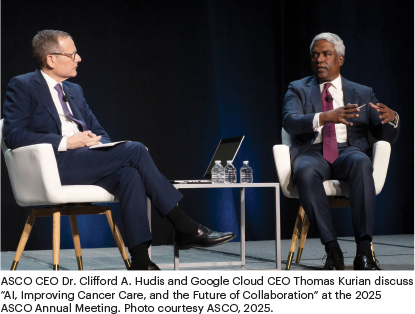

“I can’t emphasize enough that this is a guideline discovery tool,” Dr. Hudis said. “It is not a clinical decision support tool…. It’s how you get to what you’re really looking for, which is, ‘What did the guidelines say?’… You’re still going to be in charge. You are still the decision-making physician.”
Their conversation expanded to common misconceptions about AI (“There are many claims that AI is going to replace clinicians and replace doctors—at Google, we’ve never bought into that at all,” Mr. Kurian noted), its potential impact on the patient experience of health care, and how the regulatory environment around AI is likely to evolve.
During the ASCO25 Opening Session, Google president, Chief Investment Officer, and breast cancer survivor Ruth Porat served as a guest speaker, delivering a presentation on “Why Not? Opportunities for AI in the Diagnosis, Care, and Cure of Cancer.”
Ms. Porat opened by situating AI in the historical context of what economists call “general-purpose technologies”—rare innovations that transform entire economies at the national or global level, not through their invention alone but by the diffusion of their applications through many industries. She also shared her personal experience of being diagnosed and treated twice for breast cancer, and her belief that technological advances like AI can be harnessed to make the cancer experience more manageable, and hopefully curable, for more patients.
“I will be the first to say that AI is not a panacea, but I hope and I believe that technology can support the extraordinary work that you are leading,” she said, addressing ASCO25 attendees.
She discussed Google’s health-care-related AI projects and potential applications, such as accelerated discoveries in protein mapping, pattern recognition that can be used for early detection of disease in imaging, and agentic and generative AI tools which can reduce administrative workload.
AI “can help you do your work with greater precision and efficiency,” Ms. Porat said, and “that gives back time for greater humanity in the doctor-patient relationship.”
She also noted the cybersecurity applications of AI’s aptitude with pattern recognition and early data detection, a critically important consideration in health care: “The reality is, if you are running a hospital today, you are also managing one of the most targeted digital environments on the planet,” she said.
A Commitment to Shaping the Future, With Care
Through thought leadership, collaborative partnerships, and open conversations, ASCO is committed to helping its members explore and advance the use of AI in oncology in a human-centered way. The Society will continue to be an active participant in ensuring that AI is responsibly developed, thoughtfully deployed, and carefully monitored in cancer care settings for the benefit of patients and oncology professionals.
Further Listening: ASCO Daily News Podcast Episode on AI in Oncology
For more perspectives on AI applications in cancer care, listen to “From Clinic to Clinical Trials: Responsible AI Integration in Oncology” on the ASCO Daily NewsPodcast. Guest host Paul Hanona, MD, and guest Arturo Loaiza-Bonilla, MD, MSEd, discuss AI’s potential to advance precision oncology, especially through clinical trials and research, and other key advancements.
Reprinted with permission from ASCO Connection, September 19, 2025.
