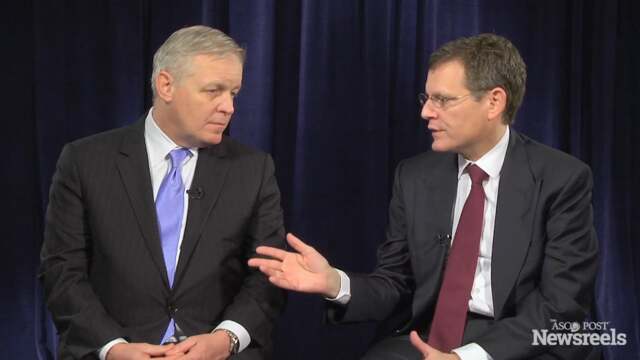
Andrew Seidman, MD, and Seema Khan, MD, MPH on Controversies in the Management of DCIS
2015 San Antonio Breast Cancer Symposium
Andrew Seidman, MD, of Memorial Sloan Kettering Cancer Center, and Seema A. Khan, MD, MPH, of the Lynn Sage Comprehensive Breast Center, discuss the session moderated by Dr. Khan on this important topic (Session ES8).
Related Videos
Andrew Seidman, MD, and Hope S. Rugo, MD
Andrew Seidman, MD, of Memorial Sloan Kettering Cancer Center, and Hope S. Rugo, MD, of the University of California, San Francisco, discuss the recent approval of a cooling cap to reduce hair loss during chemotherapy.
Andrew Seidman, MD, and Erica L. Mayer, MD, MPH
Andrew Seidman, MD, of Memorial Sloan Kettering Cancer Center, and Erica L. Mayer, MD, MPH, of the Dana-Farber Cancer Institute, discuss this phase 3 trial of palbociclib with adjuvant endocrine therapy vs endocrine therapy alone for HR-positive/HER2-negative early breast cancer. (Abstract OT1-03-21)
Clifford A. Hudis, MD, and Julia R. White, MD
Clifford A. Hudis, MD, of Memorial Sloan Kettering Cancer Center, and Julia R. White, MD, of Ohio State University Comprehensive Cancer Center, discuss a meta-analysis on efficacy and safety of hypofractionated radiotherapy for the treatment of early-stage breast cancer (Abstract P3-12-15).
Andrew Seidman, MD, and Hope S. Rugo, MD
Andrew Seidman, MD, of Memorial Sloan Kettering Cancer Center, and Hope S. Rugo, MD, of the University of California, San Francisco, discuss findings on de-escalating systemic therapy for breast cancer (Abstract ES6-3).
Clifford A. Hudis, MD, and William J. Gradishar, MD
Clifford A. Hudis, MD, of Memorial Sloan Kettering Cancer Center, and William J. Gradishar, MD, of the Lurie Comprehensive Cancer Center, discuss the most important papers and results at this year's San Antonio Breast Cancer Symposium.