Eric Lim, MD, on Increasing Incidence of Non-Smoking Lung Cancer
2015 IASLC World Conference on Lung Cancer
Eric Lim, MD, of the Royal Brompton and Harefield NHS Trust, discusses his findings on the nonspecific symptoms of never-smokers, which suggests that imaging could play a more important role in diagnosing these patients at an earlier stage.
Tony Mok, MD, and Fred R. Hirsch, MD, PhD
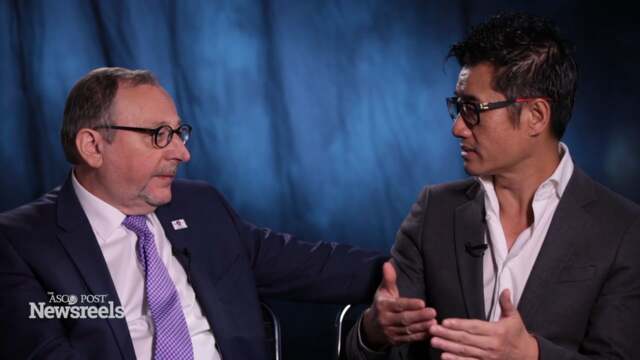
Tony Mok, MD, of The Chinese University of Hong Kong, and Fred R. Hirsch, MD, PhD, of University of Colorado Health Science Center discuss the highlights of the featured plenary session, which included the conference’s top four abstracts (Abstract PLEN04).
William D. Travis, MD
William D. Travis, MD, of Memorial Sloan Kettering Cancer Center, gives an update on the WHO classification, which is crucial for optimal personalized treatment of lung cancer patients (Abstract PLEN02.01).
Vassiliki Papadimitrakopoulou, MD
Vassiliki Papadimitrakopoulou, MD, of MD Anderson Cancer Center, discusses the ways in which patients, investigators, and pharmaceutical companies are working together to accelerate research and access to care (Abstract MTE 02.01).
Alice T. Shaw, MD, PhD
Alice T. Shaw, MD, PhD, of Massachusetts General Hospital, summarizes efficacy and safety data from studies on crizotinib, brigatinib, and alectinib for ALK-positive non–small cell lung cancer (ORAL 33.03, 33.06, 33.07).
Nagashree Seetharamu, MD
Nagashree Seetharamu, MD, of the North Shore LIJ Health System, discusses serum AGA-signatures that may provide a minimally invasive test for early detection of lung cancer risk (Abstract P3.04-085).