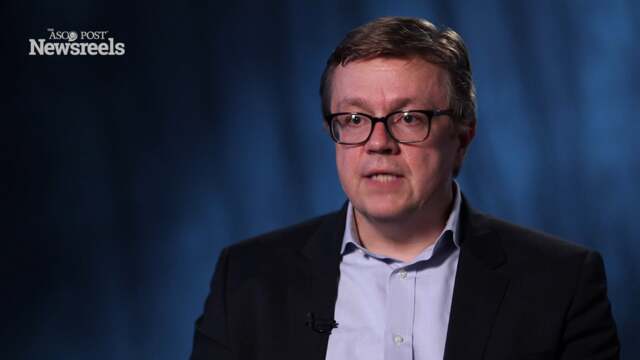
Barbara J. Gitlitz, MD: Genomics of Young Lung Cancer Study
2015 IASLC World Conference on Lung Cancer
Barbara J. Gitlitz, MD, of USC/Norris Cancer Center, discusses the first prospective study on the genomic drivers and demographics of lung cancer in patients under 40 who took part in the study remotely via the Internet (Abstract ORAL22.05).
Ramaswamy Govindan, MD
Ramaswamy Govindan, MD, of Washington University, summarizes three important papers: ROVA-T in relapsed and refractory small cell lung cancer, genomic characterization of large-cell neuroendocrine tumors, and the ECOG study on bevacizumab following chemotherapy for resected non–small cell lung cancer.
Fred R. Hirsch, MD, PhD and Paul A. Bunn, Jr., MD
Fred R. Hirsch, MD, PhD, of the University of Colorado Health Science Center, and Paul A. Bunn, Jr, MD, of the University of Colorado Cancer Center, give their views on the goals and important presentations of the 2015 World Conference on Lung Cancer.
Silvia Novello, MD, PhD
Silvia Novello, MD, PhD, of the University of Turin, discusses a much-neglected aspect of lung cancer: It is not just the province of men; women are affected in great numbers as well.
Alice T. Shaw, MD, PhD
Alice T. Shaw, MD, PhD, of Massachusetts General Hospital, summarizes efficacy and safety data from studies on crizotinib, brigatinib, and alectinib for ALK-positive non–small cell lung cancer (ORAL 33.03, 33.06, 33.07).
Pasi A. Jänne, MD, PhD
Pasi A. Jänne, MD, PhD, of Dana-Farber Cancer Institute, summarizes a workshop he conducted on the state of the art in next-generation sequencing of lung cancer (Abstract WS 01.07).