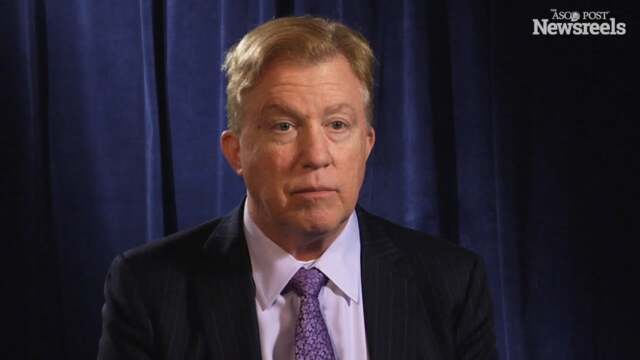
Anthony Zietman, MD, on Accelerating Treatment: RTOG 0415 Study on Prostate Cancer
2015 ASTRO Annual Meeting
Anthony Zietman, MD, of Massachusetts General Hospital, discusses the practice-changing results from a study comparing fractionation schedules in patients with low-risk prostate cancer (Abstract LBA6).
Vratislav Strnad, MD, PhD
Vratislav Strnad, MD, PhD, of the University Hospital in Erlangen, discusses results from a European study comparing accelerated partial-breast irradiation using brachytherapy, to the standard treatment of whole-breast irradiation for women with low-risk breast cancer (Abstract LBA7).
Anthony Zietman, MD
Anthony Zietman, MD, of Massachusetts General Hospital, discusses his perspective on the study of bicalutamide during and after radiotherapy in patients following radical prostatectomy and a biochemical relapse (Abstract LBA5).
Roy Decker, MD, PhD
Roy Decker, MD, PhD, of Yale University School of Medicine, discusses a National Cancer Database analysis that showed elderly patients with limited-stage small cell lung cancer can benefit from adding concurrent radiation to chemotherapy (Abstract 1010).
Howard M. Sandler, MD
Howard M. Sandler, MD, of Cedars-Sinai Medical Center, discusses this phase III noninferiority study comparing two fractionation schedules in patients with low-risk prostate cancer (Abstract LBA6).
Robert Kuske, MD
Robert Kuske, MD, of Arizona Breast Cancer Specialists, discusses the evaluation of more than 1,300 patients with accelerated partial-breast irradiation via multicatheter interstitial brachytherapy, focusing on toxicity and cosmetic outcomes (Abstract 133).