Advertisement


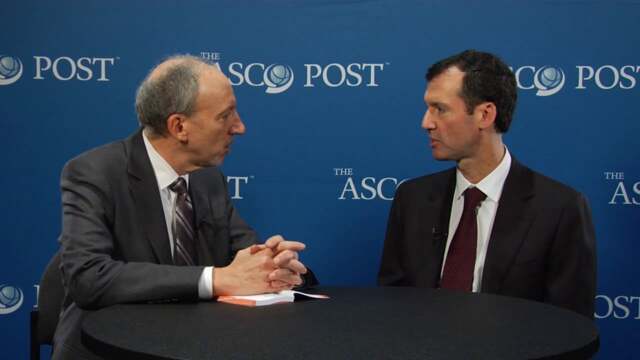
Larry Wickerham, MD, and Harry D. Bear, MD, PhD, on NSABP Neoadjuvant Chemotherapy Trials

2014 San Antonio Breast Cancer Symposium

Advertisement

Larry Wickerham, MD, and Harry D. Bear, MD, PhD, discuss three clinical trials:

•          B-40, the only study to combine neoadjuvant and adjuvant chemotherapy with bevacizumab
•          B-51, on radiation to the chest wall
•          Alliance trial, on lymph node dissection


Related Videos

Breast Cancer

William M. Sikov, MD, on the CALGB 40603 Trial

William M. Sikov, MD, of Women and Infants Hospital, discusses abstract S4-05, "Impact of intrinsic subtype by PAM50 and other gene signatures on pathologic complete response rates in triple-negative breast cancer after neoadjuvant chemotherapy with or without carboplatin or bevacizumab: CALGB 40603/150709 (Alliance)."

Breast Cancer

William J. Gradishar, MD, and Edith A. Perez, MD, on Immunotherapy and highlights of the Bolero-1 and SOFT Trials

William J. Gradishar, MD, of Northwestern University, and Edith A. Perez of the Mayo Clinic Cancer Center, discuss immunotherapy and the highlights of the BOLERO-1 and SOFT trials.

Breast Cancer

Jame Abraham, MD, FACP, on Immunotherapy in Triple-Negative Breast Cancer

Jame Abraham, MD, FACP, of the Cleveland Clinic, offers his thoughts on abstract S1-09, "A phase Ib study of pembrolizumab (MK-3475) in patients with advanced triple-negative breast cancer," presented by Rita Nanda, MD.

Breast Cancer

Hope S. Rugo, MD, on Dietary Intervention as Adjuvant Breast Cancer Therapy

Hope S. Rugo, MD, of the University of California, San Francisco, discusses abstract S5-08, “Final survival analysis from the randomized Women's Intervention Nutrition Study (WINS) evaluating dietary intervention as adjuvant breast cancer therapy,” presented by Rowan T. Chlebowski, MD.

Breast Cancer

Gunter von Minckwitz, MD, on the Phase III ICE Trial

Gunter von Minckwitz, MD, of the University of Frankfurt, offers his thoughts on abstract S3-04, "The phase III ICE study: Adjuvant ibandronate with or without capecitabine in elderly patients with moderate or high risk early breast cancer."

Advertisement

Advertisement


Advertisement