Advertisement


Related Videos

Myelodysplastic Syndromes

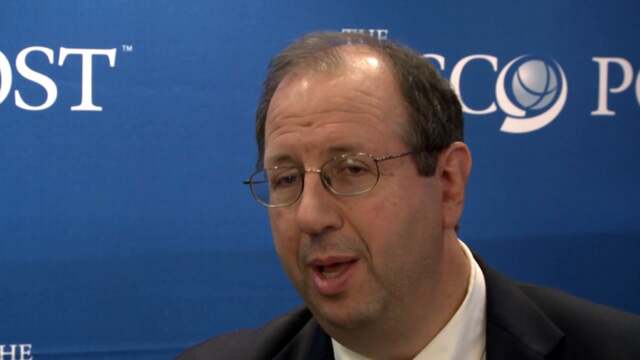
Alan F. List, MD, on the CC-5013-MDS-005 Study

Alan F. List, MD, of Moffitt Cancer Center, offers his thoughts on abstract 409, “Efficacy and Safety of Lenalidomide vs Placebo in RBC Transfusion–Dependent Patients With IPSS Low-/Intermediate-Risk Myelodysplastic Syndromes Without Del(5q) and Unresponsive or Refractory to Erythropoiesis-Stimulating Agents: Results From a Randomized Phase III Study (CC-5013-MDS-005),” presented by Valeria Santini, MD.

Hematologic Malignancies

Keith McCrae, MD, on Splenectomy in Immune Thrombocytopenia

Keith McCrae, MD, of the Cleveland Clinic, offers his thoughts on abstract 232, “Long-Term Complications After Splenectomy in Adult Chronic Immune Thrombocytopenia With a Minimum Follow-up of 10 Years: First Results From a Single-Center Case-Control Study in 140 Patients With Primary ITP,” presented by Lan-huong Thai.

Lymphoma

James O. Armitage, MD, FACP, FRCP, and Bertrand Coiffier, MD, PhD, on Managing Lymphoma: The French Perspective

James O. Armitage, MD, FACP, FRCP, of the University of Nebraska Medical Center, and Bertrand Coiffier, MD, PhD, of the Centre Hospitalier Lyon-Sud discuss three French studies on rituximab maintenance vs wait and watch after R-DHAP in mantle cell lymphoma; R-CHOP with or without radiotherapy in diffuse large B-cell lymphoma; and romidepsin and CHOP in peripheral T-cell lymphoma.

Multiple Myeloma

Sagar Lonial, MD, on the Phase III ASPIRE Trial

Sagar Lonial, MD, of Winship Cancer Institute, offers his thoughts on abstract 79, “Carfilzomib, Lenalidomide, and Dexamethasone vs Lenalidomide and Dexamethasone in Patients With Relapsed Multiple Myeloma: Interim Results From ASPIRE, a Randomized, Open-Label, Multicenter Phase III Study,” presented by A. Keith Stewart, MD.

Leukemia

James O. Armitage, MD, FACP, FRCP, and Hagop M. Kantarjian, MD, on Advances in the Treatment of ALL

James O. Armitage, MD, FACP, FRCP, of the University of Nebraska Medical Center, and Hagop M. Kantarjian, MD, of The University of Texas MD Anderson Cancer Center, discuss the diagnosis and genetics of ALL, differences in treating younger and older patients, and the latest data on the use of tyrosine kinase inhibitors, monoclonal antibodies, and CAR T cells.

Advertisement

Advertisement


Advertisement