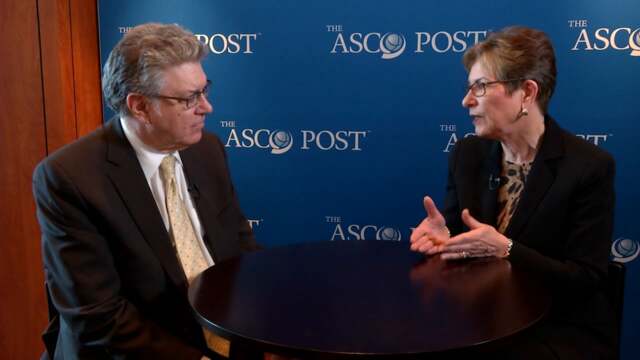
Melinda Telli, MD, on Evolving Treatment Strategies for Triple-Negative Breast Cancer
2015 NCCN Annual Conference
Melinda Telli, MD, of Stanford Cancer Institute, discusses the TNT trial for triple-negative breast cancer and the results reported at the San Antonio Breast Cancer Symposium.
Related Videos
Samuel M. Silver, MD, PhD, and David S. Ettinger, MD
Samuel M. Silver, MD, PhD, of the University of Michigan Comprehensive Cancer Center, and David S. Ettinger, MD, of The Sidney Kimmel Comprehensive Cancer Center at Johns Hopkins, discuss the evolution of the NCCN Guidelines, the importance of including palliative care and survivorship recommendations, and the use of the guidelines in community practices.
Amy Cyr, MD
Amy Cyr, MD, of the Siteman Cancer Center at Barnes-Jewish Hospital and Washington University School of Medicine, discusses advances made in the treatment of early-stage breast cancer: less radiation and a shorter course, the rising use of molecular profiling, and less invasive surgery and reduced amounts of surgery.
Rebecca H. Johnson, MD
Although guidelines worldwide mandate fertility preservation for newly diagnosed patients within their reproductive window, most patients are still not referred or offered this option. Rebecca H. Johnson, MD, of Mary Bridge Children’s Hospital, explains the steps that need to be taken when counseling patients.
Andrew J. Armstrong, MD, ScM
Andrew J. Armstrong, MD, ScM, of Duke Cancer Institute, discusses the recent practice-changing landmark studies that showed significant increases in survival for men with castration-resistant prostate cancer and led to updates in the NCCN Guidelines for this disease.
Samuel M. Silver, MD, PhD, and Margaret A. Tempero, MD
Samuel M. Silver, MD, PhD, of the University of Michigan Comprehensive Cancer Center, and Margaret A. Tempero, MD, of the UCSF Helen Diller Family Comprehensive Cancer Center, discuss drugs developed for hematologic malignancies that have activity in pancreatic cancer, vaccines, neoadjuvant treatment, and the need to focus on activated RAS.