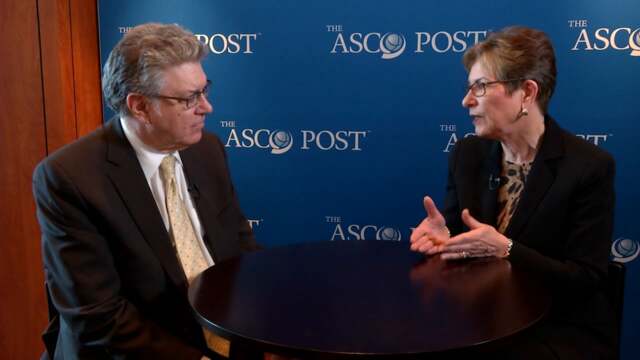
Andrew J. Armstrong, MD, ScM, on New Treatment Options in Castration-Resistant Prostate Cancer
2015 NCCN Annual Conference
Andrew J. Armstrong, MD, ScM, of Duke Cancer Institute, discusses the recent practice-changing landmark studies that showed significant increases in survival for men with castration-resistant prostate cancer and led to updates in the NCCN Guidelines for this disease.
Related Videos
Clifford Goodman, PhD, and Peter B. Bach, MD, MAPP
Clifford Goodman, PhD, of the The Lewin Group, and Peter B. Bach, MD, MAPP, of Memorial Sloan Kettering Cancer Center, discuss the affordability of cancer care, the “financial toxicities” of high drug prices, and what could and should be done about it.
Robert W. Carlson, MD, and William J. Gradishar, MD
Robert W. Carlson, MD, Chief Executive Officer, National Comprehensive Cancer Network, and William J. Gradishar, MD, Robert H. Lurie Comprehensive Cancer Center of Northwestern University, discuss the evolution of the breast cancer guidelines, the inclusion of varied fields––such as plastic surgery, pathology, patient advocacy, and radiation–– and new treatment changes.
Wui-Jin Koh, MD
Wui-Jin Koh, MD, of the Fred Hutchinson Cancer Research Center and the Seattle Cancer Care Alliance, discusses the program to adapt NCCN guidelines to regions of the world with different resource availability. The first guideline to be adapted in this way is for cervical cancer, which is prevalent in the developing world.
Robert W. Carlson, MD, and John A. Gentile, Jr
Robert W. Carlson, MD, Chief Executive Officer, National Comprehensive Cancer Network, and John A. Gentile, Jr, Chairman, Harborside Press, LLC, discuss the early days of NCCN, controversies that surrounded the first meeting, oncologists’ embrace of the guidelines, and how the organization has evolved over the past 20 years.
Samuel M. Silver, MD, PhD, and Margaret A. Tempero, MD
Samuel M. Silver, MD, PhD, of the University of Michigan Comprehensive Cancer Center, and Margaret A. Tempero, MD, of the UCSF Helen Diller Family Comprehensive Cancer Center, discuss drugs developed for hematologic malignancies that have activity in pancreatic cancer, vaccines, neoadjuvant treatment, and the need to focus on activated RAS.