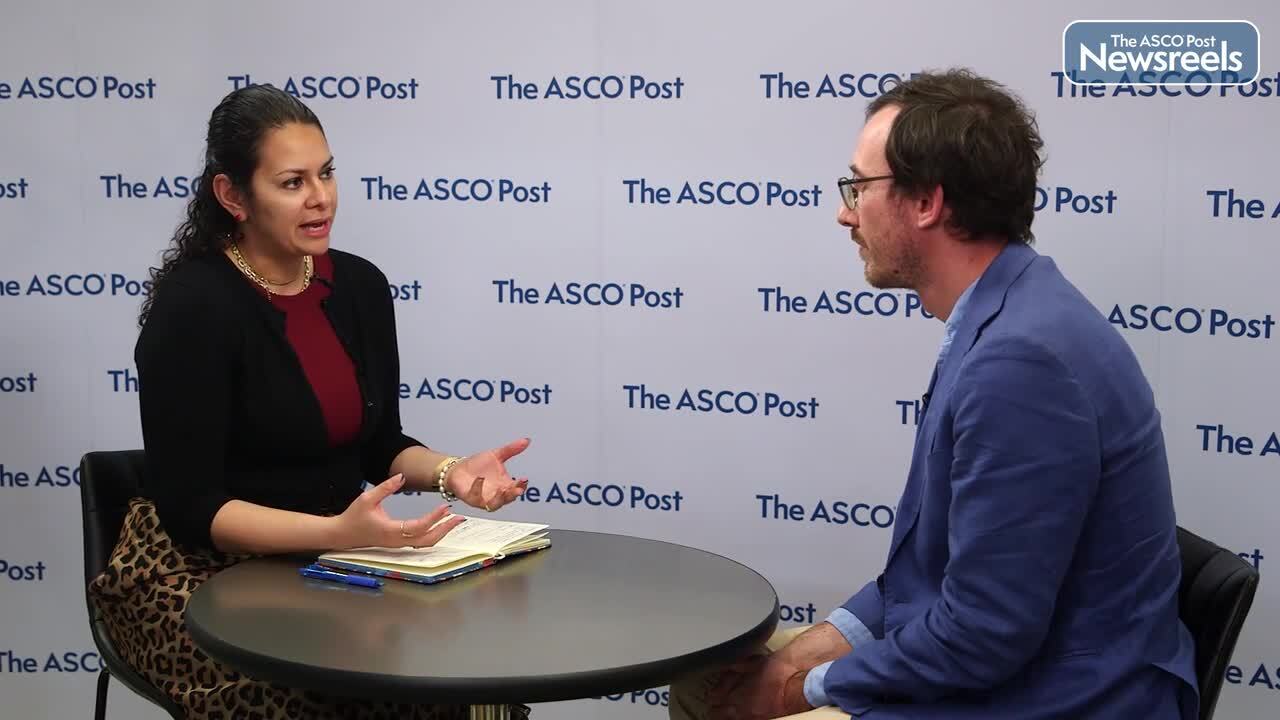
Aaron T. Gerds, MD, on Anemia in Myelofibrosis: New Data on Treatment With Luspatercept
2023 ASCO Annual Meeting
Aaron T. Gerds, MD, of Cleveland Clinic Taussig Cancer Institute, talks about treating the anemia many patients with myelofibrosis experience because of JAK inhibitor therapy. The ACE-536-MF-001 study showed that luspatercept improved anemia and transfusion burden in this population, with a safety profile consistent with that in previous studies (Abstract 7016).
The ASCO Post Staff
Omid Hamid, MD, of The Angeles Clinic & Research Institute, discusses study findings on fianlimab plus cemiplimab-rwlc, which showed clinical activity in patients with advanced melanoma, comparing favorably with other approved combinations of immune checkpoint inhibitors in the same clinical setting. This is the first indication that dual LAG-3 blockade may produce a high level of activity with significant overall response rate after adjuvant anti–PD-1 treatment. A phase III trial of this regimen in treatment-naive patients with advanced melanoma is ongoing (Abstract 9501).
The ASCO Post Staff
Sebastian Stintzing, MD, of the Charité Universitätsmedizin Berlin, discusses results from the phase III FIRE-4 study, which showed that liquid biopsy is clinically relevant in verifying mutational status in patients with metastatic colorectal cancer and is efficacious in first-line treatment of FOLFIRI and cetuximab for patients with RAS wild-type disease (Abstract 3507).
The ASCO Post Staff
James Chih-Hsin Yang, MD, PhD, of the National Taiwan University Hospital and National Taiwan University Cancer Center, discusses the latest data from the phase III KEYNOTE-789 study, which evaluated the efficacy and safety of pemetrexed plus platinum chemotherapy (carboplatin or cisplatin) with or without pembrolizumab in the treatment of adults with EGFR tyrosine kinase inhibitor–resistant, EGFR–mutated, metastatic nonsquamous non–small cell lung cancer (NSCLC) (Abstract LBA9000).
The ASCO Post Staff
Thomas E. Hutson, DO, PharmD, of Texas Oncology, discusses the 4-year follow-up results from the CLEAR study for patients with advanced renal cell carcinoma (RCC). The data showed that lenvatinib plus pembrolizumab continues to demonstrate clinically meaningful benefit vs sunitinib in overall and progression-free survival, as well as in overall and complete response rates, in first-line treatment (Abstract 4502).
The ASCO Post Staff
Narjust Florez, MD, of Dana-Farber Cancer Institute, and Filippo Gustavo Dall’Olio, MD, of Institut Gustave Roussy, discuss circulating tumor DNA tumor fraction, and its link to survival in patients with advanced non–small cell lung cancer (NSCLC) treated with maintenance durvalumab in the UNICANCER SAFIR02-Lung/IFCT1301 trial. Tumor fraction was positive in 16% of patients randomly assigned to receive durvalumab in the study. This population seems to have a limited benefit from maintenance durvalumab after induction chemotherapy (Abstract 2516).