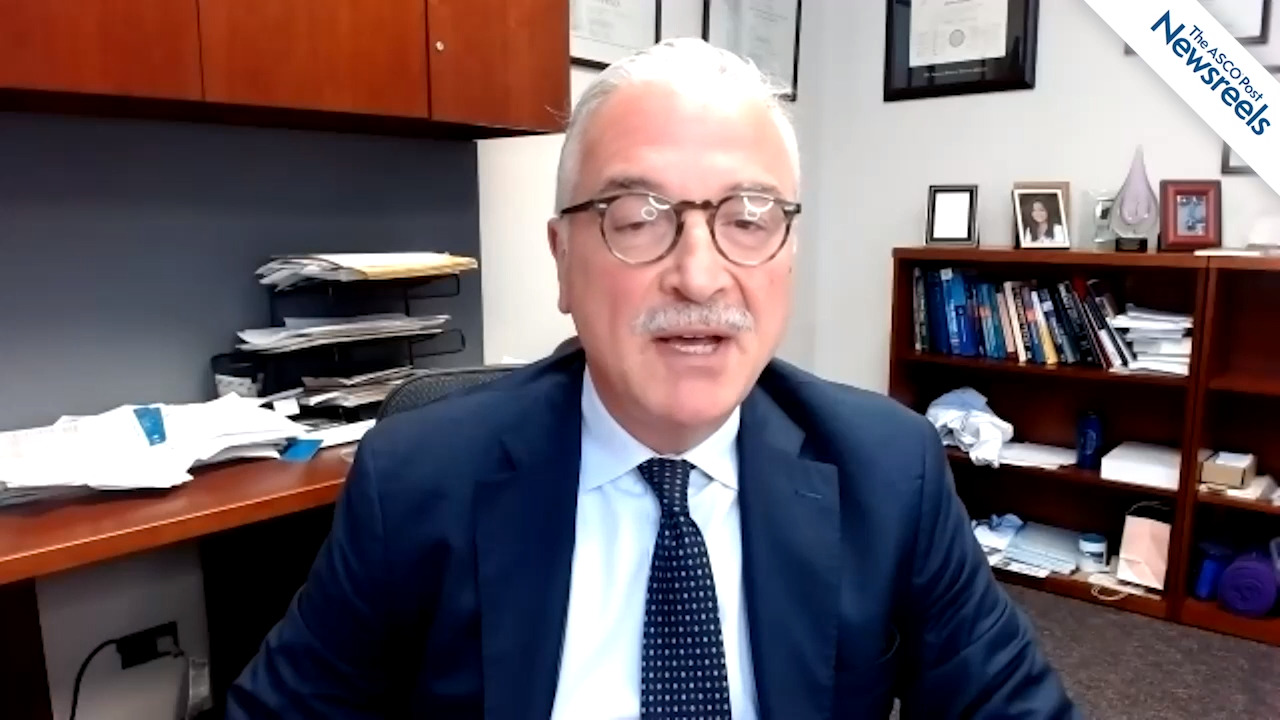
Byoung Chul Cho, MD, PhD, on NSCLC: Amivantamab Plus Lazertinib for Treatment of Relapsed Disease
2021 ASCO Annual Meeting
Byoung Chul Cho, MD, PhD, of the Yonsei Cancer Center, discusses study results that showed treatment with the EGFR-MET bispecific antibody amivantamab plus the EGFR inhibitor lazertinib yielded responses in 36% of chemotherapy-naive patients with non–small cell lung cancer whose disease progressed on osimertinib. Genetic biomarkers may be able to identify patients most likely to benefit from the combination regimen (Abstract 9006).
The ASCO Post Staff
Evan J. Lipson, MD, of Johns Hopkins University, discusses primary phase III results from the RELATIVITY-047 study, which showed that relatlimab plus nivolumab as a fixed-dose combination may improve progression-free survival compared with nivolumab monotherapy in patients with advanced melanoma. This is the first study to demonstrate a benefit from dual inhibition of the LAG-3 and PD-1 pathways.
The ASCO Post Staff
Massimo Cristofanilli, MD, of the Feinberg School of Medicine at Northwestern University, discusses updated overall survival data from the phase III PALOMA-3 trial of palbociclib plus fulvestrant in women with hormone receptor–positive, HER2-negative advanced breast cancer (Abstract 1000).
The ASCO Post Staff
Sumanta K. Pal, MD, of City of Hope, discusses results from a phase II study that sought to determine whether adding berzosertib, a selective ATR inhibitor, to the standard upfront chemotherapy regimen of cisplatin with gemcitabine may improve outcomes in patients with metastatic urothelial carcinoma (Abstract 4507).
The ASCO Post Staff
Paolo Ghia, MD, PhD, of the Università Vita-Salute San Raffaele, discusses phase II results from the CAPTIVATE study, which examined ibrutinib plus venetoclax as a fixed-duration first-line treatment in patients with chronic lymphocytic leukemia/small lymphocytic lymphoma (Abstract 7501).
The ASCO Post Staff
Neeraj Agarwal, MD, of Huntsman Cancer Institute at the University of Utah, discusses three studies that examined real-world treatment patterns and utilization of advanced therapies in men with metastatic castration-sensitive prostate cancer, which served to highlight the ways in which Black men may be treated differently (Abstracts 5072, 5073, 5704).