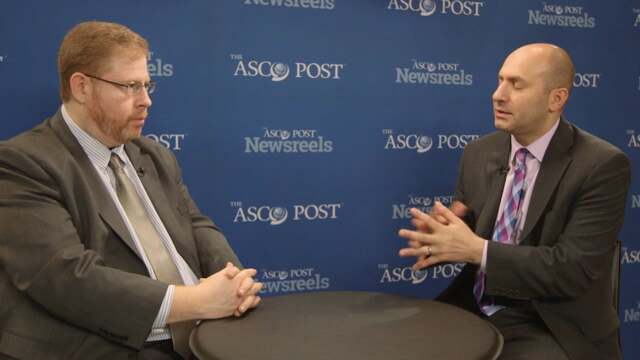
Luis G. Paz-Ares, MD, PhD, on NSCLC: Results From the SQUIRE Trial
2016 ASCO Annual Meeting
Luis G. Paz-Ares, MD, PhD, of the Hospital Universitario 12 De Octubre, discusses study findings on adding necitumumab to gemcitabine and cisplatin chemotherapy in the first-line treatment of patients with stage IV squamous non-small cell lung cancer.
To see Dr. Paz-Ares discuss this video in Spanish, please click here.
Newly elected ASCO President Daniel F. Hayes, MD, of the University of Michigan Health System Comprehensive Cancer Center, talks about his vision for the society during his tenure.
Usha Menon, MD, of University College London, discusses a significant new version of a screening test for ovarian cancer that may reduce death from the disease (Abstract 5507).
Celestia S. Higano, MD, of the University of Washington, and Chris Parker, MD, of the Royal Marsden Hospital, discuss findings from this confirmatory study evaluating the accuracy of MRI and TRUS biopsy in men with an elevated PSA (Abstract 5000).
Helen MacKay, MD, of the Sunnybrook Odette Cancer Centre, discusses findings from this phase II study of intraperitoneal vs intravenous chemotherapy following neoadjuvant chemotherapy and optimal debulking surgery in patients with epithelial ovarian cancer (Abstract LBA5503).
Jonathan E. Rosenberg, MD, of Memorial Sloan Kettering Cancer Center, and Toni K. Choueiri, MD, of the Dana-Farber Cancer Institute, discuss mutation burden—its role in response to treatment with PD-L1 immunotherapy and its impact on progression-free survival and overall survival, as well as the link between intrinsic expression subtypes and treatment outcome with atezolizumab (Abstract 104).