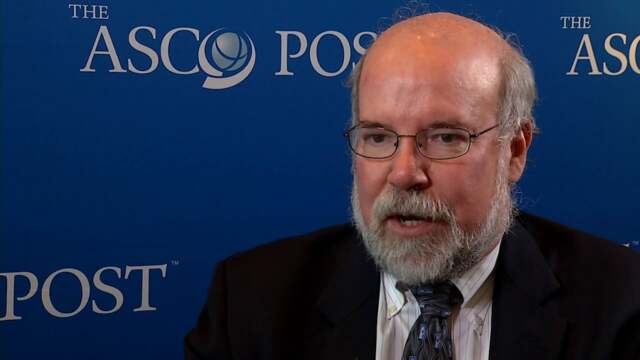
Kenneth C. Anderson, MD, on Multiple Myeloma: Current Treatment Approaches and Future Directions
2015 NCCN Annual Conference
Kenneth C. Anderson, MD, of Dana-Farber/Brigham and Women’s Cancer Center, discusses the incredible progress made in treating multiple myeloma, with nine therapeutic options approved in the past decade, two drugs approved this year, and a number of new options on the horizon.
Robert W. Carlson, MD, and Lee N. Newcomer, MD, MHA
Robert W. Carlson, MD, Chief Executive Officer of the National Comprehensive Cancer Network, and Lee N. Newcomer, MD, MHA, of UnitedHealthCare, discuss the value of NCCN Guidelines in determining coverage decisions, the future of affordable care, bundled payments, and the clear value approach.
Jerald P. Radich, MD
Jerald P. Radich, MD, of the Fred Hutchinson Cancer Research Center and Seattle Cancer Care Alliance discusses the evolution in treating and monitoring CML and whether monitoring at 3 and 6 months will ultimately prove useful.
Amy Cyr, MD
Amy Cyr, MD, of the Siteman Cancer Center at Barnes-Jewish Hospital and Washington University School of Medicine, discusses advances made in the treatment of early-stage breast cancer: less radiation and a shorter course, the rising use of molecular profiling, and less invasive surgery and reduced amounts of surgery.
Wui-Jin Koh, MD
Wui-Jin Koh, MD, of the Fred Hutchinson Cancer Research Center and the Seattle Cancer Care Alliance, discusses the program to adapt NCCN guidelines to regions of the world with different resource availability. The first guideline to be adapted in this way is for cervical cancer, which is prevalent in the developing world.
Gregory A. Otterson, MD
Gregory A. Otterson, MD, of The Ohio State University Comprehensive Cancer Center and the James Cancer Hospital and Solove Research Institute, discusses the evolution of lung cancer treatment from adjuvant chemotherapy to immunotherapy and the clinical trials underway.