Jennifer Gile, MD, on First-Line Treatment of DLBCL: POLARIX Long-Term Update and Implications
Thematic Newsreels
Jennifer Gile, MD, of Willamette Valley Cancer Institute, reviews findings from the POLARIX study, a double-blind, placebo-controlled, international phase III trial that evaluated pola-R-CHP—a modified regimen of rituximab, cyclophosphamide, doxorubicin, vincristine, and prednisone (R-CHOP), in which vincristine was replaced with polatuzumab vedotin—as compared with standard R-CHOP, in patients with previously untreated intermediate-risk or high-risk diffuse large B-cell lymphoma (DLBCL). With a 5-year update from the trial being published recently, Dr. Gile discusses long-term results, the regimen’s performance in key high-risk subgroups, and how the study altered the front-line management of this disease.
Access to second-line chimeric antigen receptor (CAR) T-cell therapy remains suboptimal in relapsed/refractory diffuse large B-cell lymphoma (DLBCL). Matthew Lunning, DO, FACP, of the University of Nebraska Medical Center, explains that prior tafasitamab exposure may theoretically affect CD19 detection or antigen persistence, but clinical evidence demonstrating impaired subsequent CAR T-cell efficacy is lacking. Real-world data have not established CD19 loss, supporting continued consideration of CAR T-cell therapy following tafasitamab-based treatment.
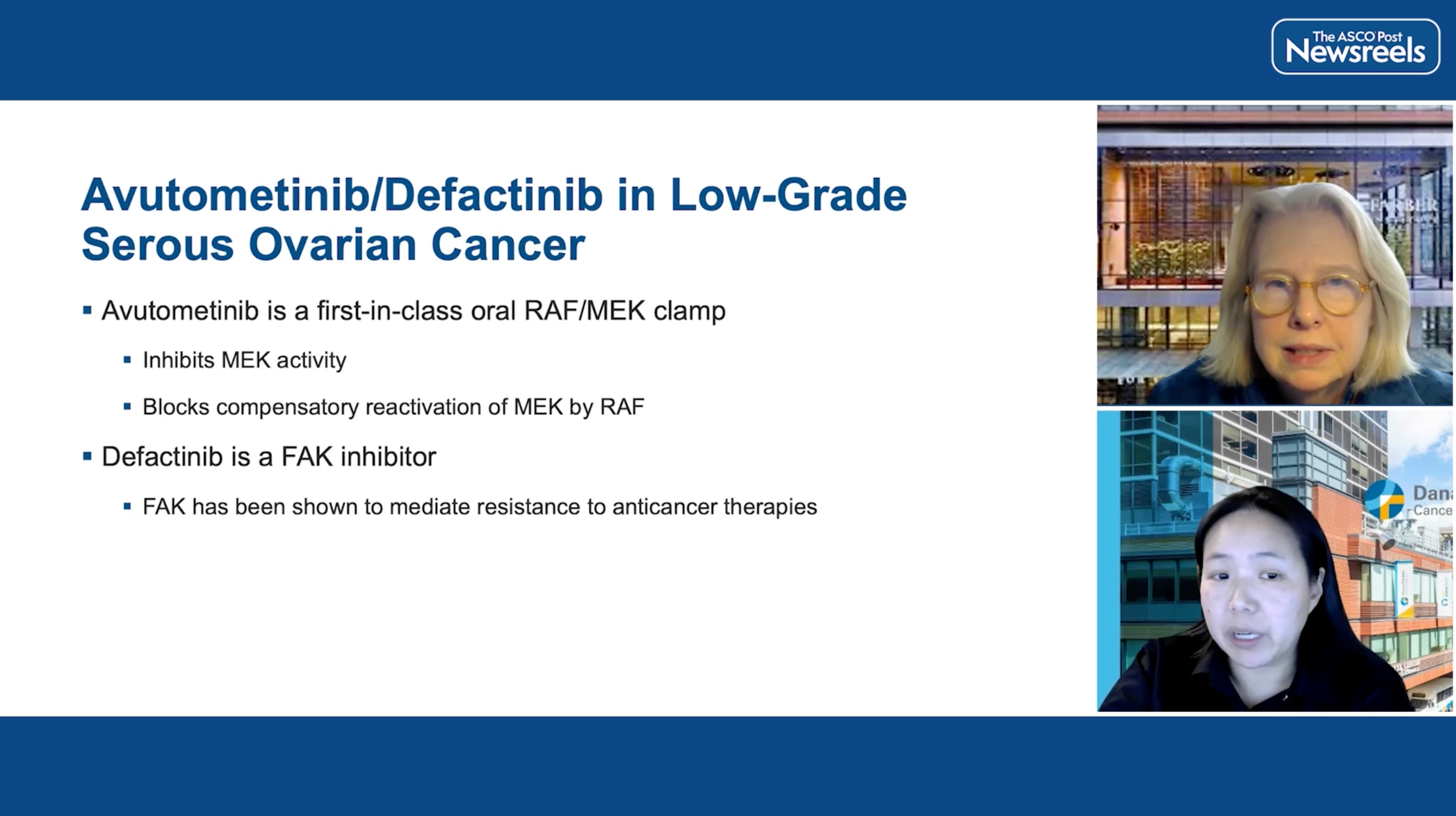
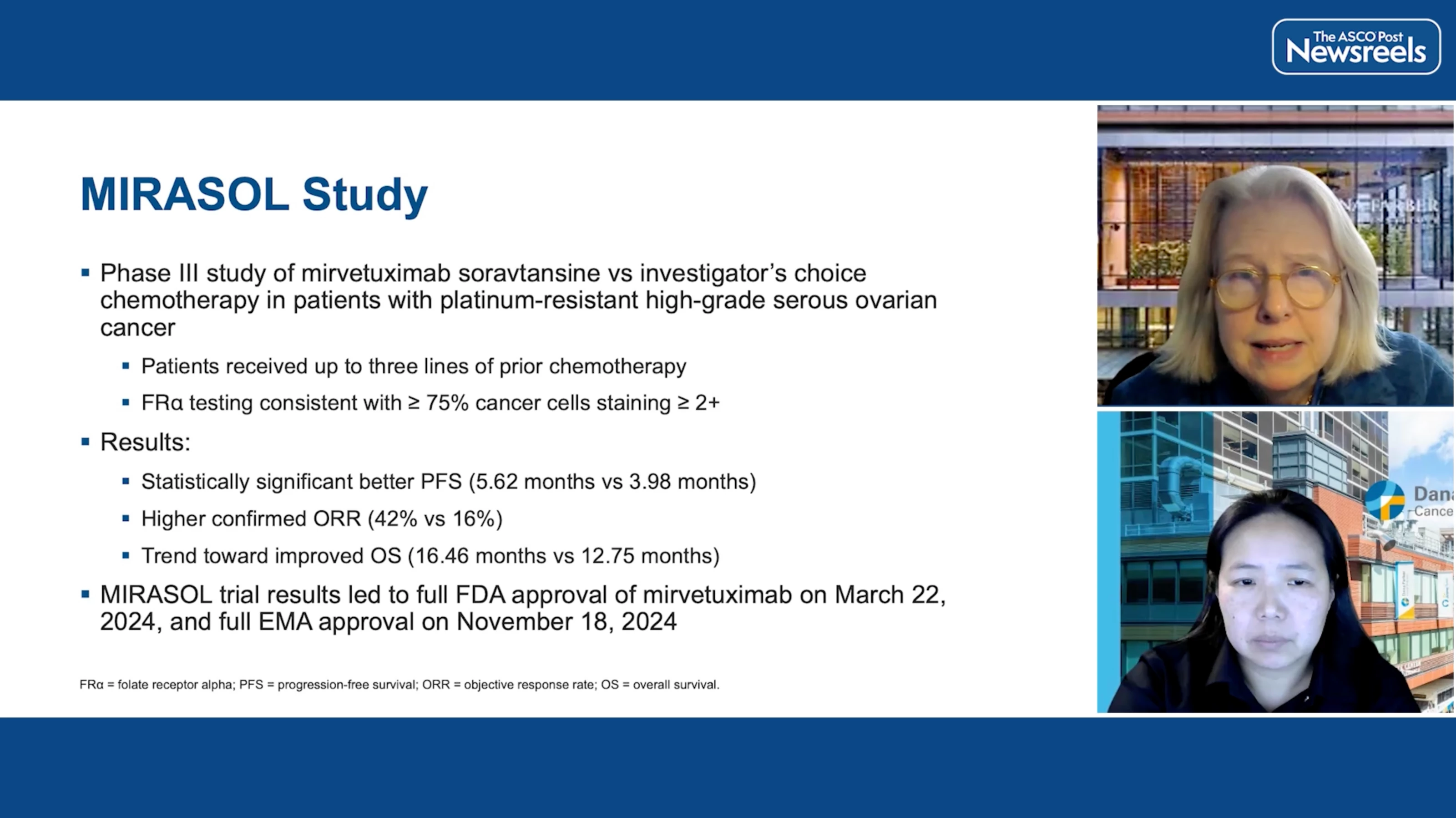
In this second installment of a two-part discussion about ovarian cancer advances for The ASCO Post Newsreels, Ursula A. Matulonis, MD, and Joyce F. Liu, MD, MPH, discuss low-grade serous ovarian carcinoma and an important recently published study. View part 1 of the program to hear them discuss antibody-drug conjugates and clinical trials including PRIMA and ATHENA.
Filmed November 22, 2024
Benjamin P. Levy, MD, of Johns Hopkins Sidney Kimmel Cancer Center, discusses research into moving KRAS G12C inhibitors from the second to the first line, as well as combining them with immunotherapies and EGFR antibodies. Some potential combinations under investigation include KRAS G12C inhibitors (such as olomorasib, fulzerasib, divarasib, and adagrasib) and single-agent immunotherapy (pembrolizumab) or EGFR-targeting therapies (cetuximab).
Over the past year, several important studies in ovarian cancer have been presented at multiple oncology meetings and published in a number of peer-reviewed publications. In this installment of a two-part discussion for The ASCO Post Newsreels, Ursula A. Matulonis, MD, and Joyce F. Liu, MD, MPH, discuss antibody-drug conjugates and clinical trials including PRIMA and ATHENA. In part two of this feature, Dr. Matulonis and Dr. Liu talk about low-grade serous ovarian carcinoma and an important recently published study.
Filmed November 22, 2024
The ASCO Post Staff
Nikhil Khushalani, MD, Vice Chair for the Department of Cutaneous Oncology at Moffitt Cancer Center, offers his thoughts on the role of immunotherapy in the treatment of advanced cutaneous squamous cell carcinoma (CSCC). Dr. Khushalani discusses the three currently approved immunotherapeutic agents for this disease—cemiplimab-rwlc, pembrolizumab, and cosibelimab-ipdl—and their confirmatory trials as well as adverse event profiles. He also talks about choosing optimal treatment strategies for patients, and studies currently exploring monotherapy vs combination therapy regimens.
References
1. Migden MR, Rischin D, Schmults CD, et al: PD-1 blockade with cemiplimab in advanced cutaneous squamous-cell carcinoma. N Eng J Med 379:341-351, 2018.
2. Hughes BGM, Guminski A, Bowyer S, et al: A phase 2 open-label study of cemiplimab in patients with advanced cutaneous squamous cell carcinoma (EMPOWER-CSCC-1): Final long-term analysis of groups 1, 2, and 3, and primary analysis of fixed-dose treatment group 6. J Am Acad Dermatol 1:68-77, 2025.
3. Grob JJ, Gonzalez R, Bassett-Seguin N, et al: Pembrolizumab monotherapy for recurrent or metastatic cutaneous squamous cell carcinoma: A single-arm phase II trial (KEYNOTE-629). J Clin Oncol 25:2916-2925, 2020.
4. Maubec E, Boubaya M, Petrow P, et al: Phase II study of pembrolizumab as first-line, single-drug therapy for patients with unresectable cutaneous squamous cell carcinomas. J Clin Oncol 26:3051-3061, 2020.
5. Clingan P, Ladwa R, Brungs D, et al: Efficacy and safety of cosibelimab, an anti-PD-L1 antibody, in metastatic cutaneous squamous cell carcinoma. J Immunother Cancer 10:e007637, 2023.
6. Zandberg DP, Allred JB, Rosenberg AJ, et al: Phase II (Alliance A091802) randomized trial of avelumab plus cetuximab versus avelumab alone in advanced cutaneous squamous cell carcinoma. J Clin Oncol 43:2398-2408, 2025.