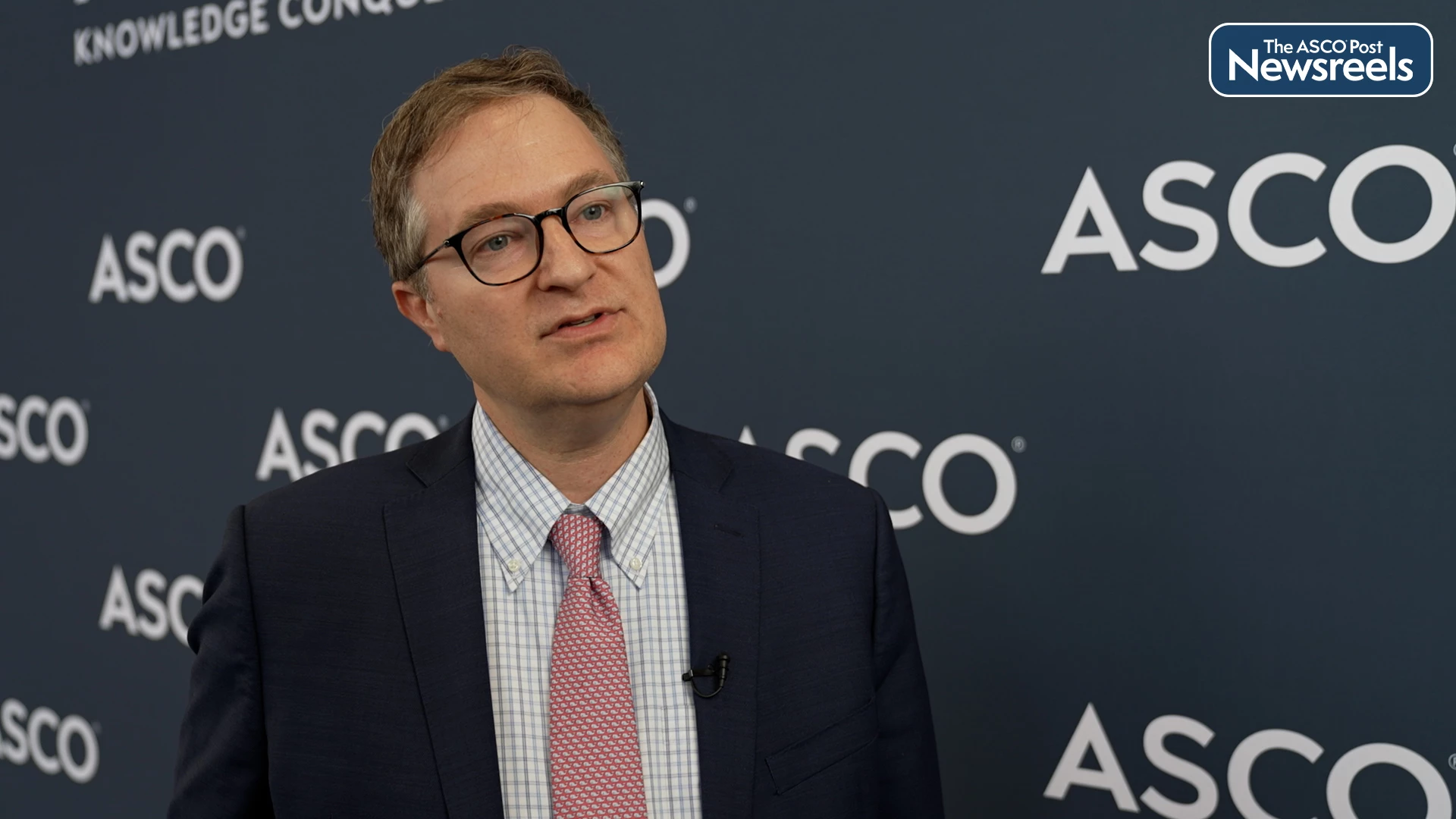
Suneel Deepak Kamath, MD, on Disparities in NIH and Federal Funding Across Different Cancer Types
2025 ASCO Annual Meeting
Suneel Deepak Kamath, MD, of the Cleveland Clinic, reports findings from a study that evaluated funding from the NIH and Congressionally Directed Medical Research Programs supporting lung, breast, colorectal, pancreatic, hepatobiliary, ovarian, cervical, endometrial, and prostate cancers, as well as leukemia, lymphoma, and melanoma, from 2013 to 2022 (Abstract 11025).
The ASCO Post Staff
Eric Huttenlocher Bent, MD, PhD, of Memorial Sloan Kettering Cancer Center, reviews results from the phase II Metacure trial (cohorts B2 and the B2 expansion), which looked at the efficacy of stereotactic body radiotherapy for PSMA-PET–detected oligometastatic prostate adenocarcinoma (Abstract 5014).
The ASCO Post Staff
David Allen Barbie, MD, of the Lowe Center for Thoracic Oncology at Dana-Farber Cancer Institute, reviews specific clinical and molecular features of early progressors and long-term progression-free survivors from the phase III ADRIATIC trial, which assessed consolidation durvalumab vs placebo after concurrent chemoradiotherapy for limited-stage small cell lung cancer (Abstract 8014).
The ASCO Post Staff
Raffaele Califano, MD, of the Christie NHS Foundation Trust and the University of Manchester, discusses outcomes by osimertinib resistance mechanisms in MARIPOSA-2, a study that evaluated the efficacy of the bispecific antibody amivantamab-vmjw plus chemotherapy vs chemotherapy in patients with EGFR-mutant advanced NSCLC after disease progression on osimertinib (Abstract 8639).
The ASCO Post Staff
Angela R. Bradbury, MD, of the University of Pennsylvania, presents findings from the eREACH trial—a randomized study of an eHEALTH delivery alternative for cancer genetic testing for hereditary predisposition in patients with metastatic cancers (Abstract 10502).
The ASCO Post Staff
Neil M. Iyengar, MD, of Memorial Sloan Kettering Cancer Center, reviews several studies that aimed to answer two questions: does menopausal hormone therapy (HRT) impact overall survival and breast cancer–specific mortality in younger women diagnosed with high-risk disease (Abstract 10506); and do GLP-1 receptor agonists (GLP-1 RAs), a class of weight-loss medications, have cancer risk reduction properties (Abstracts 10507 and 10508).