
Editor’s Note: On May 1, 2026, The New York Historical, an American history museum and library in New York City, published the following blog post by Leland Jasperse, PhD, in its From the Stacks collection. The story, “How New York City—and the Nation—Got Its First Cancer Hospitals,” chronicles the history of two early New York City hospitals, New York Cancer Hospital, which later became Memorial Sloan Kettering Cancer Center, and the New York Skin and Cancer Hospital, which is now the Skin & Cancer Unit of the Ronald O. Perelman Department of Dermatology at NYU Langone Health.
Dr. Jasperse is the 2025-2026 Robert and Helen Appel Fellow in the Patricia D. Klingenstein Library at The New York Historical. His blog is reprinted here with permission from The New York Historical. It has been lightly edited for clarity.
Specialized cancer hospitals like Memorial Sloan Kettering Cancer Center and Dana-Farber Cancer Institute are a familiar part of the health-care landscape, concentrating cutting-edge expertise and therapies in one location to provide comprehensive care for the most challenging cases. This was not always the case. For most of the 19th century, cancer was such a stigmatized and hopeless disease that most American hospitals refused to admit cancer patients, leaving those unable to afford private care without treatment or palliative care. That changed in the 1880s, when New York City saw the founding of the United States’ first two cancer hospitals in close succession: the New York Skin and Cancer Hospital (which became part of NYU Langone’s first hospital) and the New York Cancer Hospital (which became Memorial Sloan Kettering Cancer Center).
Although histories of oncology tend to focus on the 20th-century discoveries of radiation and chemotherapy, these hospitals played a crucial role in reducing the stigma attached to cancer and laying the groundwork for oncology’s emergence as its own field of medicine.
In honor of National Cancer Research Month in May, we take a look here at The New York Historical’s collection of medical pamphlets, which illuminate the now-forgotten struggle over resources, expertise, and public trust these institutions waged in their early years to transform cancer from a private tragedy to a matter of public health.
Finding a Cure for Cancer
In January 1883, the New York Skin and Cancer Hospital became the first hospital in the United States (and second in the world) to specialize in cancer care with the aim of finding a cure. It had neither a majestic campus nor gleaming laboratories, occupying a cramped converted two-story boarding house at 243 East 34 Street. These modest beginnings met dramatically growing needs: as infectious disease deaths gradually declined and new histological methods facilitated more accurate cancer diagnoses, New York City saw its cancer deaths double during the 1870s.
Dr. Lucious Duncan Bulkley, son of America’s first practicing dermatologist, along with members of the Gilded Age elite, including J.P. Morgan, John Jay, and the Schermerhorns, opened a charitable hospital free to the indigent population. As the heir to American dermatology, one of Bulkley’s ambitions was to claim cancer as a dermatological, rather than a surgical, condition. His new Skin and Cancer Hospital applied treatments that had recently proved effective for dermatological diseases to late-stage cancer patients too far gone for surgery. Although these proved largely unsuccessful and sometimes fatal, they were the first chemotherapy and immunotherapy trials in the United States.
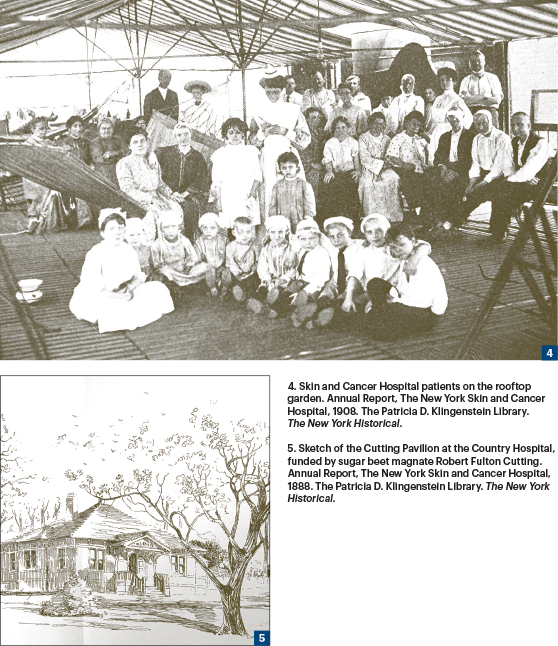
Demand was overwhelming. Within five years, the tiny 29-bed facility had treated over 700 inpatients. Straining to accommodate the chronic cancer patients it prioritized, the hospital moved its cancer unit to a 16-acre “Country Hospital” at Fordham Heights. The architecture was born of Victorian paranoia (stemming from the real scourge of hospital-acquired infection): patients were housed in cheap wooden pavilions designed to be torched after use. This “burn-to-clean” strategy originated from the hospital’s belief, in the words of its president, that “bricks and mortar may become so impregnated with the germs of disease that great harm may result therefrom.”
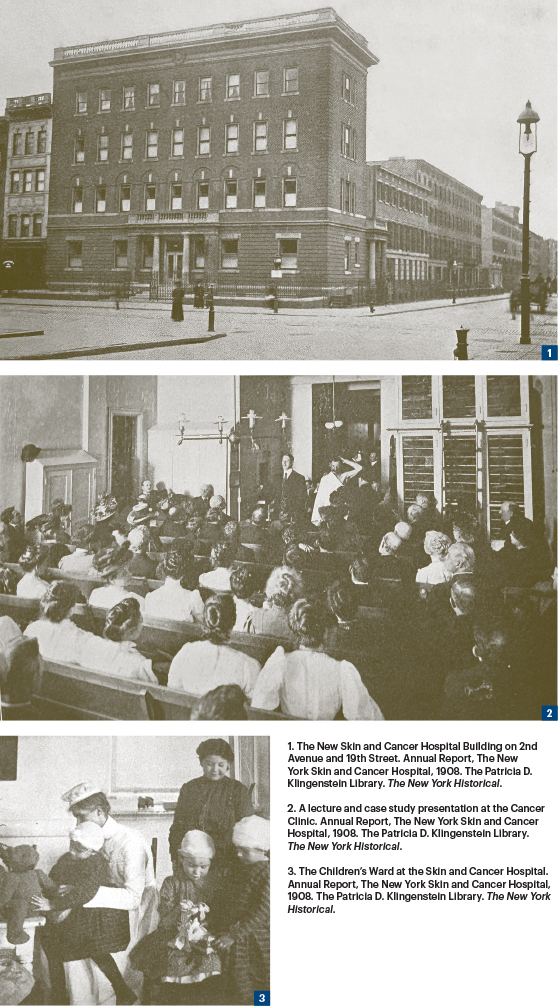
The rural retreat proved to be a disaster. Isolated from family and ignored by busy city clinicians, patients were essentially ejected from society to die. Less than a decade after opening, the hospital sold the land for a massive profit, relocating in 1898 to a modern facility at 2nd Avenue and 19th Street—the site it would call home until its 1948 merger with the New York Post-Graduate Hospital. In these expanded quarters, the Skin and Cancer Hospital launched what was likely the first children’s cancer unit in the nation, alongside a rooftop garden for patient well-being. They also hosted large lectures presenting cures to visiting health-care providers from across the country.
Searching for the Cause of Cancer
From the start, the Skin and Cancer Hospital was controversial for approaching cancer through nonsurgical and dermatological means. The New York Cancer Hospital, backed by the controversial gynecologist J. Marion Sims, opened in 1887 to wrest American oncology back into the hands of surgeons. It served a more elite clientele, with major financial backing from John Jacob Astor III, whose wife was dying of cancer, and Alexander Hamilton’s granddaughter, Elizabeth Cullum, also dying of uterine cancer. The personal investment of Gilded Age aristocrats resulted in an endowment 30 times that of the Skin and Cancer Hospital.
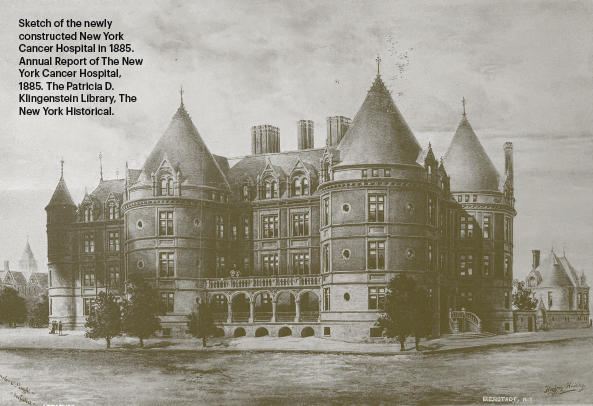
More than half of the Cancer Hospital’s initial fund went toward erecting a magnificent hospital building at 455 Central Park West (the building, now condominiums, is still standing). Charles C. Haight, one of the city’s leading architects, modeled the building on the French Renaissance style of the Château du Lude, but adapted the fortress-like towers into circular wards. These circular wards were partly meant to maximize sunlight and lend what its president called a “cheerful aspect” towards housing “depressing illness.” But in an era with high rates of hospital-acquired infections, the main motive behind the circular wards was the avoidance of corners, where germs were believed to concentrate and fester. Much more effective in combating hospital-born infections was the building’s state-of-the-art ventilation system, a system of steam-powered fans and heating coils that constantly replaced “vitiated air” with fresh air.
From the beginning, the Cancer Hospital sought to distinguish itself as the superior institution while asserting its claim to be the first actual cancer hospital in America. Its First Annual Report declares itself “the first effort in this country at an attempt for the exclusive treatment and cure of cancer,” and trumpets the “abundantly proven” central value of surgical science in this endeavor while condemning the immorality of administering experimental medical cures.
The writers of that Annual Report were taking a swipe at the Skin and Cancer Hospital, whose cancer clinic was dwarfed by its dermatological unit, and whose goal was to disrupt the orthodoxy of surgery. The Skin and Cancer Hospital struck back in Popular Science Monthly, declaring that the dermatologist is “more inclined to search for the cause of cancer and the means of reaching it medically, and is thus more nearly on the right track toward prevention and cure than he who sees a case of cancer mainly from its operative aspect.” Thus, began decades of competition for funding and disciplinary authority over cancer that would only subside after the turn of the century.
Enshrining New York as the ‘Pioneer State’ of Cancer Research
History is written by the victors. Today, the New York Cancer Hospital is remembered as the first cancer center in the United States despite the Skin and Cancer Hospital’s historical pride of place, owing to its sophisticated facilities, larger practice, appeal to “a superior class of patient,” and alignment with medical orthodoxy (the American Cancer Society largely emerged from its clinicians). Although overshadowed, the Skin and Cancer Hospital also deserves credit for its contribution to American oncology, particularly for its focus on the preventative and medical treatment of cancer, which would not enter the oncological mainstream for decades. It offered the first research prize for a cancer cure in the country, and its practitioners correctly prescribed lifestyle changes like eliminating red meat and alcohol consumption to reduce the risk of cancer recurrence (even as some falsely claimed such changes could themselves cure cancer).
The early foundation of these two hospitals enshrined New York as the “Pioneer State” of cancer research. Although it is rife with failed experiments, bioethical quandaries, and sometimes petty in-fighting, remembering this early history of America’s cancer hospitals remains important in our present moment, when artificial intelligence promises to disrupt oncological research as we know it, at the same time that research budgets have been hit by major funding cuts.
This early history reminds us that medical progress is not linear, advancement is lined with painful stumbles, and that austerity produces unproductive competition over resources. As we enter what some have called a new Gilded Age, this history also points to the continued need for major investments from America’s philanthropic organizations, without which New York City’s, and the nation’s, most vulnerable cancer patients would have remained medically uncared for, even as its wealthy achieved unparalleled riches.
Footnote: Leland Jasperse, PhD, is the 2025-2026 Robert and Helen Appel Fellow in the Patricia D. Klingenstein Library at The New York Historical in New York City.
