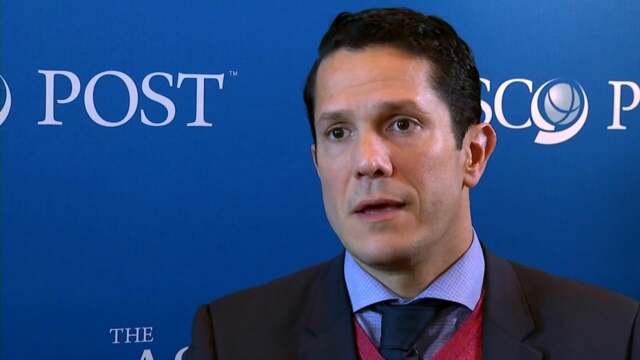
Andrew J. Armstrong, MD, ScM, on New Treatment Options in Castration-Resistant Prostate Cancer
2015 NCCN Annual Conference
Andrew J. Armstrong, MD, ScM, of Duke Cancer Institute, discusses the recent practice-changing landmark studies that showed significant increases in survival for men with castration-resistant prostate cancer and led to updates in the NCCN Guidelines for this disease.
Mary Lou Smith, JD, MBA
Mary Lou Smith, JD, MBA, of the Research Advocacy Network, discusses, from the perspective of a patient advocate, the value of the NCCN guidelines and the impact they have made on cancer care.
Thomas A. D’Amico, MD
Thomas A. D’Amico, MD, of Duke Cancer Institute, discusses the superior efficacy of thoracoscopic lobectomy. This minimally invasive procedure is used in only 50% of lung cancer surgeries in the United States, in 30% of procedures in Asia, and in as few as 10% to 20% of procedures in Europe.
Clifford Goodman, PhD, and Peter B. Bach, MD, MAPP
Clifford Goodman, PhD, of the The Lewin Group, and Peter B. Bach, MD, MAPP, of Memorial Sloan Kettering Cancer Center, discuss the affordability of cancer care, the “financial toxicities” of high drug prices, and what could and should be done about it.
John C. Grecula, MD
John C. Grecula, MD, of The Ohio State University Comprehensive Cancer Center and the James Cancer Hospital and Solove Research Institute, discusses the evolution of precision delivery of radiation for patients with small cell lung cancer and advances that include prophylactic cranial radiotherapy, thoracic radiotherapy, and the use of PET-CT.
Mario E. Lacouture, MD
Mario E. Lacouture, MD, of Memorial Sloan Kettering Cancer Center, discusses the effect on patients of dermatologic toxicities associated with targeted therapies: their psychosocial impact, financial burden, physiological pain, and potential to alter therapy. But the side effects of targeted treatments can and should be addressed.