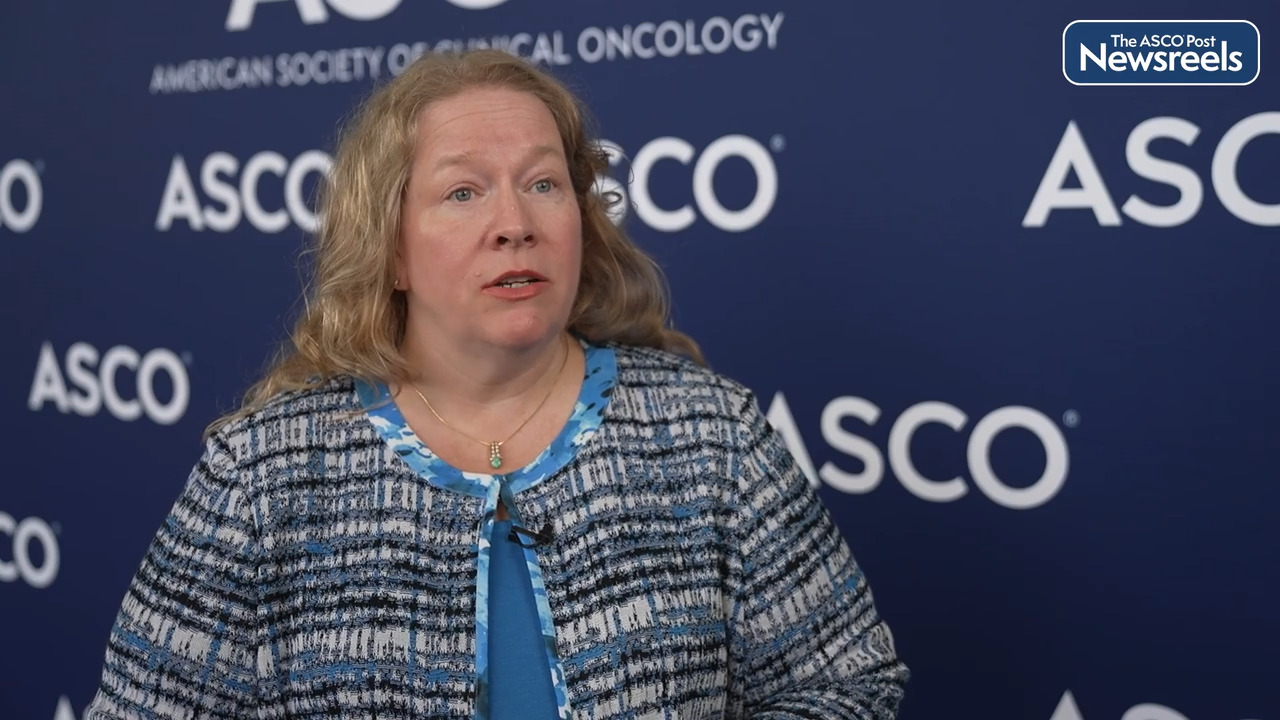
Nagla Abdel Karim, MD, on Small Cell Lung Cancer: SWOG S1929 Results on Atezolizumab Plus Talazoparib
2023 ASCO Annual MeetingAdvertisement
Nagla Abdel Karim, MD, of the Inova Schar Cancer Institute, University of Virginia, discusses phase II data showing that maintenance atezolizumab plus talazoparib improved progression-free survival in Schlafen-11–selected patients with extensive-stage small cell lung cancer. This study demonstrated the feasibility of conducting biomarker-selected trials in this disease, paving the way for future evaluation of novel therapies in selected populations (Abstract 8504).
Transcript
Disclaimer: This video transcript has not been proofread or edited and may contain errors.
Small cell lung cancer is the most aggressive cancer amongst all types of lung cancer. We basically need to find better novel therapies, in addition to finding predictive biomarkers to select the best therapy for the appropriate patient population. We do know that PARP is highly expressed in small cell lung cancer and large cell neuroendocrine carcinoma tumors. And thus, PARP inhibition has been one of the promising novel agents to use.
However, we also know that Schlafen-11 is a predictive biomarker. It has been shown by Dr. Byers and colleagues that PARP inhibitors have been noted to have improved outcome in patients with Schlafen-11 positive patients. Also, Talazoparib has been noted to be one of the most potent PARP inhibitors. We designed our study to enroll patients with Schlafen-11 positive small cell lung cancer in order that they can receive the standard of care induction therapy with platinum etoposide Atezolizumab.
However, when it comes to the maintenance part, they were randomized into arm A where they would receive standard of care Atezolizumab versus Atezolizumab plus Talazoparib, which is a PARP inhibitor. Reason is because we wanted to utilize that the PARP inhibitors are going to act very well in patients with Schlafen-11 positive status, and also because they do have a synergism to immunotherapies like PD-L1 inhibitors like Atezolizumab. That was the concept of the study and the design, with the main primary objective of progression-free survival.
The study actually achieved its primary endpoint, and primary objective was met, where patients with Schlafen-11 positive small cell lung cancer when treated with atezolizumab and Talazoparib, they had a median progression-free survival of 4.2 months compared to 2.8 months of patients on the control arm. Having said that, we mentioned that it is still a small study. It's a phase two study. This is a good signal into a predictive biomarker based therapy. But in addition, also, the feasibility of having a biomarker in small cell lung cancer is very, very promising. There were only seven days median time to obtain the results of Schlafen-11, which is very reasonable for patients to select their maintenance therapy.
Having said that, also, I want to mention that we are going to work into the levels of Schlafen-11, where they have high expression or lower expression, in correlation with the clinical outcome. That's the next step. Another follow up part is that this study actually starts the wave of new concepts where we can design studies in small cell lung cancer towards personalized approach rather than all comers, which of course was very useful to see in non-small cell lung cancer. If we can implement this in small cell lung cancer and get even more predictive biomarkers with basically Schlafen-11, but also with the subtypes of small cell lung cancer, and other markers, we also heard about in our ASCO 2023, like Dll3 and so on. If we can combine all those efforts together as the next step, this will be one of the best next movements.