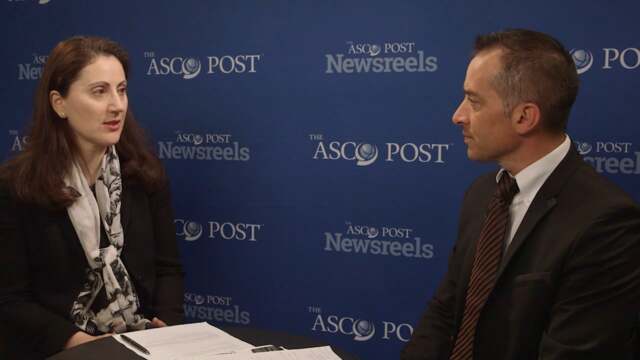
Luis G. Paz-Ares, MD, PhD, on NSCLC: Results from the SQUIRE Trial (Spanish Language Version) 
2016 ASCO Annual Meeting
Luis G. Paz-Ares, MD, PhD, of the Hospital Universitario 12 De Octubre, discusses in Spanish study findings on adding necitumumab to gemcitabine and cisplatin chemotherapy in the first-line treatment of patients with stage IV squamous non–small cell lung cancer.

To see the English language version of this video, please
click here.
The
Helen MacKay, MD, of the Sunnybrook Odette Cancer Centre, and Ursula A. Matulonis, MD, of Dana-Farber Cancer Institute, discuss findings from this phase II study of intraperitoneal vs intravenous chemotherapy following neoadjuvant chemotherapy and optimal debulking surgery in patients with epithelial ovarian cancer (Abstract LBA5503).
Luis G. Paz-Ares, MD, PhD, of the Hospital Universitario 12 De Octubre, discusses study findings on adding necitumumab to gemcitabine and cisplatin chemotherapy in the first-line treatment of patients with stage IV squamous non-small cell lung cancer.
To see Dr. Paz-Ares discuss this video in Spanish, please click here.
Eduardo L. Cazap, MD, PhD, of the Latinamerican & Caribbean Society of Medical Oncology, and Mary Gospodarowicz, MD, of the Princess Margaret Hospital, discuss oncology from an international point of view.
Alan Venook, MD, of the University of California, San Francisco, and John Marshall, MD, of the Lombardi Cancer Center at Georgetown University, discuss the impact of primary tumor location on overall survival and progression-free survival in patients with advanced disease (Abstract 3504).
Vali A. Papadimitrakopoulou, MD, of MD Anderson Cancer Center, and Fabrice Denis, MD, PhD, of the Institut Inter-regional de Cancérologie Jean Bernard, discuss findings from a phase III trial on an app used between visits for early detection of symptomatic relapse and complications in high-risk lung cancer patients (Abstract LBA9006). To see Dr. Denis discuss this study in French, click here.
 To see the French language version of this discussion, click here.