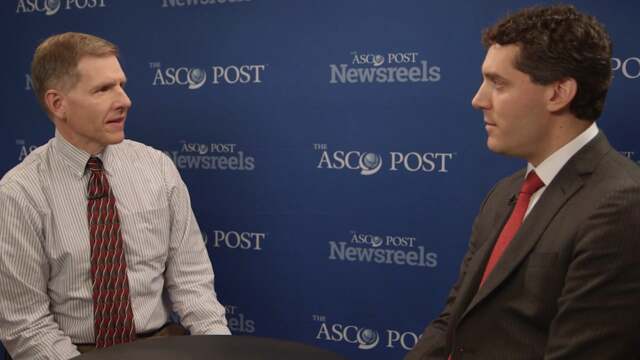
John D. Hainsworth, MD, on Advanced Solid Tumors: Results From the MyPathway Trial
2016 ASCO Annual Meeting
John D. Hainsworth, MD, of the Sarah Cannon Research Institute, discusses early findings from this umbrella basket study on targeted treatment, outside of current drug indications, for different types of advanced solid tumors (Abstract LBA11511).
Lawrence N. Shulman, MD, of Abramson Cancer Center at the University of Pennsylvania, and Daniel A. Goldstein, MD, of the Rabin Medical Center, discuss global challenges in cancer care, including treating patients in areas lacking resources, and cancer drug price disparities (Abstract LBA6500).
Eric Roeland, MD, of the University of California, San Diego, and Linda Van Le, MD, of the University of North Carolina discuss ways to manage symptoms that affect up to 80% of postmenopausal women, diminishing their quality of life.
James R. Perry, MD, of Sunnybrook Health Sciences Centre, discusses findings of a phase III trial of short-course radiotherapy with or without concomitant and adjuvant temozolomide in older patients with this tumor (Abstract LBA2).
David F. McDermott, MD, of Beth Israel Deaconess Medical Center, and Toni K. Choueiri, MD, of the Dana-Farber Cancer Institute, discuss an update on data from phase I and II studies of nivolumab given to patients with metastatic renal cell carcinoma, including long-term overall survival and potential predictors of benefit (Abstract 4507).
Anthony J. Olszanski, RPh, MD, of Fox Chase Cancer Center, and Michael A. Postow, MD, of Memorial Sloan Kettering Cancer Center, discuss findings from this phase III trial of nivolumab combined with ipilimumab in treatment-naive patients with advanced disease (Abstract 9505).