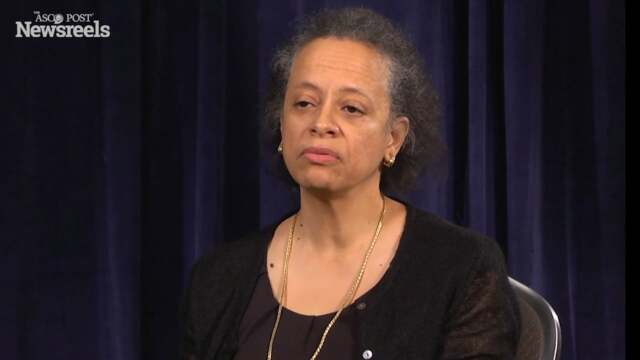
Andrew Seidman, MD, and Ruth O'Regan, MD: Update on Early Breast Cancer
2015 San Antonio Breast Cancer Symposium
Andrew Seidman, MD, of Memorial Sloan Kettering Cancer Center, and Ruth M. O’Regan, MD, of the University of Wisconsin, review practice-changing research in 2015 that was focused on early-stage breast cancer.
Andrew Seidman, MD, and Hope S. Rugo, MD
Andrew Seidman, MD, of Memorial Sloan Kettering Cancer Center, and Hope S. Rugo, MD, of the University of California, San Francisco, discuss preliminary efficacy and safety findings of pembrolizumab in patients with PD-L1–positive, estrogen receptor-positive/HER2-negative disease. (Abstract S5-07)
Gunter von Minckwitz, MD
Gunter von Minckwitz, MD, of the German Breast Group, discusses data from this phase II trial investigating the addition of carboplatin to neoadjuvant therapy for triple-negative and HER2-positive early breast cancer (Abstract S2-05).
Clifford A. Hudis, MD, and Julia R. White, MD
Clifford A. Hudis, MD, of Memorial Sloan Kettering Cancer Center, and Julia R. White, MD, of Ohio State University Comprehensive Cancer Center, discuss a meta-analysis on efficacy and safety of hypofractionated radiotherapy for the treatment of early-stage breast cancer (Abstract P3-12-15).
Clifford A. Hudis, MD, and William J. Gradishar, MD
Clifford A. Hudis, MD, of Memorial Sloan Kettering Cancer Center, and William J. Gradishar, MD, of the Lurie Comprehensive Cancer Center, discuss the most important papers and results at this year's San Antonio Breast Cancer Symposium.
Lori J. Pierce, MD
Lori J. Pierce, MD, of the University of Michigan Health System, discusses findings on second cancer incidence and non-breast cancer mortality among 40,000 women in 75 clinical trials. (Abstract S5-08)