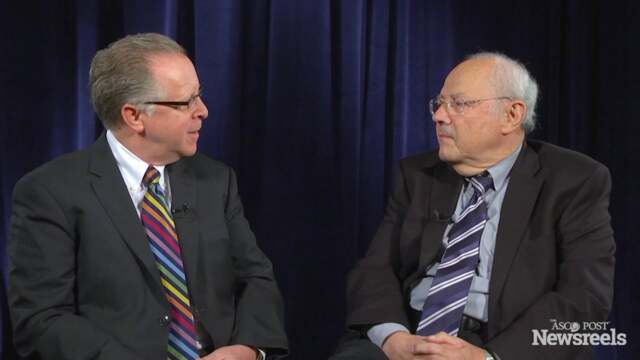
Harold J. Burstein, MD, PhD, on Results of the CREATE-X Clinical Trial on Higher-Risk Disease
2015 San Antonio Breast Cancer Symposium
Harold J. Burstein, MD, PhD, of the Dana-Farber Cancer Institute, discusses the CREATE-X adjuvant study of capecitabine in high-risk patients with residual disease (Abstract S6-01).
Clifford A. Hudis, MD, and Julia R. White, MD
Clifford A. Hudis, MD, of Memorial Sloan Kettering Cancer Center, and Julia R. White, MD, of Ohio State University Comprehensive Cancer Center, discuss a meta-analysis on efficacy and safety of hypofractionated radiotherapy for the treatment of early-stage breast cancer (Abstract P3-12-15).
Benjamin D. Smith, MD
Benjamin D. Smith, MD, of the MD Anderson Cancer Center, discusses the higher complication rates and economic burdens of mastectomy plus reconstruction vs lumpectomy plus radiation in early breast cancer (Abstract S3-07).
Mitchell Dowsett, PhD
Mitchell Dowsett, PhD, of the Royal Marsden Hospital discusses the EndoPredict test, which has improved performance compared with the widely used Oncotype Dx test (Abstract S3-01).
Clifford A. Hudis, MD, and Carlos L. Arteaga, MD
Clifford A. Hudis, MD, of Memorial Sloan Kettering Cancer Center, and Carlos L. Arteaga, MD, of Vanderbilt University, discuss the roles of IGF/insulin signaling, adipokines and inflammation, and metformin and lifestyle change in breast cancer and risk for the disease.
Andrew Seidman, MD, and Norman Wolmark, MD
Andrew Seidman, MD, of Memorial Sloan Kettering Cancer Center, and Norman Wolmark, MD, of Allegheny General Hospital, discuss the landmark trials of NSABP that have led to profound changes in breast cancer treatment. (Abstract ML-1)