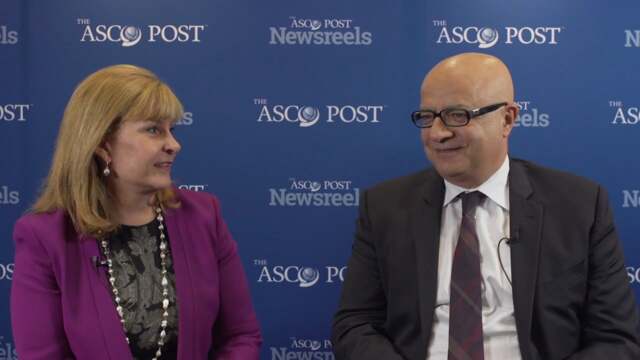
Stephen J. Schuster, MD, on CD19+ Lymphomas: Sustained Remissions in Relapsed or Refractory Disease
2015 ASH Annual Meeting
Stephen J. Schuster, MD, of the University of Pennsylvania, discusses the findings of a study of chimeric antigen receptor modified T cells directed against CD19 in patients with relapsed or refractory disease (Abstract 183).
James N. Kochenderfer, MD
James N. Kochenderfer, MD, of the National Cancer Institute, reports on remissions of multiple myeloma during a trial of T cells expressing an anti-B-cell maturation antigen chimeric antigen receptor (Abstract 99).
David A. Williams, MD
Outgoing ASH President, David A. Williams, MD, of the Dana-Farber/Boston Children’s Hospital, gives an overview of this year’s Annual Meeting of the American Society of Hematology.
Sagar Lonial, MD, and Torben Plesner, MD
Sagar Lonial, MD, of Emory University School of Medicine, and Torben Plesner, MD, of Vejle Hospital, discuss the latest findings on the use of daratumumab in combination with lenalidomide and dexamethasone in patients with relapsed or relapsed and refractory multiple myeloma (Abstract 507).
David Henry, MD
David Henry, MD, of Pennsylvania Hospital, discusses the exciting developments in multiple myeloma treatment, including the three new drugs approved for the disease in November 2015.
Julie Vose, MD, MBA, and Rafat Abonour, MD
Julie Vose, MD, MBA, of the University of Nebraska Medical Center, and Rafat Abonour, MD, of Indiana University Simon Cancer Center, discuss the session that he chaired on the question of whether researchers can design therapy that addresses the heterogeneity of the disease and eradicate most if not all of the myeloma clones.